
Burying The Proverbs 31 Woman™

Standard

Recent conversations with the fairer sex will form the basis for this post and the next. My track record on speaking about issues that women face has not been perfect, though, as I tend to get a large number of livid comments from women who enjoy the evangelical status quo just fine. On the other hand, I also get an equally large number of women who write me privately and thank me for exposing the pressure they feel to conform to impossible “Christian” standards for women.

I think the standard that leads to more burnout of women in 2010 is striving to be The Proverbs 31 Woman™. I add the to distinguish a genuine, Biblical womanhood from the chimera that evangelicals have spawned in creating the idealized form of womanhood as depicted in that Proverb.

To get a clear idea of this problem, let’s look at the text:

An excellent wife who can find? She is far more precious than jewels. The heart of her husband trusts in her, and he will have no lack of gain. She does him good, and not harm, all the days of her life. She seeks wool and flax, and works with willing hands. She is like the ships of the merchant; she brings her food from afar. She rises while it is yet night and provides food for her household and portions for her maidens. She considers a field and buys it; with the fruit of her hands she plants a vineyard. She dresses herself with strength and makes her arms strong. She perceives that her merchandise is profitable. Her lamp does not go out at night. She puts her hands to the distaff, and her hands hold the spindle. She opens her hand to the poor and reaches out her hands to the needy. She is not afraid of snow for her household, for all her household are clothed in scarlet. She makes bed coverings for herself; her clothing is fine linen and purple. Her husband is known in the gates when he sits among the elders of the land. She makes linen garments and sells them; she delivers sashes to the merchant. Strength and dignity are her clothing, and she laughs at the time to come. She opens her mouth with wisdom, and the teaching of kindness is on her tongue. She looks well to the ways of her household and does not eat the bread of idleness. Her children rise up and call her blessed; her husband also, and he praises her: “Many women have done excellently, but you surpass them all.” Charm is deceitful, and beauty is vain, but a woman who fears the LORD is to be praised. Give her of the fruit of her hands, and let her works praise her in the gates.
—Proverbs 31:10-31

Being a geezer, I remember the old Enjoli perfume commercial. I think a lot of other people do, too, because we continue to cultivate that image for women today.

I think women today resent that “she should do it all” image. (And I think that evangelical men everywhere breathe a sigh of relief that they don’t have to contend with a Proverbs 32!)

Yet that image remains the evangelical ideal. Except that being The Proverbs 31 Woman™ also adds homeschooling, leading an American Heritage Girls troop, making the family’s clothes and meals from scratch, crafting high-demand handmade doodads for sale on eBay or Etsy, running a women’s Bible study (or, at minimum, participating in one, preferably with Beth Moore’s imprimatur) , and out-Deborah-ing the female judge of the Old Testament.

I think I could probably retire today if all the Christian women who are burned out of the expectations of being The Proverbs 31 Woman™ sent me a dollar.

I know it’s not possible to talk about cultural distinctives in the Bible that don’t align with our modern age. People who do get called all sorts of names. I’m going to talk cultural distinctives anyway.

Most women today do not have handmaidens who do the real grunge work around the ol’ tent. And while she may still bring her food from afar, it’s because she packed up her five kids into the minivan and headed to Kroger, not because she dispatched her servants to the Italian Coast for fresh olive oil. The woman of Proverbs 31 made her family’s clothes because all the necessary components her household grew or bred, though I don’t know any woman today with easy access to sheep and flax. Today’s woman’s husband is not likely the vanguard at the gates, but some middle management automaton who slaves in a cubicle 20 miles from home. And the woman in Proverbs 31 didn’t have to take a full-time job out in that business world because her husband got downsized and has not been able to find work for a year.

American women today don’t live in tribal villages that offer an unseen network of support. Instead, most have cocooned their households because they’ve had it drummed into their heads that it’s every family for itself.  Even if she wanted to, she could not go to the tents next door to trade for medicines, balms, sandal repairs, fresh spices, and so on. Instead, she fights wrong charges on the phone bill, diagnoses the reason the oven stopped working, sits endlessly in pediatrician’s offices, and fills out mountains of bureaucratic paperwork. And the woman of Palestine 2000 B.C didn’t have to spend every evening shuttling her four kids to band, soccer, or basketball practice, piano lessons, and 4-H Club meetings.

Yet somehow, we expect American women of today to exactly model their Palestine-dwelling counterparts of 4,000 years ago.

Ha!

All that said, what is the real point of Proverbs 31?

The Bible makes it very clear what the wrong kind of woman is:

Idle

Gossiping busybody

Adulteress

Prostitute

Call me crazy, but the latter two are not going to be issues for most Christian women.

Skipping the gossiping busybody for now, idleness is the remaining issue. Look at the list of activities of the woman in Proverbs 31 and note how it concludes:

She looks well to the ways of her household and does not eat the bread of idleness.
—Proverbs 31:27

Given the manic lifestyle that we’ve created for women circa 2010, who among them is truly idle? Who ignores her household’s needs? What Christian woman out there is not giving 110 percent? Most women work harder than their husbands! Almost every woman I know contends with two lives worth of responsibilities and daily chores. Yet somehow we continue to add requirements to their being The Proverbs 31 Woman™.

I chose the word Burying in the title of this post for a two-fold reason. It’s high time we stopped burying today’s Christian women under the expectations of being The Proverbs 31 Woman™. We need to let them be who God made them to be and not force them to conform to a standard that none can attain. In other words, grace. I also think we need to bury that title of The Proverbs 31 Woman™ and move on.  It’s used by too many as a cudgel, and I think a lot of women would agree that they’re tired of the beatdown.

Now, about gossiping busybodies…

I think that women who feel most buried by The Proverbs 31 Woman™ are those who get looked down upon by other women. Some women who pride themselves on being The Proverbs 31 Woman™ are the ones administering the beatings to those women they feel don’t meet that standard. Fact is, any woman who concerns herself with how some other woman is not doing The Proverbs 31 Woman™ correctly is headed right into that gossiping busybody title. In other words, the self-selected arbiters of what constitutes The Proverbs 31 Woman™ probably need to stop being judgmental prigs and just mind their own business. That would please God more than anything.

Proverbs 31 offers us God’s word about a woman who is giving her all for her Lord, her husband, and her children. Almost every woman I know is already doing that. Let’s stop making her job harder.

***

See also:
When Being “Discerning” Isn’t, Part 2

Standard

In the first part of this limited series, I talked about how we Christians often make pronouncements that eliminate all genuine discernment. Today, I want to expand that post and note how easily we fall into ghettos of thinking that harm our ability to engage a dying world for the better.

As if perfectly anticipating this post, the following showed up online:

A recent article on the CNN website entitled, “More teens becoming ‘fake’ Christians,” drew my attention to a book written by Kenda Creasy Dean, a United Methodist minister and Princeton seminary professor. The author’s credentials, I have to admit, initially set off my alarm bells, signaling “liberalism alert.”  Yet I am very, very glad I kept reading.

The author of that statement is the chancellor of the strongly evangelical Patrick Henry College, Michael Farris. His “Are We Becoming a Nation of ‘Fake’ Christians?” is worth reading.

Fact is, for the educated believer, plenty of articles are worth reading.

But you wouldn’t always know that from the way some Christians talk and act. The statement above that grieves me is this: “The author’s credentials, I have to admit, initially set off my alarm bells, signaling ‘liberalism alert.'”

Fortunately, Farris decided to keep reading.

But many Christians never get that far. Too many of us naturally assume that nothing “the other guys” have to say is worthwhile. We can’t learn anything from “them,” so let’s stick to “our” stuff and disengage the rest of the world.

If we want to know why our country is in trouble, this is one of the major reasons. We stick with a party line and never once ask if the other party has anything worthwhile to say. Simply granting that they may will get us labeled “traitor.”

Or “heretic” in Christian circles, which is about as low a label as a supposed believer can receive.

In those Christian circles, we just substitute different labels than the political ones. Let’s try a few and see how they read:

“The author’s credentials, I have to admit, initially set off my alarm bells, signaling ‘charismatic alert.'”

“The author’s credentials, I have to admit, initially set off my alarm bells, signaling ‘Calvinist alert.'”

“The author’s credentials, I have to admit, initially set off my alarm bells, signaling ‘Emergent alert.'”

Now some may consider the above overkill, yet every day I read blogs written by Christians of one sect/denomination/belief or another, and this kind of thing goes on all the time. Instead of adding “Yet I am very, very glad I kept reading,” the conversation stops right there.

The reasoning? Discernment.

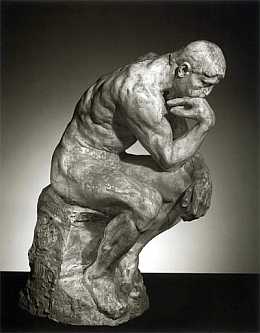
But stopping right there and blaming an inability to engage the ideas of someone who thinks differently from us is not discernment. The Thinker by RodinIt’s small-mindedness. In truth, it’s a form of willful ignorance.

Worse, the tendency is to fall into a perpetual state of ridicule. Some people DO keep reading, if only to add more grist for their predisposed mill.

The problem is that people who think differently from us, even Christians who think differently from us, may still have valid points we need to consider. No one is wrong on everything. Ignoring those who think differently or lampooning their most obvious errors without considering areas in which they may be correct (because that would get us labeled “soft” or something worse) is the height of spiritual pride and sloth. It is in no way being discerning.

Somehow, Paul was able to wade into the very midst of the philosophers and speak to them about Christ, even using some of their own illustrations to do so. Somehow.

Wouldn’t it be great if…

…the charismatic open-mindedly read Dietrich Bonhoeffer?

…the Calvinist open-mindely read Watchman Nee?

…the Emergent open-mindedly read John MacArthur?

Wouldn’t it?

Instead, we increasingly see people retreating to their own little ghettos of thought and practice, and the conversation either gets more shrill or it ceases altogether. When that occurs, problems go unsolved, community dies, and everyone retreats to his or her own bunker.

People who think differently than I do have helped shaped my Christian walk for the better. If it were not for them challenging the established way I thought, I wouldn’t be the Christian I am now. And the only way I got that bettering was by engaging hard and radical ideas that put my existing belief system under a microscope.

Yes, that’s scary. Yes, that raises the potential that my carefully crafted persona of perfection will come crashing down. Fact is, for most of us, that persona does need to come crashing down. We all need to admit that we could stand to learn a few things. We all need much more humility.

The worst thing we Christians can do to our perceived foes  in the public square is to call for their silence, to stick our fingers in our ears, or to resort to shouting them down. None of that shows any discernment. It’s just childish.

Francis Schaeffer wrote extensively that we Christians cannot be afraid of ideas. We must also not be afraid of genuine truth that may show holes in our own beliefs, even if those truths come from “the other guys.” Our holes don’t necessarily mean that we are wrong, only that greater truths and understandings exist, and we must understand them for what they are and how they may help us bolster our own understanding of what is true, honorable, just, pure, lovely,  commendable, excellent, and worthy of praise.

When Being “Discerning” Isn’t, Part 1

Standard

One of the things that bothers me most about living in a culture mired in spotlights is the sheer number of forums and opportunities available to say or do something foolish in public. Within that subset of bother, nothing makes me slap my forehead faster than shining the spotlight on Christians who haven’t thought through all the ramifications of their theologies or who make the most appalling statements when a mic is shoved under their nose.

I fully admit that I am one of those people whose mouth runs faster than his brain. Let me talk long enough and the chance that I’ll inadvertently say something that grossly offends someone runs to about 1:1 odds. People who know me only through the blog probably consider me some deep, intellectual introvert with a bit of Old Testament prophet mixed in. In other words, kind of scary. Fact is, I’m a big, motormouth chucklehead who spends most of his time laughing—and sticking my foot in his mouth at some point in the conversation because I don’t know enough to shut up.

That said, I am a much more reflective person than I used to be. I’m not nearly as hard on other people or myself than my former persona of “angry young man destined to change the world singlehandedly.” Which is why the whole issue of discernment in the real world is one that never leaves my thoughts.

We just can’t seem to get discernment right. And if we can’t get discernment right, then nothing else in life will function as it should.

A couple weeks ago, a conversation in the comments of Tim Challies’s blog brought this home. Tim had posted a link to a blog post on another blogger’s site. That blogger argued that Christians should not friend ex-boyfriends and ex-girlfriends on Facebook. Here’s the reasoning:

I believe that all relationships in my life either support or detract from my marriage, however tacitly, and they stay or go based on that criterion. I believe spouses should have access to each others’ phones and e-mails and should approve of each others’ Facebook friends. I believe privacy with exes, even and perhaps particularly virtual privacy, is dangerous. I’m on the road I chose, and no good will come from revisiting roads not taken.

C.S. Lewis said this:

There are two equal and opposite errors into which our race can fall about the devils. One is to disbelieve in their existence. The other is to believe, and to feel an excessive and unhealthy interest in them.

Lewis’s rationale can be extrapolated to mean that we can think that there will never be a demon lurking around the next corner or we will think that one will always be awaiting us.

I believe the wisdom of Lewis’s statement applies to all aspects of the Christian life. We may find it easy to believe that money is neither intrinsically good nor evil, but we often find it impossible to think that some other aspects of life also fall into that same gray or neutral area. We want our good and our evil clearly delineated.

Yet life is not always black and white. When Christians automatically flee to those poles, we’ve abandoned discernment for a knee-jerk reaction.

In the case of the anti-ex blogger, her error is found in the automatic dichotomy imposed on human relationships. She believes that every relationship is either helping or hurting her marriage.

Perhaps I’m a serious backslider here, but who frames life that way? Isn’t that automatically assuming that evil lurks behind every corner? Isn’t that falling into a trap of unhealthy concern about everything that might possibly go wrong? Is it impossible for anything, even friending a former flame on Facebook, to be neutral?

My son’s bus driver warned him that he could not read on the bus anymore because some girl was reading, got jostled, and the corner of the book flew up and bruised her eye. So now on the school bus (emphasis on school) it’s a crime to read a book.

That’s where this kind of “anything might go wrong” discernment always leads.

Folks who advocate to live that way always call on the same verses:

Flee from sexual immorality. Every other sin a person commits is outside the body, but the sexually immoral person sins against his own body.
—1 Corinthians 6:18

But as for you, O man of God, flee these things.
—1 Timothy 6:11a

Therefore, my beloved, flee from idolatry.
—1 Corinthians 10:14

That’s a lot of fleeing. And when applied rightly in the right situations, it’s a proper response.

However, the problem is that fleeing is but one option, the most drastic one. It’s not the sole option for dealing with life that works for most cases. For a good example of when it’s appropriate to flee, consider this:

Now Joseph was handsome in form and appearance. And after a time his master’s wife cast her eyes on Joseph and said, “Lie with me.” But he refused and said to his master’s wife, “Behold, because of me my master has no concern about anything in the house, and he has put everything that he has in my charge. He is not greater in this house than I am, nor has he kept back anything from me except yourself, because you are his wife. How then can I do this great wickedness and sin against God?” And as she spoke to Joseph day after day, he would not listen to her, to lie beside her or to be with her. But one day, when he went into the house to do his work and none of the men of the house was there in the house, she caught him by his garment, saying, “Lie with me.” But he left his garment in her hand and fled and got out of the house. And as soon as she saw that he had left his garment in her hand and had fled out of the house…
—Genesis 39:6b-13

Given what a lot of Christians endorse concerning relationships, it was a bad idea for Joseph to even set foot in Potiphar’s house in the first place, given that he was single man in the home of a married woman. But Joseph didn’t flee that situation right away, did he? Somehow, he resisted, as it notes, “day after day.”

Eventually, though, Potiphar’s wife trapped Joseph in a no-win situation, grabbing ahold of his clothing, and offering him the classic proposition again. So he fled.

In other words, the situation was so bad that fleeing finally became the only option.

How Joseph reacted throughout the entirety of his dealings with his master’s wife is how we must rationally apply the “flee model” of dealing with temptation.

In my conversation in the comments over at Tim Challies’s blog, a commenter who advocated the flee model for even the least issue eventually got to the point where he questioned whether youth groups of mixed sexes were a good idea because they don’t allow a good option for fleeing.

If that’s where we are in the Christian Church today, then we’ve lost the battle. We might as well barricade ourselves in our rooms alone. When our first instinct is to flee at the slightest temptation, then we are no longer practicing discernment. Instead, we have become slaves of finding a demon lurking around every corner.

Here’s the verse that mature Christians apply in most cases of temptation:

Submit yourselves therefore to God. Resist the devil, and he will flee from you.
—James 4:7

And this:

Put on the whole armor of God, that you may be able to stand against the schemes of the devil.
—Ephesians 6:11

Real Christians in a real world must navigate through gray. It’s why the Holy Spirit was put inside us. He’s our guide to dealing with issues that are unclear or those that have yet to descend to flight. He’s also the one who gave Joseph the will to say no day after day until it got so bad that fleeing became the only option.

In the case of friending ex-girlfriends and ex-boyfriends on Facebook, no blanket “helping my marriage or harming it” dichotomy exists in the real world.

Jesus and the Samaritan woman at the well

Single man + "married" woman = flee?

Both you and the Holy Spirit know which exes it would be okay to friend and which it wouldn’t. Listen to what the Lord shows you about your own weakness and be mature about it.

And let’s also be mature and acknowledge that in a world of two sexes attracted to each other, we’re going to have to employ some other method than resorting to fleeing at the least attraction.

As an older married man, I want to speak honestly to younger men and those who have never been married but anticipate it some day: There will be times when you are attracted to women who are not your wife. Those women may even be the wives of your friends. You may attend a party with a lot of other couples, and before you walked into that party, you and your wife had some major fight about something stupid. When that other woman at the party lends you an ear, there might be a spark of attraction in that moment.

Discernment acknowledges forthrightly that such situations will arise. Discernment also acknowledges that flight is not always an option unless you want to be a complete idiot with no friends who makes his wife constantly suspicious of his seemingly unbridled lust.

The wise person must employ some other means of dealing with these kinds of situations. That’s real discernment. And it’s real Christian maturity too.

In my next post, I’ll talk about another discernment issue that even the most learned Christians fumble.