When Being “Discerning” Isn’t, Part 2

Standard

In the first part of this limited series, I talked about how we Christians often make pronouncements that eliminate all genuine discernment. Today, I want to expand that post and note how easily we fall into ghettos of thinking that harm our ability to engage a dying world for the better.

As if perfectly anticipating this post, the following showed up online:

A recent article on the CNN website entitled, “More teens becoming ‘fake’ Christians,” drew my attention to a book written by Kenda Creasy Dean, a United Methodist minister and Princeton seminary professor. The author’s credentials, I have to admit, initially set off my alarm bells, signaling “liberalism alert.”  Yet I am very, very glad I kept reading.

The author of that statement is the chancellor of the strongly evangelical Patrick Henry College, Michael Farris. His “Are We Becoming a Nation of ‘Fake’ Christians?” is worth reading.

Fact is, for the educated believer, plenty of articles are worth reading.

But you wouldn’t always know that from the way some Christians talk and act. The statement above that grieves me is this: “The author’s credentials, I have to admit, initially set off my alarm bells, signaling ‘liberalism alert.'”

Fortunately, Farris decided to keep reading.

But many Christians never get that far. Too many of us naturally assume that nothing “the other guys” have to say is worthwhile. We can’t learn anything from “them,” so let’s stick to “our” stuff and disengage the rest of the world.

If we want to know why our country is in trouble, this is one of the major reasons. We stick with a party line and never once ask if the other party has anything worthwhile to say. Simply granting that they may will get us labeled “traitor.”

Or “heretic” in Christian circles, which is about as low a label as a supposed believer can receive.

In those Christian circles, we just substitute different labels than the political ones. Let’s try a few and see how they read:

“The author’s credentials, I have to admit, initially set off my alarm bells, signaling ‘charismatic alert.'”

“The author’s credentials, I have to admit, initially set off my alarm bells, signaling ‘Calvinist alert.'”

“The author’s credentials, I have to admit, initially set off my alarm bells, signaling ‘Emergent alert.'”

Now some may consider the above overkill, yet every day I read blogs written by Christians of one sect/denomination/belief or another, and this kind of thing goes on all the time. Instead of adding “Yet I am very, very glad I kept reading,” the conversation stops right there.

The reasoning? Discernment.

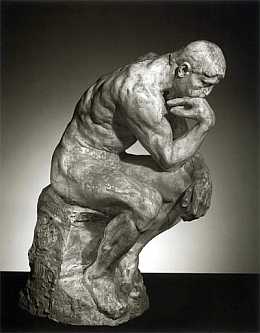
But stopping right there and blaming an inability to engage the ideas of someone who thinks differently from us is not discernment. The Thinker by RodinIt’s small-mindedness. In truth, it’s a form of willful ignorance.
Worse, the tendency is to fall into a perpetual state of ridicule. Some people DO keep reading, if only to add more grist for their predisposed mill.

The problem is that people who think differently from us, even Christians who think differently from us, may still have valid points we need to consider. No one is wrong on everything. Ignoring those who think differently or lampooning their most obvious errors without considering areas in which they may be correct (because that would get us labeled “soft” or something worse) is the height of spiritual pride and sloth. It is in no way being discerning.

Somehow, Paul was able to wade into the very midst of the philosophers and speak to them about Christ, even using some of their own illustrations to do so. Somehow.

Wouldn’t it be great if…

…the charismatic open-mindedly read Dietrich Bonhoeffer?

…the Calvinist open-mindely read Watchman Nee?

…the Emergent open-mindedly read John MacArthur?

Wouldn’t it?

Instead, we increasingly see people retreating to their own little ghettos of thought and practice, and the conversation either gets more shrill or it ceases altogether. When that occurs, problems go unsolved, community dies, and everyone retreats to his or her own bunker.

People who think differently than I do have helped shaped my Christian walk for the better. If it were not for them challenging the established way I thought, I wouldn’t be the Christian I am now. And the only way I got that bettering was by engaging hard and radical ideas that put my existing belief system under a microscope.

Yes, that’s scary. Yes, that raises the potential that my carefully crafted persona of perfection will come crashing down. Fact is, for most of us, that persona does need to come crashing down. We all need to admit that we could stand to learn a few things. We all need much more humility.

The worst thing we Christians can do to our perceived foes  in the public square is to call for their silence, to stick our fingers in our ears, or to resort to shouting them down. None of that shows any discernment. It’s just childish.

Francis Schaeffer wrote extensively that we Christians cannot be afraid of ideas. We must also not be afraid of genuine truth that may show holes in our own beliefs, even if those truths come from “the other guys.” Our holes don’t necessarily mean that we are wrong, only that greater truths and understandings exist, and we must understand them for what they are and how they may help us bolster our own understanding of what is true, honorable, just, pure, lovely,  commendable, excellent, and worthy of praise.
Beating Down the Newbies

Standard

The following made mistakes in their ministry and held erroneous views of God, Jesus, the Holy Spirit, the Bible, and basic Christian doctrine:

  • C.H. Spurgeon
  • Billy Graham
  • A.W. Tozer
  • John MacArthur
  • Jack Hayford
  • Apollos
  • Amy Carmichael
  • Jonathan Edwards
  • Martin Luther
  • George Whitefield
  • John Wesley
  • Gladys Alward
  • David Brainerd
  • C.S. Lewis
  • Leonard Ravenhill
  • D. Martyn Lloyd-Jones
  • Peter
  • George Mueller
  • Watchman Nee
  • Elisabeth Elliot
  • John Calvin
  • Dallas Willard
  • John Wimber
  • Hudson Taylor

And you can add to that illustrious list the name of every born-again believer who has ever lived, including you and me.

The funny thing about growing in Christ is that you don’t start from a blank slate; you start from erroneously held beliefs about the way it all works. And erroneously held beliefs don’t vanish the second someone says, “Jesus, I put my faith in you alone.”

Growing in Christ is an experiment in reaching your hand into the fire and finally realizing that fire is slightly warm. While the Holy Spirit gives believers a new set of senses that turn us on to another world, for the newest of us we are like the blind man who responded to the first portion of Jesus’ healing with “I see men, but they are like trees walking.”

The great saints listed above at some point in their Christian ministry changed their view from more worldly to more godly. None of them (or us) sprang fully formed from the head of God. If we think otherwise, then we’ve confused God with Zeus and us with Athena. Greek myths, folks. Greek myths.

Which is why I am utterly perplexed at the beat down so many young Christians receive from supposedly mature believers. A  boot to the neckWe can claim all sorts of spiritual adventures and trips to the fourth heaven that even Paul didn’t get to, but if we can’t treat with kid gloves the young believer who has a mistaken notion about some spiritual thing, then we don’t know what discipleship is all about. And rather than looking like the Lord we claim to know so well because of our eight-hour a day quiet times, we bear more than a passing resemblance to a giant, round piece of bronze beaten with a large mallet held by a guy who should lay off the Twinkies.

I don’t read as many Christian blogs as I used to because I got tired of the smackdowns. No one gets any theo-points from God for flaming some newbie Christian who mistakenly confused justification with sanctification. As far as the guy spewing the napalm goes, for all all he knows, he could be setting back the cause of Christ by beating down a young Christian who would otherwise go onto greater and greater ministry sooner and sooner had that newbie not incurred the wrath of a Protector of the Faith™.

And it’s not just online.

The way many new and not-yet-mature Christians are treated in our assemblies, it’s a miracle of God the gates of hell have NOT prevailed against the Church. Supposedly mature believers say all sorts of soul-crushing things to young Christians. And trust me, it sets people back. The kind of self-righteous, loveless rebuke some inexperienced believers receive is like a focused magnifying glass on a sunny day to an ant.

As a counter to that, consider one of my favorite passages of Scripture:

Now a Jew named Apollos, a native of Alexandria, came to Ephesus. He was an eloquent man, competent in the Scriptures. He had been instructed in the way of the Lord. And being fervent in spirit, he spoke and taught accurately the things concerning Jesus, though he knew only the baptism of John. He began to speak boldly in the synagogue, but when Priscilla and Aquila heard him, they took him and explained to him the way of God more accurately. And when he wished to cross to Achaia, the brothers encouraged him and wrote to the disciples to welcome him. When he arrived, he greatly helped those who through grace had believed, for he powerfully refuted the Jews in public, showing by the Scriptures that the Christ was Jesus.
—Acts 18:24-28

Apollos was good—but he wasn’t quite good enough. He didn’t see the whole picture. He didn’t have the full empowering of the Spirit. He was too raw.

But rather than verbally lashing Apollos for the inadequacies in his mostly decent theology, rather than crushing the life out of him because he had not “arrived,” Priscilla and Aquila took him aside and worked with him. Other brothers in Christ actively encouraged him and treated him as they themselves would wish to be treated.

And the result was worth waiting for. Folks would not have been saying, “I am of Apollos” (1 Cor. 1:12), if Apollos had not finally come into his own as he grew in favor with God and walked that journey from good to great.

Our transitions from sinners to saints is not a clean, clear-cut process. If you’ve been a Christian long enough, the one reality that comes out is that discipleship is messy. Your walk is a mess and so is mine.

But we can’t look at our own mess and excuse it, especially if we are looking at someone else’s and shrieking, “Man, what a disaster you are!”

Log and speck, right?

So what is the deal with beating down the newbies?

Here are a few suggestions I pray we can all consider or practice with believers who don’t have their Christian walk together yet:

Always lead with love. Always.

Consider that Jesus uttered The Golden Rule for a reason.

Start with encouraging a young Christian in what he or she is doing right.

Keep praying that God would take that young Christian from one degree of glory to the next.

When considering confronting a raw, young Christian, pray that God would do an inner confrontation in that youngster by His Holy Spirit first. Later, if the Spirit should reveal a need to partner with Him in offering gentle removal of specks, do so only after removing one’s own logs.

NEVER correct unless willing to work alongside the young Christian to help him or her reach maturity. If unwilling to partner with that immature believer, then find others who will and leave the correction to them.

Remember that if a young Christian is truly walking with the Lord, then God will not fail to complete His work, no matter how rough things appear at the moment.

And remember: You and I started out rough, too.

Did I mention to always lead with love?

The world is full of beat downs of people who don’t quite have it right. We live in merciless times among smug people who think they know it all.

But that can never be the Church of Jesus Christ. If anything, our love and mercy should always go out to the tenderest among us.

Laying Down “Us” to Reach “Them”

Standard

If you were to ask me right in this moment what one thing I would really like to see change in the American Church, it would have to be our devotion to the cause of Us vs. Them.

More and more, it sticks in my craw when I am with fellow Christians and the Us. vs. Them talk starts up. Who are Them ?

Political liberals

Homosexuals

Abortion supporters

Jews

Muslims

Immigrants

Other races

Mainline Protestants

The promiscuous

The homeless

The poor

The lost

And so on

That list will look different for different people, but in short, Them are those people who are not Us.

You get into strange conversations with people who always think in terms of Us vs. Them. Try talking with an Evangelical who claims to love Israel yet complains about all the Jews running Hollywood, with its family-unfriendly movies filled with bad language and smutty imagery. A homeless man sleeping outside a churchOr the folks who go on and on about reaching the lost or ministering to the poor, yet who wish the Mexicans would go back where they came from. The disconnect is head-scratching.

I once had lunch with someone who made no pretenses to being a Christian. When I asked her why she liked living where she did, she said it was because the residents were so tolerant of others, not like those rednecks in the Midwest.

Too many American Christians have that same mentality. Its not only irrational, it’s ugly too. And its a large reason why so many people have tuned out the Church here. They know us by the culture war. They know us by whom we oppose. They have no idea of whom we are for. And if they’ve heard that old ’60s-era song “They’ll Know We Are Christians by Our Love,” they wonder inside when it was ever true. (Maybe back in the ’60s. But then, didn’t we all love each other back in the ’60s?)

Look, there’s not a Christian alive who hasn’t heard the parable of the Good Samaritan. Three-year-old kids who still wet their pants from time to time know that story. How come so little of it ever sinks in? The Us passed by. The Them loved. Jesus smashed the stereotype of Us vs. Them to smithereens in that parable.

Many of the greatest novels ever written contain the archetypal story of the hero who does good because he remembers his roots. He never lets himself forget his humble origins, and that remembering helps him change the world for the better.

I think that one thing Jesus Christ would like to impress upon many American Christians is that each of Us was once Them. And that the people who are most effective for the Kingdom of God are those people who never let themselves forget that truth.

The time of forgetting we were once lost is past, folks. It’s time to start laying down Us to reach Them.