
That Other Standoff

Standard

Is it almost Thanksgiving? You’d never know it from the various wars erupting all over the Christian blogosphere as one faction yells to the other faction,Standoff “Oh yeah, well what about this!”

Yes, I’ve participated, but I’ve tried to be as civil as possible. I’m not trying to establish a beachhead. I just desire that other people understand the faction I’m tenuously a part of, especially since mine seems to be on the small side as factions go.

The cessationist/charismatic debate on the surface has tended to be civil. I think that the default faction leaders, David and Adrian, have done well. There have been a few gashes, but I’m not seeing any severed limbs lying around.

But there’s another war out there and this one has turned grisly: Emerging Church vs. Traditional Church. The rhetoric on both sides is so dense that it’s approaching depleted uranium stage. This week brought out the mustard gas and biowarfare as Emerging Church proponent Justin Baeder attempted a domain rustling by securing “emergentno.com” in an effort to put the spoofing screws to Traditional Church proponent Carla Rolfe of Emergent No at “emergentno.blogspot.com.”

Two words: Truly Lame.

While the cessationists and charismatics appear to at least be listening to each other so far, the Emerging Church (EC) vs. Traditional Church (TC) battle has degenerated into a hatefest. I’m halfway tempted to pronounce a pox on both their houses. (I’ve previously blogged about this issue here, here, and here.) The sad part is that there are people on both sides of this EC/TC war whom I appreciate, and the truly thoughtful folks on both sides are not as heinous as they are portraying the other side to be. In many ways, both sides there are attacking the same fringe elements that are under assault in the charismatic/cessationist debate.

But assaulting the weirdos is easy. I’m a charismatic and I’m fed up with the fringe within the charismatic movement. (I’m even more fed up that the fringe may be taking over!) When examining the war going on between the EC and TC camps, each side has every right to be hacked at the lack of Christlikeness in the other side, but then we all know what Jesus said to the group ready to stone the woman caught in the midst of adultery.

I’ve got zero diplomatic skills, so if I tick someone off here in either the EC or the TC camps, I apologize in advance.

This is what the Bible says:

And one of the scribes came up and heard them disputing with one another, and seeing that he answered them well, asked him, “Which commandment is the most important of all?” Jesus answered, “The most important is, ‘Hear, O Israel: The Lord our God, the Lord is one. And you shall love the Lord your God with all your heart and with all your soul and with all your mind and with all your strength.’ The second is this: ‘You shall love your neighbor as yourself.’ There is no other commandment greater than these.”
—Mark 12:28-31 ESV

Earlier this week, Ingrid Schlueter of Slice of Laodicea, one of the TC blogs that is most fiercely battling the EC, had this to say about Traditional Churches:

There is, without doubt, a shortage of biblical love and concern on the part of church members in Bible preaching churches today. There is a reason that emergent churches and mega churches with small groups are attractive. There is no more empty feeling in all the world than having attended a church service as a visitor and leaving without a kind word being spoken. In my husband’s and my search for a church for our family in an area where good churches were in short supply, we found this again and again. At one point, after attending a church for almost a year, I said, “Tom, we could be in an advanced stage of rigor mortis in the back pew and I doubt seriously that anyone would notice.” … After moving to a new state, we visited one church where we needed directions. I went to the church office and said, “Excuse me, we’re just visiting and we need to find out where to put our children for Sunday School.” The woman looked me up and down rather cooly, and gestured vaguely down the hall. “Someone will help you down there.” She said. This, folks, was a small church. But I was new and uninteresting looking and that was that.

I don’t think I can add anything to her disappointment. Far too many Traditional Churches, filled with people who adore God and love the Scriptures, are getting the first part of Jesus’ two greatest commandments right, but are missing the second. Doctrine has no strength unless it’s put into practice. It’s not enough to be able to cut down every heretical anti-lapidarydipsydoodlearian out there with the Truth of the Scriptures. Yes, that has extreme value and must be guarded, but if we do not love the very people that the Lord Jesus died for, all the doctrine in the world will sit idle in our hearts, gone begging for someone, anyone to put it into practice for the disenfranchised of the world.

Ingrid’s lament is even more tragic, since it should be second nature for us to at least love the rest of the Body of Christ, even if we have difficulties with extending the love of Christ to the lost. Yet how can we do the latter, as the Lord Himself showed us, if we can’t even love our brothers and sisters in Christ?

Does the EC do this better than the TC? Probably. That need to be part of a loving community greater than oneself is one of the reasons that the EC is gaining adherents. The people who don’t normally get called to the wedding party are being handed an invitation. The Traditional Church needs to understand this and repent.

Now as open as Ingrid was about failures of the TC, I’ve searched high and low to find someone within EC ranks who was willing to take on the fact that the EC plays fast and loose with a lot of Scripture, muddying just about every doctrine it touches. With Open Theism increasingly discussed within the EC (but not in those exact terms, since the EC doesn’t desire to have exact terms about anything), one wonders if they’re doing the second commandment right, but are unraveling the tapestry that spells out that the first commandment clearly. What the TC does well—speaking to sin, holding up the cross, affirming the inerrancy of Scripture and its authority—the EC outright mangles, with many of the leading lights in the EC giving depositions on doctrine in the same manner that Clinton asked us to rethink what the definition of “is” is.

For this, the TC has every right to hold the EC’s feet to the fire, but the EC won’t stand for it. I won’t go into all the sites posting doctrinal fallacies attributed to the EC (and they are legion), but suffice it to say, it’s hard to think of the EC in any way other than a reactionary movement that can’t form a coherently Biblical reason for everything it supposedly believes. What other outcome, other than rank heresy, can be expected from the EC if it continues to deconstruct the Scriptural base on which it’s supposedly founded. The oldest lie in the Book is, “Did God really say…?” The Emerging Church needs to understand this and repent.

All this makes me tired.

Why is it incongruous to think that we can have solid doctrine that holds up the full revelation and personhood of the Triune God while ministering Christ to His Chosen and the lost around us? When those two are melded in purpose, isn’t that The True Church? Emphasizing any part of the whole revelation of the Gospel over any other part is a recipe for disaster, yet somehow Traditional Churches and Emerging Churches are doing their best to cook up such a mess.

And we wonder why the Church in the West is failing.
Just How Hard Is It to Be Saved?

Standard

About midnight Paul and Silas were praying and singing hymns to God, and the prisoners were listening to them, and suddenly there was a great earthquake, so that the foundations of the prison were shaken. And immediately all the doors were opened, and everyone’s bonds were unfastened. When the jailer woke and saw that the prison doors were open, he drew his sword and was about to kill himself, supposing that the prisoners had escaped. But Paul cried with a loud voice, “Do not harm yourself, for we are all here.” And the jailer called for lights and rushed in, and trembling with fear he fell down before Paul and Silas. Then he brought them out and said, “Sirs, what must I do to be saved?” And they said, “Believe in the Lord Jesus, and you will be saved, you and your household.” And they spoke the word of the Lord to him and to all who were in his house. And he took them the same hour of the night and washed their wounds; and he was baptized at once, he and all his family. Then he brought them up into his house and set food before them. And he rejoiced along with his entire household that he had believed in God.
—Acts 16:25-34 ESV

…if you confess with your mouth that Jesus is Lord and believe in your heart that God raised him from the dead, you will be saved. For with the heart one believes and is justified, and with the mouth one confesses and is saved. For the Scripture says, “Everyone who believes in him will not be put to shame.”
—Romans 10:9-11 ESV

No one can come to me unless the Father who sent me draws him. And I will raise him up on the last day.
—John 6:44 ESV

Therefore I want you to understand that no one speaking in the Spirit of God ever says “Jesus is accursed!” and no one can say “Jesus is Lord” except in the Holy Spirit.
—1 Corinthians 12:3 ESV

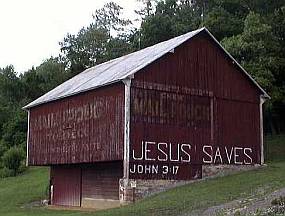
I like to follow trends in the Church and in the Christian blogosphere. One trend that is gaining power attempts to tell who’s in and who’s out by questioning if some people who think they’re saved really aren’t. Jesus Saves barnAny consistent readers of Cerulean Sanctum will know that on more than one occasion I’ve quoted Leonard Ravenhill asking if only 2% of professed Christians are truly born again. So even here there’s been some of that same rhetoric.

John Piper has a new book out called God Is the Gospel and it’s stirring up controversy about this very topic of how one is saved. Over at Old Truth, there was a post about decisional regeneration that adds fuel to the fire.

The debates about who’s in and who’s out rage, but I have to wonder if we are making it too hard. Look at the four verses posted above, for instance.

In the case of the jailer, look how simple his conversion was. Believe on the Lord Jesus Christ and you’ll be saved. Did the Lord draw him? Yes, in the middle of despair, the Holy Spirit was drawing him. Did Paul ask anything of him other than to believe? Not that’s listed here. Nor does Luke list anything different said by Paul than what the apostle himself outlines in the Romans passage above.

We can try to second-guess God on this, piling up other requirements, but isn’t that adding to the Gospel? If someone confesses with their mouth that Jesus Christ is Lord, why is there reason to believe that God has not drawn that person?

My confession is that I’m a Lordship salvation person. Have been for a long time. But that puts me in the company of others who make coming to Jesus a real trial.

Perhaps the problem here is one of theological systems.

The Calvinist position is hard to hold because persistence of the saints becomes a problem. What do you do with people who profess Christ then seemingly fall away. The out for Calvinists is saying that those people never really were drawn by God in the first place and therefore never made a true profession of faith. But do the Scriptures above, when taken together, paint that picture? It sure doesn’t seem so. It certainly appears that someone can be drawn of God, confess Christ with their lips and believe in their heart and still have the possibility there for falling away. Saying they were never a Christian in the first place seems like a lazy out.

Those against decisional regeneration are confronted with the fact that the jailer responded not because he was confronted with the full measure of the Gospel, but because he was in despair. He was ready to be saved without hearing a full Gospel presentation. He didn’t say to Paul, “I’m a sinner under full conviction of the Spirit as He’s brought me to the foot of the cross!” His rationale was that his boss was going to kill him OR he was astonished at the miracle earthquake that made it possible for the apostles to leave. I know plenty of people who became Christians at a remarkably low point in their lives or because they were confronted with a miracle. Is their salvation null and void? Can God not use situations to draw people? Do the passages above say that?

A Lordship salvation person, like me, struggles for a couple reasons. One is that I’m forced into an Arminian position, even though I don’t want to ascribe to it, simply because I have to struggle with the same issue as the Calvinists: what to do with people who fall away. The other is that the verses above do not say anything about the actual living out of the Lordship of Christ in one’s life. It’s assumed, obviously, but the question must be asked then if the process of Lordship begins at conversion and progresses, or is completely in place at conversion. The former makes salvation progressive while the latter makes it instantaneous. A quandary, obviously.

I could go into great deal about how all the other views on this struggle, but that doesn’t provide a solution to the original question: are we adding too many qualifiers to a person’s coming to Christ?

I would truly like to hear what other people think about this. Just how hard is it to be saved?

The Myths of Homeschooling #4 (Conclusion)

Standard

In concluding this series (which previously was found in three parts: 1, 2, and 3), I’d like to reference a reply I made in the comments section of my last post to explain my rationale for taking on these myths:

[H]omeschool is used like a set of brass knuckles to the jaws of some parents. They are being crushed by guilt for not homeschooling or are likened to sinners or profligate parents for not homeschooling. Those accusers and accused know who they are, and I hope they’re reading this and seeing that homeschool is not the be all and end all of life. I also want those parents who homeschool their kids to know how to work the land or to raise animals that they are not freaks for doing so.

I meet victims of homeschoolers’ ire and they are indeed hurting. Many are Christians and yet their own churches label them negatively because they don’t homeschool or they think some things are more important than understanding Plato’s dancing shadows.

I see the moms with seven kids who are homeschooling them all. They get all the accolades. Good for them. But what about the mom who can’t homeschool because her ailing parents consume her time? To have people berate her for that disgusts me! And I’ve seen that happen.

Homeschooling is used increasingly as a ruler to measure people and judge their fitness as parents. If you don’t see that, then count yourself lucky that you live in a place where people don’t do that. I don’t live in that place. Despite living all over the Midwest and California, I’ve never lived in a place where homeschooling wasn’t used to judge people.

All I want is to tone down the rhetoric; it’s hurting people. It’s also forcing people into homeschooling who are not equipped or are overburdened already. If keeping up with the homeschooling Joneses is what it is coming down to, then we need to offer people more grace to pursue other options without feeling like the spawn of hell.

That’s all that this series is about. I hope the people who need to hear this are getting the message.

I’ve had a lot of arguments tossed at me during this series. Several comments, weblinks, and e-mails have said that what I’ve witnessed in my 18 years of watching the homeschooling movement simply isn’t true. At homeschoolOthers have said that they’ve never seen some of the behaviors I’ve talked about.

My challenge to those folks is to look around, step out of the hype for a few seconds, and examine the messages and behaviors espoused in the homeschooling movement. Some scary thoughts and practices exist in homeschooling circles, and we choose to ignore them at our own peril—and to the peril of the accused I referenced in my quoted comment above.

Consider that some women no longer introduce themselves as “a mom of four kids” but as “a homeschooling mom of four kids,” as if the homeschooling tag must be added to ratchet up the standard of successful parenthood one more notch. That’s nothing but competitive pride. Notice, too, what happens when a group of homeschooling parents encounters parents who do not homeschool. Watch the social dynamic. Look at people’s faces. Watch the reactions when the topic of homeschooling arises. The societal pressure is obvious, especially in Christians.

The myths I’ve featured in this series are used to beat down people in a new kind of social class ranking. That stratification extends even to homeschoolers, as various teaching methodologies gain or lose traction. With the rise of classical education within homeschooling ranks, other methods have been relegated to lower positions as if there’s a right and wrong way to present knowledge.

Some of this is a reaction against educational methodologies originally made popular in the public schools. With all things related to public school under massive scrutiny by homeschooling advocates, anything that smacks of public school is subject to scorn. John Holt’s educational ideas that form the backbone of the “unschooling” movement were highly popular in public schools in the late ’60s and early ’70s, and some homeschooling parents consider them suspect. Other homeschooling parents who were not exposed to Holt as practiced in public school are more willing to use his ideas. This, of course, will bring conflict to a massing of homeschooling groups where one methodology is preferred to another. Stick classicists with unschoolers and let them have at it—the results are sadly amusing.

In conclusion, a few points.

Homeschooling is not for everyone. We need to be more accepting of families that choose not to homeschool. In almost all cases, they are not helmed by bad parents. In fact, those parents may be doing their children a favor by acknowledging their own weaknesses in teaching. One of the backbone beliefs of the homeschooling movement is that parents know their own kids best. Why then do some homeschool advocates lambaste parents who believe their children would thrive in a non-homeschooled environment? I have great respect for parents who acknowledge their own insufficiencies to meet their child’s educational needs. Most parents WILL struggle with teaching once a child gets beyond a seventh grade education. We resist thinking the world has changed, but a vast sea of knowledge has been added or has trickled down to lower grade levels since we were in school. Do we persist in homeschooling beyond a certain level for the right reasons? Or do we capitulate to peer pressure and pride?

No one educational method reigns. Frankly, I believe that parents homeschooling to a lone methodology (e.g., classical, unschooling, behavioral, etc.) rob their kids of a broad-based education. That goes for private and public schools, too. There is no magic bullet. Teaching kids to think for themselves is fine, but that’s not what the corporate world wants, quite honestly. Which world do we teach to then? How we accommodate what is valued in our society today matters. Creating a superkid who can’t make his learning conform to societal demands is asking for another Todd Marinovich-type burnout. Tunnel vision is dangerous, and too many homeschoolers have so focused their teaching that I wonder how their kids will cope when their entire education proves to be the square peg in society’s round hole.

Don’t despise the basics. In our rush to turn our kids into quantum physicists who will unite both the particle and wave models of the universe, we may well be creating children who can’t feed themselves. With globalization opening up American workers to foreign competition, our children will not be able to compete on an equal playing field if money is the bottom line. It would be wise of us to acknowledge this truth and prepare our children for a markedly different work future than the one we faced at the same age. Engineers in the U.S. are finding that they can’t convince their kids to go into engineering, and this is a shock to them; perhaps the kids are smarter than they are given credit, considering that many of them would rather work for less pay than face the perpetual layoff cycle they saw their parents endure. In light of this, I firmly believe that instructing our children in a locally-needed trade may be the best work prep we can offer them. If we subsequently add  an understanding of the land, animal husbandry, and small farm techniques, we can ensure them a better future than the one already upon us. Remember, THAT was a biblical education in the days of Jesus. While it is true that we need the educational superstars to continue to build the next-generation medical devices and such, increasingly those superstars are not going to be Americans. Honestly, skyrocketing tuition costs may put college out of reach of the middle class, so other job and education options must be explored. We need to prepare our kids differently for a different future.

God is a God of grace. If we firmly believe He is in control, then we will entrust the care of the children He’s given us—children that are not ours but His—to Him and Him alone. How that plays out in your children’s educations is something God alone can deliver. And that may NOT include homeschooling. We should not limit God on how He can work in our children’s educations. Nor should we enforce our will on other parents. God deals with all of us in different ways. We should not judge people by their schooling choices, especially if we are not vehicles of grace to accept their decision or help them move into a homeschooling model if the toughness of living is making it hard for them to do so. We’ve made homeschooling a millstone around the necks of parents and children alike, and the Lord is not in the millstone necklace business.

Education is not the path to salvation. Ironically, it is the very secular humanists that Christians vigorously oppose who truly believe that premise. However, as much as Christians say that is not them, George Barna recently showed otherwise. In one of  Barna’s published surveys showed Evangelical parents were more concerned that their kids got into an elite college than that their kids followed Christ. That’s a devilishly misplaced priority! Homeschooling, like anything else, can become an idol. God would much prefer a non-scholar with a heart that burns for Him than a Nobel-winning scientist who claims He does not exist. That’s where our focus should be, raising kids for Christ, no matter where they go to school.

Thanks for reading through this series. I hope the gang now preparing the tar and feathers will graciously reconsider.

***

This four-part series:

The Myths of Homeschooling #1

The Myths of Homeschooling #2

The Myths of Homeschooling #3

The Myths of Homeschooling #4