
Justice Is for Losers

Standard

My son’s been playing soccer at the YMCA this last year. He’s now on his third team. He played on two 5-6 year old teams, then graduated to 7-8 this year. Even then, he’s barely seven.

We had our first game of the season today, and it was clear to me that he’s outclassed. His first year he scored a goal in the last game of the season, and I could not have been prouder. His second team showed him improving his skills; he scored three times for that team. From what I saw today, he’ll be lucky if he gets a dozen good kicks in the entire season—and by that I mean making actual contact with a soccer ball. A goal seems almost ludicrous to expect.

In previous seasons, the Y fielded about six 3-4 yr. old teams, four for 5-6 yr. olds, two for 7-8 yr. olds, and two 9-10 yr. old teams. This season, they couldn’t get any 10-yr. olds at all to play and could not even fill up their 7-8 yr. old teams. That means we have only two 7-9 yr. old teams.

The Y must compete against SAY and Select soccer in our area. The Y has one practice and one game per week. SAY and Select have two practices and two games per week. (Now imagine having two or more kids in those programs! Is it any wonder we’re so ridiculously busy!)

I have to be realistic. My son, no matter how hard he works, may simply lack the inherent talents he needs to play in those two highly-competitive leagues. But what makes it sad for me is the reality that parents don’t want their kids to play in the less competitive Y league because (I believe) they think their own kids will never play for USA Soccer and win that elusive World Cup unless they shun the less competitive Y program and go for the REAL kids’ soccer leagues.

Here’s to ratcheting all of life up a notch or two. (For some reason the phrase “metal fatigue” keeps popping into my head.)

I hate Darwinism, especially Social Darwinism. The idea of the Selfish Gene theory driving all that we do, that our mantra for life is reduced to survival of the fittest, just makes me nuts. And what makes me even more despondent is that, too often, Christians are the ones driving that Excellence At All Cost mentality. So much for fun, fairness, and good sportsmanship. It lost out to Kill or Be Killed—in pre-tween soccer.

It seems to me that the Gospel of grace stands in stark opposition to this non-stop treadmill of competition that drives our lives. If nothing else, it demands we seek justice for the oppressed. Anymore, the oppressed may very well be anyone who isn’t deemed “a winner.” While I’m definitely not into the highly PC idea that we forgo having winners and losers in sports to shield our children’s fragile egos, I don’t think we have to naturally fall into the other extreme. We’ve made every aspect of life into a competition, and that’s simply evil. In our free country, we’ve traded political oppression for social and economic oppression. And let’s be honest: that may be the worse trade. At least in the politically oppressed nation, it’s only the government that’s against you. In ours, everyone is.

The Bible says this:

Whoever closes his ear to the cry of the poor will himself call out and not be answered.
—Proverbs 21:13

The soul of the wicked desires evil; his neighbor finds no mercy in his eyes.
—Proverbs 21:10

God has taken his place in the divine council; in the midst of the gods he holds judgment: “How long will you judge unjustly and show partiality to the wicked? Selah. Give justice to the weak and the fatherless; maintain the right of the afflicted and the destitute. Rescue the weak and the needy; deliver them from the hand of the wicked.”
—Psalms 82:1-4

“In all things I have shown you that by working hard in this way we must help the weak and remember the words of the Lord Jesus, how he himself said, ‘It is more blessed to give than to receive.'”
—Acts 20:35

He has told you, O man, what is good; and what does the LORD require of you but to do justice, and to love kindness, and to walk humbly with your God?
—Micah 6:8

Last week, I discussed issues facing men. One of the fallacies that the modern Christian men’s movement upholds with religious fervor is the power of the strong. Something about a song Beck sang...But in the Bible, on the whole, strength is only good when God wields it. When Man throws it around, people wind up crushed. Sadly, too many of us root for the crushers rather than defend the crushees.

When we speak of justice, we must remember that justice is for losers. As Christians, we’re to minister justice on behalf of the losers of this world, the ones who cannot keep up, the ones who do not have the strength to carry on. As much as we rant about righteousness, I hardly ever hear Christians begging to be more just in their hearts.

But David says this about God:

Righteousness and justice are the foundation of your throne; steadfast love and faithfulness go before you.
—Psalms 89:14

Justice is one of the pillars of God’s throne. Heaven itself is established on justice! Why then do we ignore justice in our lives? Why do we American Christians throw in our lot with the popular and not with the ignored? Why do we love winners and hate losers? Why is our theology based on Social Darwinism and not on justice for the weak?

If the Church in this country is doing justice right anywhere, it’s in the anti-abortion movement. We’ve got that down to a science. Good for us. I hate to think what it would be like if we ignored that justice issue.

But what is the Christian’s obligation to workers crushed in the wake of unjust business practices? What is the Christian’s obligation to the children who go unadopted because they are the wrong age, or have a learning disability, or simply aren’t good looking enough to make it in a culture obsessed with appearances? Does God not hear their cries for mercy?

I cannot say that I love my neighbor if I do not seek justice for him. The two go hand in hand. Yet when was the last time you heard this preached from your church’s pulpit?

Consider the following:

Rescue those who are being taken away to death; hold back those who are stumbling to the slaughter. If you say, “Behold, we did not know this,” does not he who weighs the heart perceive it? Does not he who keeps watch over your soul know it, and will he not repay man according to his work?
—Proverbs 24:11-12

God does not care for our excuses. No, our justice will never be as perfect as His, but He still calls us to fight on behalf of others.

One last Scripture from the lips of Jesus:

You will be hated by all for my name’s sake.
—Luke 21:17

You see, we Christians should understand that the world sees us as losers. For this reason, how can we not understand justice? How can we ignore the plight of those who cry out for justice?

I have to wonder if our lack of concern for justice has turned us into friends of the perpetrators of injustice rather than friends of God the Righteous Judge.

How will that look on the Day of Ultimate Justice?
A Letter to Rich, the Young Ruler

Standard

Dear Rich,

What a pleasant surprise to receive a letter from you! Your previous letter said you’d been working 60 hours a week to get the promotion you wanted, and now I read that you’ve received it. Looks like your hard work has paid off. You certainly are living the American Dream!

Congratulations, too, on your new five-bedroom home and your new Porsche Cayenne. I’m sure your wife and kids are deliriously happy with both. Thanks also for the pictures from your recent vacation to St. Kitts. My, the twins sure have grown.

I read the printout you enclosed of the blog article written by the CEO of Thomas Nelson Publishers. You agree with his contention that there’s no compelling reason to buy an Apple iPhone. That’s probably a wise decision.

In reading that article, though, I find his reasons for not buying an iPhone intriguing. Most of the reasons he cited were technological. I, for one, think a far better reason to avoid it exists.

In our previous correspondence, we’ve gone back and forth on Jesus and what it means to be a Christian. I know you are quite a spiritual person, a “seeker” as you say, but I believe being spiritual and religious doesn’t go far enough.

So, Rich, I’d like to consider a word you don’t hear much today: profligate. That’s a word I would have liked to have seen mentioned in the article from the Thomas Nelson CEO, but even companies that deal with words shy away from some of the less popular ones. Profligate is one of those words.

Here’s how the dictionary defines the term:

Profligate

†“adjective
1. utterly and shamelessly immoral or dissipated; thoroughly dissolute.
2. recklessly prodigal or extravagant.

†“noun
3. a profligate person.

I can’t help but think, Rich, that since perfectly good cell phones can be had for $50, the desire for one that costs ten times that much seems…well, profligate. No doubt, the iPhone reeks of style and trendiness, and no doubt, many people who claim to follow Jesus will buy one. I’m not sure, though, that those buyers understand the word profligate.

Let me tell you about some people I know. I know a couple who bought a small home in one of the worst neighborhoods in our city. He has a good job and could afford a much larger home, but he and his wife elected to use their extra money to meet the desperate needs of their poorer neighbors. I know a man who forgos the expensive medication he needs to feel better so he can help a woman who has no health insurance pay for the even more expensive cancer medication she needs. I know a family who sent $1000 of their hard-earned money to help an unemployed couple they had never met in person make a house payment so they could keep their home. I know a man who gave every cent he owned in the world to fund a missionary couple who would have been recalled. Those missionaries were in the middle of their translation of the Bible into a new language. They would’ve had to come home unless they raised enough money to complete the translation.

Funny thing is, those people I just mentioned don’t know the common, negative understanding of the word profligate either—but for a far different reason. They live a different way: the way of Christ. If they have any profligacy in their lives, it’s profligacy in giving, not taking.

You mentioned in your last letter that I sounded out of step with the rest of the world. Indeed, I fear I am. You see, for me, it’s not so much about accumulating the hip trinkets of this life, things that break, become obsolete, and ultimately do not satisfy the longings of the heart. That’s because I believe in a world far more real than this one, a world where hip trinkets pale in the light of the Gospel of Jesus Christ.

Yes, as you said, it’s a risky belief. It means not keeping up with the social standing of the rest of the world. I would probably never be voted into the wonderful country club you and Mrs. Ruler just got accepted to. But that’s okay, Rich. It really is.

Some Christians believe this world is not their home. They won’t be understood by the rest of the world, nor by some other people who say they believe in Jesus. They’ve said no to many of the things the world offers and that’s an exceedingly hard thing to do.

You see, Rich, it’s one thing to say you believe something. It’s another thing altogether to believe something so much that your life looks radically different from the rest of the crowd. The crowd says so many things and believes so many things, doesn’t it? But who is willing to die to the voice of majority and give what he cannot keep to gain what he cannot lose? In a way then, the true profligate may be the one who appears to have every thing deemed good by the world’s standard, but will one day wind up losing it all in tears and flames. He has gained the world, but lost his soul.

I know my letter may not make sense to you. I’ll keep praying, though, that for all your seeking, God in His grace will make Himself known to you.

But I must caution you, Rich. If He does, and you take that revelation seriously, it may mean an end to one dream and the beginning of another. That new dream won’t look much like the old one, though. It may mean not only forgoing an iPhone, but giving up cell phones altogether. You may end up thinking it better to share those extra bedrooms in your new home with orphans or widows even if it means you could no longer afford that home theater system you said you might be purchasing. Don’t expect to be popular for electing not to keep up with the Joneses so you can minister life to others. The folks you run with probably won’t approve of your new dream. You may lose your standing at the country club. You may even be kicked out because you’re no longer one of the right kind of people.

But then again, that new dream’s the only dream that counts, the only one that ends in the Eternal Golden City. I pray I see you there.

For the Kingdom,

B. A. Disciple

Finishing Well

Standard

Do you not know that in a race all the runners run, but only one receives the prize? So run that you may obtain it. Every athlete exercises self-control in all things. They do it to receive a perishable wreath, but we an imperishable. So I do not run aimlessly; I do not box as one beating the air. But I discipline my body and keep it under control, lest after preaching to others I myself should be disqualified.
—1 Corinthians 9:24-27

I have fought the good fight, I have finished the race, I have kept the faith.
—2 Timothy 4:7

What good is it, my brothers, if someone says he has faith but does not have works? Can that faith save him? If a brother or sister is poorly clothed and lacking in daily food, and one of you says to them, “Go in peace, be warmed and filled,” without giving them the things needed for the body, what good is that? So also faith by itself, if it does not have works, is dead. But someone will say, “You have faith and I have works.” Show me your faith apart from your works, and I will show you my faith by my works. You believe that God is one; you do well. Even the demons believe–and shudder! Do you want to be shown, you foolish person, that faith apart from works is useless? Was not Abraham our father justified by works when he offered up his son Isaac on the altar? You see that faith was active along with his works, and faith was completed by his works; and the Scripture was fulfilled that says, “Abraham believed God, and it was counted to him as righteousness”–and he was called a friend of God. You see that a person is justified by works and not by faith alone. And in the same way was not also Rahab the prostitute justified by works when she received the messengers and sent them out by another way? For as the body apart from the spirit is dead, so also faith apart from works is dead.
—James 2:14-26

I mentioned my Dad in yesterday’s post, “The Gospel of Manliness.” In a post from a couple years back, I said that my Dad did not finish well; a reader wanted to know what that meant.

I’ve had a chance to think about finishing well lately, and the conclusion I’ve come to roils me inside, especially when I consider our preconceived notions of what it means to be a Christian in America 2007 (and beyond).

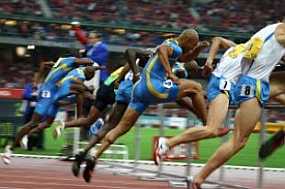
Paul knew he was finishing the race of faith well. He noted as much to Timothy, his protegé. How did Paul finish? Running the race, clearing the hurdlesHe won the prize after losing his head.

Peter got a second chance from the Lord. Jesus prophesied how His impetuous disciple would live and die. Peter finished well—crucified upside down.

That’s not how we think of finishing well, is it?

For most Americans, finishing well means retiring rich to a condo in the Florida Keys, drinking margaritas while listening to Jimmy Buffet all day. Oddly enough, the Christian version of that dream varies little, except it drops the booze from the margarita and subsitutes Salvador for Mr. Cheeseburger in Paradise.

So much for martyrdom.

Which makes me wonder how well most of us will finish.

At one point I believed that the true saint of God lives in such a way that the worldly must kill him or her to snuff the blinding light. I know most people in this country don’t believe that. But if we’re running the race with all our heart, with our eyes fixed on Christ, how is it possible that our end isn’t at the hands of those who hate Christ? If we’re REALLY living out the Gospel, how can we possibly end up poolside on the beach counting our money?

My Dad walked away from the Faith and finished badly. Like watching a train wreck, most people who witnessed his self-destruction couldn’t take their eyes off the disaster. It was that obvious.

But what happens when it’s not obvious? What happens when folks start easing up on the race track, then absent-mindedly wander off it over the course of years, never to cross the finish line? How many people start out brilliantly in Christ but spend the next fifty years on a runaway train headed for disaster—and they don’t even know it?

What kind of prize does one receive when one retires to that beach condo? From God’s perspective, isn’t that its own reward?

And what a bitter prize it may be.