The Little Things: The Zodiac Blogger

Standard

God's been bringing these Little Things to my mind more and more. These posts were supposed to be occasional, but I can't stop noticing them of late. This post is about one little thing that makes my heart sink when I see it.

I'm sometimes clumsy when I confront people, so I hope that I'm not accusatory in this post. Think of this as a challenge to purity of conviction then. We've become inured to the whole issue, and anything we're inured to is for all intentions invisible. Magnifying glassThe diabolical part about this particular Little Thing is that it's astonishingly prevalent. I want to believe it's just because it's so ingrained in American culture that we don't think about it at all.

It's being a Zodiac Blogger.

It may seem like a little thing, but my informal poll of people who listed "Christianity" or "Jesus" as a topic of interest in their Blogger profile shows that two-thirds of them have their zodiac sign listed.

God says this:

And beware lest you raise your eyes to heaven, and when you see the sun and the moon and the stars, all the host of heaven, you be drawn away and bow down to them and serve them, things that the LORD your God has allotted to all the peoples under the whole heaven.
—Deuteronomy 4:19 ESV

And also this:

…but test everything; hold fast what is good. Abstain from every form of evil.
—1 Thessalonians 5:21-22 ESV

Horoscopes and astrology fail the test of the above passages. The Father desires that we have no other gods before Him.

This look at Little Things is about just that: the little things that keep us from walking in fullness of life. They may not seem like much, but they still speak to our allegiances. I don't want to show the world I have any allegiances to worldviews that are against the worldview of Jesus Christ. Honestly, I wish I had no idea what my astrological sign was. But this I do know: I definitely won't be putting it out there for others to see. I don't want anything to disqualify my witness for Christ, so I just avoid anything astrological altogether.

If you have a Blogger profile that includes your zodiac sign, consider removing that sign. It may not seem like all that much, but I think God would be pleased if we eliminated those things that might hold us back or divide our hearts.

Brothers, I do not consider that I have made it my own. But one thing I do: forgetting what lies behind and straining forward to what lies ahead, I press on toward the goal for the prize of the upward call of God in Christ Jesus. Let those of us who are mature think this way, and if in anything you think otherwise, God will reveal that also to you. Only let us hold true to what we have attained.
—Philippians 3:13-16 ESV

Update: I've been told—I assume the sources to be good here—that Blogger automatically puts up your zodiac sign if you fill in your birthdate in your Blogger profile. I did not know this. Still, it's a product of the times that these things are assumed as being desirable to know. If I were in the position of displaying that sign, I'd still consider removing my birthdate if all it's doing is generating a zodiac sign.

Some of the commenters here have said that this may be too little a thing to be part of this series, but I don't feel that way. I'm a big advocate of grace and grace will cover these things if we are ignorant of them. But I believe we still need to think about them because too many things like this add up to us being held back by the world.

I've long been convicted of the narrative in Joshua 7 that found the army of Israel being routed in their battles against the Amorites. When Joshua fell on his face before God and asked why, God told him that someone in the camp had taken as plunder of war items that were dedicated to the Canaanite gods, items that God had said must be destroyed (after a previous military victory.) That man, Achan, had hidden these in his tent. Joshua took Achan, his entire family, and all his animals, and stoned them to death. Then he burned everything that had been associated with Achan.

God takes these things seriously. Thankfully, we don't have to suffer stoning for what we've done. I know that I'd be under a pile of stones for the things I've done in my life. But it doesn't mean we should tolerate those things, either, especially when we consider their source.

This last year the Lord has been showing me what I need to purge from my life, more things than ever before. I think what has changed is that I no longer desire anything that will hold me back from being all that He can make me, so now He can get down to work. I'm sharing some of those issues in this series and Cerulean Sanctum, in general. I'm simply hoping my comments on this will help others out there. Whether people can accept these things or not, I understand.

Have a blessed day, all of you.

The Humble Warrior

Standard

I [Paul] therefore, a prisoner for the Lord, urge you to walk in a manner worthy of the calling to which you have been called, with all humility and gentleness, with patience, bearing with one another in love, eager to maintain the unity of the Spirit in the bond of peace.
—Ephesians 4:1-3 ESV

Do nothing from rivalry or conceit, but in humility count others more significant than yourselves.
—Philippians 2:3 ESV

Put on then, as God’s chosen ones, holy and beloved, compassion, kindness, humility, meekness, and patience, bearing with one another and, if one has a complaint against another, forgiving each other; as the Lord has forgiven you, so you also must forgive. And above all these put on love, which binds everything together in perfect harmony. And let the peace of Christ rule in your hearts, to which indeed you were called in one body. And be thankful.
—Colossians 3:12-15 ESV

He must increase, but I must decrease.
—John 3:30 ESV

There is much talk about manhood today, but I don’t see much of it in practice. Contrary to popular opinion, it’s not about hunting bear with a pointy stick and never has been.

Many bestselling Christian writers talk about being warriors. They sell truckloads of books and inspire the creation of thousands of men’s groups in countless churches. Men go on “advances” (don’t EVER call it a “retreat”—too girlie) to learn how to develop their inner warrior, or if the group has more of a business focus, their inner leader.

Despite the millions of books sold, speaking engagements across the world, and a guaranteed bestselling sequel when the sales of the latest warrior tome peak, one arrow is routinely left out of the warrior author’s quiver: humility.

By nature, humility and war are a hard marriage. The examples don’t come as readily as the images we get of tough, swaggering men in bullet-shredded uniforms, each with a cigar firmly clenched between his teeth, mowing down one wave after another of Nazis, flamethrower in one hand, tank gun ripped off a flaming Sherman in the other. Such men ascend through the ranks and become twelve-star generals, husbands to nubile movie starlets, and CEOs of multinationals that consume lesser companies no matter how many poison pills are consumed. That’s the role model of manliness we Americans hallow. (In the American Christian world, the model’s pretty much the same, though the cigar is suspect.)

I’ve thought long and hard about some examples of humility and warrior spirit, the best example I can toss out there (besides the obvious ones) is that of the man after whom the city near where I live is named, Lucius Quinctius Cincinnatus.

The story is told that Cincinnatus, a farmer well-liked by his neighbors, was called to serve in 458 BC during a time of great threat: enemies were advancing against Rome. Despite the fact that his family might starve as a result of his decision, Cincinnatus accepted a call to lead the armies of that great city. He was declared dictator, swiftly defeated the invaders in just sixteen days, and immediately resigned as dictator, going back to his farm. Nineteen years later, he was called out of retirement to meet a new threat to Rome. And again, he fought the fight and promptly gave up the throne to go back to rural life.

That’s not the kind of example we are given too often today.

Less often than that do we have examples of men who never picked up a sword or gun, who never spilled blood, but spent most of their time on their knees. Prayer WarriorGeorge Mueller was such a man. A lot of the testosterone-laden out there wouldn’t think much of Mueller; he was concerned for orphans. Sounds kind of womanly compared with the examples we see held up in bestselling men’s books. But Mueller prayed. That man sweated out big prayers that met big needs and overcame ferocious principalities and powers that sought to destroy little boys and girls, demonic forces that wanted nothing more than to grind up children in the hardscrabble streets of England. And the one thing that people said about Mueller besides the fact that he was a praying man? That he was humble.
As much as the bestseller shelves are loaded with books jam-packed with bone-chewing examples of manliness, the dearth of books featuring meek and humble men speaks volumes. Simply possessing a penis and knowing every great line from Spartacus, The Green Berets and the king of all warrior movies, Braveheart, doesn’t qualify you for warriorhood. Making prideful, snarky assertions about someone’s eternal security on the God-blog flavor of the week doesn’t make you God’s man, either. It takes a humble man to walk into his prayer closet (where, it should be noted, there are no ticker-tape parades), kneel in humility before the Lord, and start assaulting the powers of darkness through prayer. Your average street dog can easily sink his teeth into a flesh and blood foe, but only a meek man devoted to prayer can tear down demonic strongholds in spiritual places!

The problem with Christian manhood today is not that there aren’t enough villages to plunder, it’s that humble, stooped grandmothers are out there on their knees fighting the battles that “real” men are too proud (or lazy or weak) to fight. Too many men in our churches moan that someone stole their warrior badge. Meanwhile, Satan is plundering OUR village. And he’s doing it not in the obvious places, but in the spiritual realms, the very place that prayer alone works.

John the Baptist prayed (you didn’t realize it was a prayer, did you?), “He must increase, and I must decrease.” Men, that’s meekness and humility right there. That prayer is the true warrior’s marching order. Likewise, our call to honor is found in Ephesians 4:1-3. If the Savior emptied Himself and became a servant, dying in the utmost humility, meekly refusing to justify Himself before men, how can we be any different? Only after Christ fully humbled Himself was He exalted and given The Name Above All Names.

Do we get it? Or are we going to keep on blathering about our warrior birthrights while we pick off the “weak” through our clever arguments, our mocking haughtiness, and our brutal gracelessness?

True Christian warriors are men of humility and grace. They understand that only when they are weak are they strong.

Which kind of warrior are you?

Not So Wild About Harry

Standard

I’ve ignored writing on all things Harry Potter over the years, but this weekend forced me to change my mind. With my wife’s sister’s family down for the weekend, we were looking for things to do. Unfortunately for us, the city we live near was in the grip of Pottermania and half the activities in town were geared to the release of the latest book.

I’ve written a few posts about the world of fiction in the last couple weeks, but this isn’t going to be a diatribe about J.K. Rowling’s billions or the quality of her writing. The problem is not one of literary aspirations. To me, Harry Potter is a symptom of the much larger problem.

When I was a kid I watched Bewitched, I Dream of Jeannie, and any host of shows that featured magic. Some Christians would say that I was leaving myself open to all sorts of negative spiritual forces for doing so, but what no one could claim then is that they knew real witches. I certainly didn’t at that time. There weren’t any girls in my school that fancied themselves to be a witch (or even sympathetic to the witch’s cause.) The worst thing you could say about some young woman was that she had the lousy ’70s and ’80s fashion sense to dress just a little too much like Stevie Nicks. But witches? Nah. In fact, it was more likely that guys could be accused of witchcraft because Dungeons & Dragons was insanely popular by the time I graduated from high school. At Carnegie Mellon University in the early 80s I knew guys who skipped all their classes just to play D&D, sitting around getting high and drawing arcane symbols on the walls of their dorm rooms.

While some of the signs for a groundswell were in place even when I was a child, it can be argued that the later syndication of those TV shows I mentioned above lowered the defenses for witchcraft for the generation that came after mine when added to later societal changes. Today, everywhere you look, you can’t seem to get away from all things Wiccan or pagan. In fact, I have to believe that the fastest growing religion in the United States is not Islam, but the same one that has captured so much of the British population in recent years, Neo-paganism. Sorcery, vampire cults, an affinity for the goth lifestyle, even postmodernism—all of it has roots in paganism. Couple this with a societal outlook that is rational but growing more irrational by the day, and Neo-paganism looks ready to explode in the West.

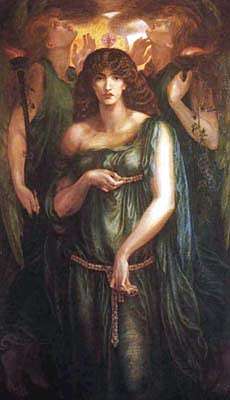
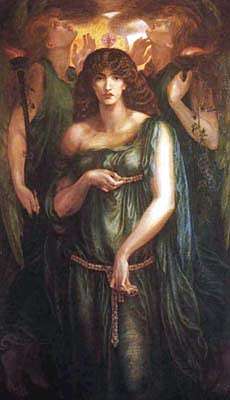
Why? Nature abhors a vacuum. Especially human nature. With Christianity on the down side in the Western world, people who are searching for answers, particularly those answers that cater to humanity’s fallen need to have power and control, are finding what they want in paganism.'Astarte Syriaca' by Dante Rossetti Earth religions are picking up adherents left over from the New Age movement, the children of the Haight-Ashbury crowd, and the rise of “organic culture.” (My wife and I are trying to get an organic farm going and it is shocking how much the “religion” of some organic farmers is rooted in goddess worship and fertility cult thinking.)

Earth religions have been around nearly as long as there has been a planet with that name. The Bible contains numerous commands of God to keep trees and natural distractions away from His altars lest they be construed to have anything to do with the worship of nature (Deut. 16:21 is an example.) The entire religion of Astarte/Ashera/Ishtar that bedeviled the prophets and kings of the Old Testament is the same earth goddess worship we see today (much of it penetrating Christianity in the form of the Roman Catholic Church’s Marian cult.) There truly is nothing new under the sun.

With the desire to worship the creation rather than the Creator comes the desire to control the creation; this leads us to witchery and the rise of Wicca as a religion to be reckoned with in the United States. While the number of self-identified witches, pagans, and Wiccans is wildly variable (anywhere from 100,000 to over three million adherents in the United States), the one truth is that their numbers are growing rapidly.

But nowhere has there been greater capitulation to Neo-paganism than in the UK. With studies showing that less than 3% of the population of Great Britain attends church on the weekends, Neo-paganism has filled the void left behind by the abandonment of Christianity. Even some high-ranking church officials in that country have been linked to the ancient Druid religion, and druid gatherings have been picking up in number, with more and more people flocking to see druidic ceremonies performed.

So it comes as no surprise that Britain gave Harry Potter to the world. Say what you will about the books, they are certainly a phenomenon we’ve never seen before. The problem here lies in the fact that Harry Potter could very well be the poster child for Neo-paganism. As a recruiting tool par excellence, nothing will break down the walls to the further acceptance of Neo-paganism than a boy sorcerer intent on saving his friends, his school, and the confused, non-“gifted” Muggles from evil machinations that threaten the world.

The problem then of Harry Potter that separates him from other books featuring magic is not only the craze that has developed around the books, but that reality is being blurred. When I was watching Bewitched I knew that witches weren’t real. People didn’t go around saying that they were witches. It put a kibosh on anyone thinking that being a witch was a likely choice of religion. But not so today. In my county alone there are several recognized covens. Elsewhere I had mentioned that a young couple came into the Christian bookstore I worked in many years ago and told us they had just left a coven that was actively attacking the bookstore via prayers and incantations. Needless to say, I was naive to this modern reality.

We cannot afford to be naive. If Harry Potter had hit the scene in the 1940s, I believe his impact would have been negligible compared with today. But given that the environment into which he’s flown is primed for his brand of Neo-paganism, I believe the influence of Rowling’s books is far more dangerous. While some might claim that I’m cutting my own throat as a writer of speculative fiction, I can’t keep silent while a generation’s defense against Neo-pagan thought is being systematically disabled by what many Christians consider a harmless story. Fantasy novels of all kinds are some of the bestselling books in bookstores and it is safe to say that the most rabid fans are the ones who are most likely to self-identify not as Christians, but something more akin to Neo-paganism.

Although this may seem like a broad brush, the fact remains that the Harry Potter generation will be the backbone of Neo-paganism in the next dozen years. They’ve been groomed with what on the surface was a mere gripping read, but which planted a seed that will grow into a noxious fruit that we Christians of 2020 will have to confront. We must fight it now and work to deprogram kids before they grow up as enemies of the Lord.