
Elusive Wisdom

Standard

Before we get to the second part of my posting on being a Church family, I want to add some thoughts on wisdom in a modern age. I couldn’t stop thinking about the issue this weekend, and as I was out on my tractor for several hours Sunday, I had plenty of time to think.

I was interviewed for a radio show called “Wise People” this last Saturday and will be again this Saturday. But the fact is, despite the title of the show, I find wisdom elusive.

I’m 47 years old, and if I were asked to comment on the pat answer about getting older and gaining wisdom, I’d have to say that the conventional wisdom on wisdom and age just doesn’t work. Or at least it doesn’t work in the conventional sense.

At the age of 21, I didn’t have a lot of room for “wisdom” that didn’t meet my preconceptions. I was pretty much the standard angry, young know-it-all. Sadly, that was a state that persisted for far too long.

But as I’ve gotten older, I seem to have fewer prepackaged answers and a whole lot more questions. The list of “Stuff I Don’t Get” gets added to daily.

When you get down to it, all practical wisdom concerns making sense of people and God. In 47 years, what I have come to understand of people is that I don’t understand them at all. And while I can definitely see God  moving in certain situations, it’s those situations in which I don’t see Him that I come to realize that my understanding of God could fill a thimble—one made for Barbie.

The supposedly wise person makes sense of people in light of sin. Understand the nature of sin and you understand why people do what they do.

But honestly, the older I get, the less satisfying that response becomes. And it is less satisfying because no one can know the future, and it’s our relationship to the past, present, and future that makes understanding humanity so difficult. How sin informs the past and present is hard enough to comprehend, but add the future and I don’t see how any nonprognosticator can make predictions.

Now put God into that mix. The result, at least to me, is too big to get one’s head around.

Which is why Romans 8:28 is so hard for me to understand:

And we know that for those who love God all things work together for good, for those who are called according to his purpose.
—Romans 8:28

The first part is hard enough to grasp, but it’s the phrase after the comma that makes my head spin.

If you’re couple who spent years trying to conceive, and finally that blessed bundle comes, what is to be said when the little baby dies unexpectedly? Did that babe get in the way of your purpose in life? Is it a good thing then that the baby died? And what can be said when no more children come?

Or you’re a missionary couple with kids, and after 25 years of marriage the whole couple thing crumbles. One day you were sharing the Lord with lost tribes of people in the backwaters of India, and the next day you’re in divorce court. PotholeHow did it all go so wrong? If the calling to marriage and mission were there, why did it end up like this?

Or you’re part of a leadership team at your church, and one by one every person on that team gets hit with calamity: cancer, divorce, depression, suicide, and so on. Do all those calamities really work together for good? Is it enough to say, “I survived,” and call that outcome good?

I talked about Christian maturity in the radio interview, but defining maturity is hard. We tend to think of it as some kind of Ph.D. in theology, but if my own experiences are any indicator, perhaps it’s something else entirely. And perhaps there’s some other meaning behind Romans  8:28 that eludes us.

Karl Barth, when asked to summarize the contents of his massive book Church Dogmatics, responded, “Jesus loves me/This I know/For the Bible tells me so.”

A children’s song.

In response to Barth’s answer, I’m sure some “wise” people snickered. Yet when faced with all the craziness, the nonsensical happens, the head-shaking personal calamities in the lives of ordinary people, the godly decisions that went south, the hopes that fell to pieces, and the general nastiness of human existence 2010, perhaps Barth’s answer is the wisest of all.

God knows that I don’t understand life—or Him—any better than that.

{Update: I had originally thought J.I. Packer was behind the “Jesus Loves Me” quote, but it was Swiss Reformed theologian Karl Barth.}
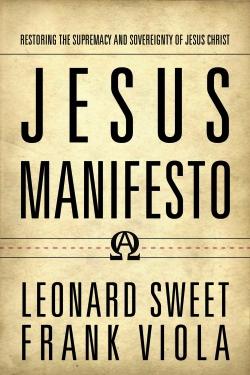
Book Review: Jesus Manifesto

Standard

“We Need a Whole Lot More of Jesus (and a Lot Less Rock ‘n’ Roll)”
—Wayne Raney

I don’t normally review books here at Cerulean Sanctum, but when offered the opportunity by Thomas Nelson to read an advance copy of Jesus Manifesto by Leonard Sweet and Frank Viola, two of the most prominent critics of traditional American Churchianity, I couldn’t pass.

What drew me more than anything to this book, which released June 1, is summed up in the quote that leads off this post. Sweet and Viola mirror Raney’s song title in their insistence that the Church in America has descended into spiritual noise, much to the detriment of our grasp of the person of Jesus Christ. Jesus Manifesto by Sweet and ViolaWe seem to be about everything BUT Jesus. We act as if we barely know Him at all; if we did, everything about the Church would be different. Sweet and Viola diagnose this disaease as Jesus Deficit Disorder. Jesus Manifesto attempts to rectify that disorder.

Sweet’s and Viola’s manifesto starts with a purge. The authors go right to the heart of the matter of the supremacy of Jesus Christ by calling us to re-examine what is meant by Acts 2:42’s mention of “the apostles’ doctrine,” noting all the debris that modern churches tend to teach has nothing to do with that doctrine, which is Christ Himself. We get sidetracked into eschatology, how to live by faith, spiritual warfare, evangelism, holiness, Bible memorization, and on and on. That list of diversions features a large number of sacred cows the authors eventually gore and then ask readers to purge. No Christian is left unchallenged.

The authors write that the ineffective Church is the one that focuses on things rather than the person of Jesus. Instead, the occupation of each Christian must always be Christ and Him alone. Getting a revelation of Jesus and seeing that revelation take root and grow in our lives is all that matters. Anything of value in the Church begins in the Alpha and ends in the Omega. The authors quote Watchman Nee  (in one of the many sidebars filled with wisdom from Christians throughout the ages):

“The characteristic of Christianity lies in the fact that its source, depth, and riches are involved with knowledge of God’s Son. It matters not how much we know of methods or doctrines or power. What really matters is the knowledge of the Son of God.”

Much of the Jesus Manifesto centers on the Book of Colossians. Sweet and Viola mine an excellent Christology from the book, not only elevating Christ to the position He deserves, but also noting how Christ’s elevation is our own by virtue of us being in Christ and Him being in us. The contemporary Church’s failure to tell Christians who they are in Christ has done massive harm, and it’s a blessing to read works by modern authors that address this lack.

Indeed, Sweet and Viola have given us in Jesus Manifesto a timely book filled with spiritual food a starving American Church needs to digest. If you have read Cerulean Sanctum for any length of time, you know my concern that we have lost our connection to the Head and have forgotten who we are and what we are to be about. Jesus Manifesto hits most of those points.

But the book is not without flaws, despite the fact that it focuses intently on our flawless Lord. As much as I found the book compelling in spots, it lacks the cohesiveness and majesty found in a similar book, A.W. Tozer’s The Knowledge of the Holy. Tozer’s book, which examines the character of God, is always riveting and powerful. Sweet’s and Viola’s book, in contrast, soars but equally drifts. One paragraph may be life-changing, while the next adds nothing—or worse, diminishes the profundity of the preceding words.

The book struggles with flow, too. This may be due to attempting to cram the ideas of two fascinating thinkers into a sub-200-page book on the Lord of the Universe. While the authors have much to say, their framing methods for doing so lack a coherent base. Jesus Manifesto reads as if it were written by a committee.

Together, these issues render Jesus Manifesto a huge paradox: a book that is too short and yet too long, profound yet prone to reader skimming, exciting and yet dull. In short, it needed an attentive editor to manage and direct these two intriguing authors.

I would encourage others to read Jesus Manifesto, for it contains a valuable reminder of the real point of the Christian faith we believe and practice. Too much “rock ‘n’ roll” exists in the American Church. Less of that and more of Jesus Himself is most definitely the cure for what ails us.

The Church Beyond the Cross

Standard

Sun & CrossIf you were to ask me what day in the Christian calendar grabs my attention the most, I would have to say Good Friday. Something about that day lays hold of my heart and gets me thinking about the things of Christ, even more so than Easter. (I suspect that is largely due to my upbringing.)

When I enter the online Christian world, one reality hits me time and again:  The top Christian blogs present solid cross-centered theology. In an age of Your Local Nondenominational Community Megachurch and its emphasis on showmanship and “what’s in it for me?” churchianity, that’s a good thing.

Yet at the risk of sounding heretical, I wonder if there’s a shortsighted lack associated with a focus on the cross alone.

Over at The Sola Panel, Gordon Cheng titles a post “Too Much Cross of Christ?” and calls on John Stott to help him with his answer, which is no. (HT: Challies)

That answer to the post title troubles me because it follows from a different question than the one Cheng actually addresses in his blog post, especially when he answers in light of a teaching and preaching emphasis. The question he is really asking is “Can the cross be too essential to the core of Christian theology?” That’s a solid no; obviously, much of our theology stems from an understanding of sin and the cross. The problem is that it is not the same question as Cheng asks in his blog post title.

We live in an age soft on sin. Despite this, many parts of the Church today are stuck on sin. Believers are constantly reminded that they are sinners in need of salvation. Reminding people of the necessity of the cross is a fine message, but is it the only one?

To me, some churches live as if it were always Good Friday and never Easter and Pentecost. As lamented by the inhabitants of Narnia, winter seems to have a perpetual grip on the land, unthawed by springtime and rebirth. Some preachers and teachers capably get people to the cross, but they can’t seem to get them to the empty tomb and to the assembling place where Holy Fire fell from heaven. In that light, the answer to whether we can have too much cross of Christ may very well be yes.

Without the resurrection, Paul writes that our faith is in vain and we are men most pitied (1 Cor. 15:1-22).

Without Pentecost, there is no Church and no empowering of the saints for service (see the entire book of Acts).

So it seems to me that while the Christian faith begins at Good Friday, it continues on and on in Pentecost.

Why then do our churches often fail so badly to venture beyond the cross? Why are so many of us still rooted in our identities as sinners and not in the new birth identity of saint?

Consider this passage:

Now if the ministry of death, carved in letters on stone, came with such glory that the Israelites could not gaze at Moses’ face because of its glory, which was being brought to an end, will not the ministry of the Spirit have even more glory? For if there was glory in the ministry of condemnation, the ministry of righteousness must far exceed it in glory. Indeed, in this case, what once had glory has come to have no glory at all, because of the glory that surpasses it. For if what was being brought to an end came with glory, much more will what is permanent have glory. Since we have such a hope, we are very bold, not like Moses, who would put a veil over his face so that the Israelites might not gaze at the outcome of what was being brought to an end. But their minds were hardened. For to this day, when they read the old covenant, that same veil remains unlifted, because only through Christ is it taken away. Yes, to this day whenever Moses is read a veil lies over their hearts. But when one turns to the Lord, the veil is removed. Now the Lord is the Spirit, and where the Spirit of the Lord is, there is freedom. And we all, with unveiled face, beholding the glory of the Lord, are being transformed into the same image from one degree of glory to another. For this comes from the Lord who is the Spirit.
—2 Corinthians 3:7-18

I am troubled by some denominations and Christian thought-groups that fail to teach believers that they are daily transitioning from sinners into saints. Such pew-dwellers repeatedly hear how they are mired in sin, but they never hear that as the redeemed they are being transformed from one degree of glory into another. In fact, in churches that never seem to venture beyond the cross, one must ask if they are even a New Testament church at all.

In some circles where the sinner mentality reigns, their pneumatology appears rooted more in the Old Testament than New. The radical reality of the New Testament is that the Holy Spirit of God comes to dwell inside the redeemed believer. Such was not the case with the Old Testament heroes of the faith. The Holy Spirit would fall on them for a time, but the permanent dwelling inside was reserved for the New Testament saint.

Some Christians have this tendency to continue to place God solely outside the believer. This is an Old Testament kind of thinking, though. It gives the individual believer no authority. All things supernatural that happen do so despite the believer, not because of the believer. It creates a worldview where the Church does not matter because God can do it all Himself.

There is no doubt that God can do it all Himself. The reality is that He chooses NOT to do it that way. Instead, He invest authority in believers by virtue of His own Spirit dwelling inside them. This is the exciting—and essential—truth of what it means to be in Christ!

The ramifications of this are astonishing: The lowliest New Testament saint is greater than the greatest Old Testament prophet (see Luke 7:27-28 and throughout the NT for corroboration).

When was the last time you got that sermon in church? How many Christian blogs discuss this reality at length?

If the answers to those questions trouble you, they should. This lack is largely due to the fact that we have an underdeveloped understanding of what it means to be Spirit-filled believers. And we have that lack because we are not preaching and teaching what exists beyond the cross: the resurrection, Pentecost, the transition of the sinner into sainthood, and the authority of the redeemed believer in Christ. Instead, we continue to push a theology that keeps the believer a meaningless, individual sinner and not a saint.

Consider this passage:

And God was doing extraordinary miracles by the hands of Paul, so that even handkerchiefs or aprons that had touched his skin were carried away to the sick, and their diseases left them and the evil spirits came out of them. Then some of the itinerant Jewish exorcists undertook to invoke the name of the Lord Jesus over those who had evil spirits, saying, “I adjure you by the Jesus whom Paul proclaims.” Seven sons of a Jewish high priest named Sceva were doing this. But the evil spirit answered them, “Jesus I know, and Paul I recognize, but who are you?”
—Acts 19:11-15

How is it that the demon recognized Paul? Because Paul had authority as a saint in the Kingdom of God. Consider the depth of what that means!

When that same Paul wrote to the young churches, he greeted them as fellow saints, not as fellow sinners. He talked about how they had all once been slaves to sin but were now translated into the Kingdom of God where they were now saints entrusted with the Spirit of God.

For the Church to truly rise to the calling of Christ, we need not only the cross but the resurrection and Pentecost. We need our preachers and teachers to tell the people in the seats that “sinner” is not their final identification. We need to learn what it means to have authority in Christ because He makes His home inside us. We need to know the full breadth of our birthright because of what the cross won for us, not just for the sin Christ took away from us.

We can have no pure Christian theology without the essential of the cross! But the cross is not the sole essential. Resurrection and empowerment by the Holy Spirit spring from the cross. And if we fail to teach and live what comes beyond the cross, we will fail to be the Church of Jesus Christ.