
Book Review: Jesus Manifesto

Standard

“We Need a Whole Lot More of Jesus (and a Lot Less Rock ‘n’ Roll)”
—Wayne Raney

I don’t normally review books here at Cerulean Sanctum, but when offered the opportunity by Thomas Nelson to read an advance copy of Jesus Manifesto by Leonard Sweet and Frank Viola, two of the most prominent critics of traditional American Churchianity, I couldn’t pass.

What drew me more than anything to this book, which released June 1, is summed up in the quote that leads off this post. Sweet and Viola mirror Raney’s song title in their insistence that the Church in America has descended into spiritual noise, much to the detriment of our grasp of the person of Jesus Christ. Jesus Manifesto by Sweet and ViolaWe seem to be about everything BUT Jesus. We act as if we barely know Him at all; if we did, everything about the Church would be different. Sweet and Viola diagnose this disaease as Jesus Deficit Disorder. Jesus Manifesto attempts to rectify that disorder.
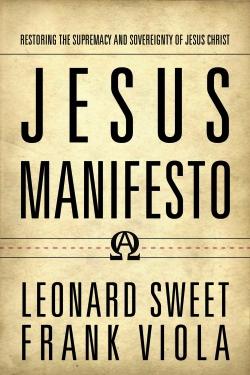
Sweet’s and Viola’s manifesto starts with a purge. The authors go right to the heart of the matter of the supremacy of Jesus Christ by calling us to re-examine what is meant by Acts 2:42’s mention of “the apostles’ doctrine,” noting all the debris that modern churches tend to teach has nothing to do with that doctrine, which is Christ Himself. We get sidetracked into eschatology, how to live by faith, spiritual warfare, evangelism, holiness, Bible memorization, and on and on. That list of diversions features a large number of sacred cows the authors eventually gore and then ask readers to purge. No Christian is left unchallenged.

The authors write that the ineffective Church is the one that focuses on things rather than the person of Jesus. Instead, the occupation of each Christian must always be Christ and Him alone. Getting a revelation of Jesus and seeing that revelation take root and grow in our lives is all that matters. Anything of value in the Church begins in the Alpha and ends in the Omega. The authors quote Watchman Nee  (in one of the many sidebars filled with wisdom from Christians throughout the ages):

“The characteristic of Christianity lies in the fact that its source, depth, and riches are involved with knowledge of God’s Son. It matters not how much we know of methods or doctrines or power. What really matters is the knowledge of the Son of God.”

Much of the Jesus Manifesto centers on the Book of Colossians. Sweet and Viola mine an excellent Christology from the book, not only elevating Christ to the position He deserves, but also noting how Christ’s elevation is our own by virtue of us being in Christ and Him being in us. The contemporary Church’s failure to tell Christians who they are in Christ has done massive harm, and it’s a blessing to read works by modern authors that address this lack.

Indeed, Sweet and Viola have given us in Jesus Manifesto a timely book filled with spiritual food a starving American Church needs to digest. If you have read Cerulean Sanctum for any length of time, you know my concern that we have lost our connection to the Head and have forgotten who we are and what we are to be about. Jesus Manifesto hits most of those points.

But the book is not without flaws, despite the fact that it focuses intently on our flawless Lord. As much as I found the book compelling in spots, it lacks the cohesiveness and majesty found in a similar book, A.W. Tozer’s The Knowledge of the Holy. Tozer’s book, which examines the character of God, is always riveting and powerful. Sweet’s and Viola’s book, in contrast, soars but equally drifts. One paragraph may be life-changing, while the next adds nothing—or worse, diminishes the profundity of the preceding words.

The book struggles with flow, too. This may be due to attempting to cram the ideas of two fascinating thinkers into a sub-200-page book on the Lord of the Universe. While the authors have much to say, their framing methods for doing so lack a coherent base. Jesus Manifesto reads as if it were written by a committee.

Together, these issues render Jesus Manifesto a huge paradox: a book that is too short and yet too long, profound yet prone to reader skimming, exciting and yet dull. In short, it needed an attentive editor to manage and direct these two intriguing authors.

I would encourage others to read Jesus Manifesto, for it contains a valuable reminder of the real point of the Christian faith we believe and practice. Too much “rock ‘n’ roll” exists in the American Church. Less of that and more of Jesus Himself is most definitely the cure for what ails us.

Asking the Radical Questions

Standard

Please watch these video excerpts from a Francis Chan message:

I love Chan’s heart. He’s one of the few contemporary preachers with national reach who is asking the hard, radical questions that contemporary Christians must ask. He seems to have a better understanding of what it means to be human, to feel out of place in the institutional church, to read the Bible and then wonder why our expression of it fails so poorly to truly reflect it.

For people who have been Christians for more than a few years, shaking off the “system” of Christianity that we have erected is mind-bogglingly hard. Gaining that fresh perspective on the Scriptures and looking at them “sideways” doesn’t come easily—if it ever comes at all. We are more likely to simply kowtow to whatever our denominational flavor says and never truly ask the radical questions.

We throw around the word countercultural when it comes to the Church and the world, but the older I get, the more I find that the real counterculture is swimming against the tide of Church systems erected by well-intentioned believers who saw through a glass darkly and missed the real heart of the Gospel.

But that truly Christian counterculture is awakening. It makes my heart glad to see that some people get it, even if most of us still don’t.

My hope for all Christians, especially the ossified ones that predominate in the West, is that we will ask the kind of tough questions people like Francis Chan are asking. And more than anything else, I pray that we are prepared to do what it takes to provide answers, even if those answers painfully tear down idols in our churches, our culture, and our own lives.

Sadness, Depression, and the Christian

Standard

He was despised and rejected by men; a man of sorrows, and acquainted with grief; and as one from whom men hide their faces he was despised, and we esteemed him not. Surely he has borne our griefs and carried our sorrows; yet we esteemed him stricken, smitten by God, and afflicted.
—Isaiah 53:3-4 ESV

It is better to go to the house of mourning, than to go to the house of feasting: for that is the end of all men; and the living will lay it to his heart. Sorrow is better than laughter: for by the sadness of the countenance the heart is made better. The heart of the wise is in the house of mourning; but the heart of fools is in the house of mirth.
—Ecclesiastes 7:2-4 KJV

We live in an age when sadness is under assault.

A few weeks ago, I was chatting with a fellow Christian. At one point, I brought up some of the sadness I felt over the state of the world 2010 and some genuine losses in my life and the lives of family members. In the course of the discussion, he mentioned antidepressants.

Back in the dark ages of 40 years ago, depression was considered a debilitating mental illness. To be diagnosed with depression, one had to be nearly nonfunctional, unable to perform even simple tasks, such as getting out of bed in the morning. I had a college professor who talked about losing three entire years to crippling depression. He said he couldn’t think and could barely lift himself out of his favorite chair. Depression had rendered him completely inert.

I like to listen to Science Friday on NPR. Recently, they did a program on depression. During the interview, the two experts discussed the explosion of cases of depression diagnosed today and the reality that antidepressants are the most common drug prescribed, with one person out of every 15 in America taking them. And those numbers are growing.

Those experts noted disconcertingly that pharmaceutical company marketing departments helped manufacture much of the need, dramatically reducing the threshold for what is considered depression. Doctors bought into that marketing. Now, we have created an atmosphere of  “Sad? Well, there’s a pill for that.”

In effect, in many cases, we are using drugs to eliminate ordinary sadness.

A friend who works with mentally ill children attended a recent symposium. He later wrote that an expert on depression divulged that for most people, if left to a natural grief-resolution process that omits drugs, feelings of sadness equated to “depression” typically fade away on their own in about nine months. Intriguingly, that expert works for a drug company that sells antidepressants.

Something is terribly wrong in our society when we are unable to separate normal sadness from debilitating depression.

March 29 is turning out to be a sad date on the calendar for me. My mom, a woman greatly loved by everyone who knew her, died on that date nine years ago. In one of those terrible synchronicities of life, I got the news that the man who led me to Christ, the most Spirit-filled person I ever met, and the one whose life still serves as my example of what it means to be a Christian, died yesterday. He mentored me in what it means to live by the Spirit and to listen to what God is saying. He loved people unconditionally. God spoke to him and used him to always give a word in season. Fred Gliem was 90.

Even though Fred lived a full life and impacted many for the Kingdom, his death makes me sad.

Some Christians out there don’t like sadness. Like the society around them, they want to replace sadness with a sort of Pollyanna-ish happiness that never abates lest one discredit the joy of having Christ dwell in one richly. I hear about Christians who want to turn every funeral into a cause for celebration. Honestly, I wonder what those folks are smoking.

Here’s what the Bible says is the reaction of Spirit-filled people to the death of one of their own:

Devout men buried Stephen and made great lamentation over him.
—Acts 8:2

Those devout men knew their friend was in the arms of Jesus. Still, they wept and wailed over his tragic loss.

I think one of the reasons why so few people know how to deal with sadness, why some want to toss medications at those who are sad, is because our worldviews allow no place for anything less than individual fulfillment and happiness. Sadness and grief are rendered deviant emotions.

Sadness also demands a response from others. While many emotions can go without comment, sadness can’t. Sadness asks for comfort. And comfort means availability.

Do we make time for the sad and grieving? Or do we prefer they pop a few happy pills and stop bothering us?

Job’s friends are almost universally reviled because God chastised them for speaking while ignorant of the facts. But one thing God did not do was criticize Job’s friends for their dedication to their stricken friend:

Now when Job’s three friends heard of all this evil that had come upon him, they came each from his own place, Eliphaz the Temanite, Bildad the Shuhite, and Zophar the Naamathite. They made an appointment together to come to show him sympathy and comfort him. And when they saw him from a distance, they did not recognize him. And they raised their voices and wept, and they tore their robes and sprinkled dust on their heads toward heaven. And they sat with him on the ground seven days and seven nights, and no one spoke a word to him, for they saw that his suffering was very great.
—Job 2:11-13

Seven days and nights Job’s friends stayed with him—before they even said a word. They mirrored Job’s grief, tearing their robes and weeping as they took on the dust of his despair.

When was the last time you or I heard of anyone showing such devotion to a friend in his or her time of sadness? Isn’t our tendency instead to quote Romans 8:28 and casually discount another’s abyss? Man of SorrowsHaven’t we become people who blithely say, “You know, they have a pill for that,” so we can go on with our lives, make our next business meeting on time, and not be bothered by the natural outcome of living in a sin-soaked world?

If one of Christ’s titles were not “The Man of Sorrows,” how could we ever claim that He was fully human? No, we know Jesus was well acquainted with sadness. He did not run from that emotion. How then can we?

The Scriptures say that the fool’s heart is always in the house of mirth. The fool learns nothing of the breadth of life’s truths, including the truth that sadness serves a purpose. From its depths come a kind of wisdom that can’t be gained from always thinking happy thoughts. Indeed, a sad face is good for the heart. It grounds us in real meaning and makes us better people.

Listen to “Sad Face” by The Choir:

There’s a crystal in the window
Throwing rainbows around
There’s a girl by the mirror
And her feet won’t touch the ground
‘Cause she never saw the sky so bright
Isn’t that like a cloud, to come by night
Nevermind the sky
There’s a tear in her eye

A sad face is good for the heart
Go on cry, does it seem a cruel world?
A sad face is good for the heart of a girl
A sad face

There’s a woman in my kitchen
With a rainbow on her cheek
Well isn’t that a promise?
Still I never felt so weak
There’s a tiny spirit in a world above
Cradled so sweetly in our Father’s love
So you don’t have to cry
No there’s something in my eye

A sad face is good for the heart
Maybe just now I don’t understand
A sad face is good for the heart of a man
A sad face

A sad face is good for the heart
It’s alright you don’t have to smile
A sad face is good for the heart of a child
For the heart of a child
A sad face A sad face…