

Politics, Economics, and the American Church

Standard

Empty pocketHere at Cerulean Sanctum, we talk little about politics and much about economic justice issues. Today, we'll see how those two items intersected in the election last week and how we American Christians must wake up to a brutal reality.

Pundits galore propounded the reason that Republicans got tossed off Capitol Hill, but they missed the real voter zeitgeist. Given the glowing economic news trumpeted in the usual Republican-sympathetic media sources, the talking heads looked only to non-economic federal issues to explain stunning Republican losses.

But to update a famous phrase, "It's still the economy, stupid."

While voters may talk about the Iraq War, terrorism, and a number of other global issues Republicans bungled, they'll vote based on local issues. Only people satisfied with their local outlook will vote global and national issues. If the local outlook is grim, forget about anyone looking beyond his own backyard. Local economic health, in particular, drives voting.

Here in (formerly, as of 11/7/06) Republican-dominated Ohio, the state with the worst job prospects in the country, a poll showed that 83% of Ohioans viewed economic issues as "very important" or "extremely important" in determining their Senate pick (Source: The Wall Street Journal, 11/8/06). But Republicans, thinking the economy was superb for everyone, continued to campaign on any issue but improving the economy. They expected folks to suck down the hoopla over the "great economy" despite seeing bare cupboards. As a result, Ohio incumbent Republican senator Mike DeWine got slaughtered by his Democratic challenger, Sherrod Brown, who took a more aggressive stance regarding Ohio's economic health. We talk about Virginia tipping the balance of power in the Senate, but DeWine's loss was potentially a greater news story, since it highlighted voter unease with the supposedly terrific economy. Plenty of people took one look at their bank accounts and the collective sigh sounded a lot like "*&^%!"

Ohio can't be the sole state with hurting workers. As we'll see, national figures could scare the heck out of anyone, regardless of state. So I suspect that many of the Republican losses reflect middle-class voters facing economic pressures, voting with their empty pockets.

As we know, money talks.

Consider the following realities:

  • The American savings rate hovers in negative numbers. (Source)
  • While salaries in the United States rose substantially in the United in the period 2000-2004, that wealth was almost entirely concentrated in the top one percent of wage-earners (household incomes of $300,000+/yr). That one percent saw a 19.8 percent increase in their income over the period. The other 99 percent? A 3 percent increase—not even close to keeping pace with 3 percent year-over-year inflation. (Plus, recent analysis of 2005-2006 shows a continued widening of the salary discrepancy.) (Source)
  • Consumer debt continues to rise. As of August 2006, Americans have never carried greater debt. (Interestingly,  those numbers backtracked a bit in September. I suspect people smelled trouble on the horizon. Perhaps that further proves Election Day results, especially since Republicans polled better against their Democratic opponents before September.) (Source)
  • For the first time since records began, highly educated Americans saw their earnings potential decrease in 2005, demolishing the accepted wisdom that more education translates into higher salaries. (Source)

While some debate that the negative savings rate ignores overall wealth, the information becomes even more dire when factoring in leverage and who holds investment wealth.

Many Americans leverage their home equity. With housing prices falling in almost every state, that leverage only eats away wealth and consumes retirement savings, compounding the problem. In addition, overall wealth incorporates investments, and again, that top one percent controls 93 percent of all investment wealth. (Just wait until those rich Baby Boomers start retiring, too, and begin pulling their money out of stocks.)

Given the rich are getting richer, what does the economic news tell us of the average family? For starters, the typical worker watched upper management prosper, while his or her real world dollars lost buying power. I know many people in their peak earning years whose companies reported record income, yet watched helplessly as their employers eliminated bonuses, cut back on insurance compensation, and froze or reduced cost-of-living increases.

I can't speak for you, but in our area in the last year alone, the cost of consumer goods skyrocketed. The box of cereal I bought last year for $2.29 is $2.99 now—a 31 percent increase. Broccoli cost $1.59 last November, but $1.99 a year later—25 percent more. Our electric company raised area rates 30 percent. And don't get me going on gasoline. I paid $1.59/gal. in the summer of 2005 and almost a dollar more now.

One doesn't need a PhD in mathematics to note that no one out there's received a 35 percent cost of living increase in the last year! Increasingly, middle class folks like us watch helplessly as our incomes buy less and less.

Five years ago, I knew several families where dad worked and mom didn't. I can't think of a single one like that now. While the unemployment figures look strong, do they merely reflect more families forced to put both parents to work to keep pace? If more women enter the job market (primarily in low-wage retail or service industry jobs) just to make ends meet at home, that puts a damper on much of that ecstatic job info, doesn't it?

My mother-in-law told me a new Wendy's opened in her small town. To her shock, most of the employees are over forty. Is working at a fast food restaurant the goal of people in their peak earning years? If so, we're in deep trouble.

In March 2006, I asked readers about their financial stability. More than sixty replied, about half via personal e-mail, the others through comments. Almost universally, people under 35 were better off at the end of 2005 than in previous years. That's to be expected, since many of them are young marrieds with both spouses working and few (or no) children. But the real shocker—and almost all these replies came through personal e-mails—concerned the state of people over forty. Many were far worse off than just five years before, having lost jobs (often multiple times) or  relegated to underemployment, compromised financially in what many consider peak earning years. Those tales broke my heart. I understand that kind of pain and what happens when the Church has no response—and none on the horizon, either.

And in the end, that's what this post is all about. I just completed a series on community , and I believe that our churches must start working toward some kind of money pool to help fellow congregants who fall on hard times. With so many families' money highly leveraged, and the reality that the middle class is fighting a losing battle against rising costs, something needs to be done on a macro level to fix some of the financial injustices people face today.

But the pulpit is silent. Sure, you'll hear about Ron Blue or Crown Financial stuff from time to time, but they only address individual issues. Who in the Church in America speaks out against the real problem, our broken system? 

Sure, we Americans spend too much of our incomes. But if the middle class continues to erode, it won't be a matter of spending too much on a consumeristic lifestyle. The real problem will be how to cope when curtailing excess spending simply won't halt the slide. You can shave expenses down to the bone, but when the bone's gone missing…

All it takes is a minor recession, I think. Or Ford or GM collapsing. With so many precariously perched families with no savings, high credit card debt, loans taken against homes of decreasing value—it won't take much.

Church, are we ready? Truly?

Time to wake up and start preparing for that day. It's coming faster than we think. 

UPDATE: I only got to see this last Saturday's Wall Street Journal late Monday evening. A front page story shows that Democrats running on anti-free-trade, anti-offshoring, and anti-outsourcing platforms crushed their Republican opponents in North Carolina, Indiana, and Pennsylvania. This further proves my theory that middle class voters smarting from job losses and inequities in the economy voted with their wallets, not with an eye toward Iraq, terrorism, or any other topic.

UPDATE II: Some who have read this post knee-jerked and assumed I was a Democrat or some other kind of liberal. Nothing could be further from the truth. In reality, I consider myself a pure conservative in that I believe in conserving what God values. I hold to many of the ideas espoused in Rod Dreher's book, Crunchy Cons. Also, I have a dim view of most political parties, Republican or Democrat. Both have sold out to special interests and forgotten the average American. Lastly, I firmly believe that politics is not the answer; the Kingdom of God is. The sooner American Christians realize this and start living it, the sooner we'll see many things come to pass that we're now foolishly hoping politics will give us.
Being the Body: How to Forge Real Community, Part 5 (Conclusion)

Standard

In this last post in the series “Being the Body,” we’ll look at a few more ways that our churches can better grow the community of believers within them.

#8 – Our communities should regularly enjoy a real communion feast together.

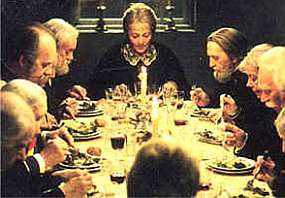
Folks who have studied the communion meals of the early Church come away with one truth: they were true feasts. Not the thimble of grape juice and a portion of a cracker, Still from the movie Babette's Feastbut entire meals in which the sharing of the bread and wine was the high mark.

We need to encourage our churches to prepare this kind of feast at least once a month. In fact, the more meals we eat together as a church, the more we’ll grow to know each other.

I would also encourage these real communions services to be a time when people share what Christ has done for them (since the last time a communion meal was held). We need those stories of faith to build our own faith,  but we seldom get to hear them enough for them to do any good. This would also be a time for the entire church to pray for individuals in need. We could hear the need, pray for the need, and use that time to meet the need right then, if possible.

#9 – Those of us in community should always keep an open home.

A community is not closed. It’s always open to others. It’s 24/7/365, too. Because our homes are the Lord’s and not ours, we need to always make them open to others, be they part of the community or not.

We can’t let the fortress mentality so prevalent in our country today keep others out of our homes. Our homes are not bunkers, but stations of ministry. Our mission field starts within the walls of your house and mine. If we’re not making our homes open, then we’re despising God’s gift to us.

We’ve got to get over having each room perfect, too. If you’re house is a little messy, who cares? Real homes are messy to some extent. We’re not supposed to live in museums. Obsessing over a home’s cleanliness speaks more about our fixation on the material rather than loving people. Better that a house be filled with love for everyone who enters it than it be spotlessly clean.

(See sidebar category listing “Hospitality” for more on this.)

#10 – As a community, we must find a holistic Christian perspective on our employment.

We have no excuses: we spend too much of our day devoted to our means of employment. If you’re a regular reader, you’ve heard this before, but unless we Christians rethink the way we work, we will forever have the Lord third or fourth in our lives. We need a revival of Christians seeking God for ways to drop out of the rat race and still provide for our families. Since we’re making community a priority, these issues should be discussed by the community.

We must also rethink unemployment. As a community, we are responsible to ensure that no brother or sister in the community goes without work if they need it. Despite the fact that today’s jobs are much more specialized than in ages past, we must ALWAYS draw alongside anyone seeking work and actively help them find a job. Our community is diminished by letting the unemployed search for work alone. If we are not dropping at least two dozen leads for each unemployed person a week, then we’re shirking our responsibility. The Bible commands that we work, therefore we are compelled to provide or seek work for those in the church community who need it. And we don’t stop helping until they get it.

(See sidebar category listing “Work” for more on this.)

#11 – True community makes ministering to the “weaker parts of the Body” a priority.

And who are these? The single parents, the elderly, the mentally ill, the sick, the developmentally disabled, and the families of those people.

An exceedingly powerful way to tell how vital a church truly is would be to examine how they deal with these folks. Are people ashamed of the mentally retarded teen, or do they go out of their way to incorporate him in the life of the church? Do people volunteer to take care of him so his parents can have a couple nights out to themselves each month?

Same goes for the single mom or dad. Some churches treat them as if they’re an embarassment rather than ministering to them as Christ would. If their singleness bothers us, then we should be routinely watching their kids so they can get out and meet a potential mate.

Real community always considers the weak and asks what can be done to bless them or their families. It’s one of the perpetual thoughts of people who esteem others better than themselves.

#12 –  True community is never afraid to be countercultural.

Being a community flies in the face of everything we hear daily as Americans. Thinking of others first does not come naturally to the natural man, but to the spiritual man it is the core of his ministry. If we fear Man, we should not be servants of Christ.

For this reason, we must pursue real community in the Body of Christ even if the world fights viciously against our desire to do so—and it will, because the world is passing away. But the communion of saints is eternal! What we begin here in our church communities is the groundwork for something that will never perish. We must always remember that our fitness as a community will reflect in the afterlife. God gives us our time here to fit us to heaven, and if we’re not living in a godly community that stands apart from the world’s individualism, then we are not being good stewards of the time the Lord has given us.

The bottom line of community is this: we can continue to live as randomly scattered body parts that accomplish little for God’s glory, or we can be the vital Body of Christ living in countercultural community. God demands the latter of us when we come to Christ. Yet our American cultural mandate is anything but community-focused.

We Christians in America must rethink everything we’ve assumed about community, putting it under the authority of the Scriptures as illumined by the Holy Spirit. That we’ve failed to do so even the slightest bit speaks against the American Church’s obedience to the very principles God lovingly gave His people.

I believe that nearly every vice in our churches today can be traced back to a flawed understanding of what it means to live in true community. We are the Body of Christ. To live as a Body, we must make life-changing decisions. Time is short, so we must start being real community or God will judge us for it.

So do more than consider the twelve ideas presented in this series, start living them out. And go before the Lord and find even better ways to live out community. What I’ve laid out here is a mere sketch of what can be done

Have great week and bless others.

Posts in this series:

(Image: Still from the movie Babette’s Feast, 1987)

Being the Body: How to Forge Real Community, Part 3

Standard

In this fourth installment of the series “Being the Body,” we’ll look at the major conceit of most of us in the Western Church. I believe this fallacy prevents us from becoming the real community of Jesus Christ on Earth. If we can get over this lie we’ve believed, great things will happen in our midst.

The Scriptures say this:

The earth is the LORD’s and the fullness thereof, the world and those who dwell therein….
—Psalms 24:1 ESV

[King David praising God before the assembly of Israel:] “But who am I, and what is my people, that we should be able thus to offer willingly? For all things come from you, and of your own have we given you….”
—1 Chronicles 29:14 ESV

“The silver is mine, and the gold is mine,” declares the LORD of hosts.
—Haggai 2:8 ESV

“Behold, all souls are mine; the soul of the father as well as the soul of the son is mine….”
—Ezekiel 18:4a ESV

“For none of us lives to himself, and none of us dies to himself. If we live, we live to the Lord, and if we die, we die to the Lord. So then, whether we live or whether we die, we are the Lord’s.
—Romans 14:7-8 ESV

“You are not your own, for you were bought with a price…..”
—1 Corinthians 6:19b-20a ESV

Here’s the short summation: you and I own nothing. We don’t even own ourselves. It’s all the Lord’s.

But do we Evangelicals, so enamored of our supposed political and economic power, truly believe that? The way we live would suggest otherwise. Yet for us to embody the fullness of Christ as His Body, we need to realize an important truth:

#6 – Real community can only come about when we understand that everything God has given us must be in play for others at all times, especially for those within the community of faith.

If we truly believe the Scriptures above are true, then we have no right to ever withhold needful things from others. Sort of explodes our fallacious notion of “mine,” doesn’t it?

If our current church culture is any indication, no lie from hell can outdo our allegiance to “mine.” We may talk about original sin and point to the lies children tell as proof, but a sixteen-month-old child whose first words consist of “mine” is just as convincing a proof of original sin as lying. Unfortunately, though we discourage the lying, we smirk at the grab for what’s mine. “Isn’t that cute, hon? He’s destined to be a corporate raider some day!”

As we know, “mine” knows no boundaries. It doesn’t stop at the expensive items like cars or houses. Our love for what we convince ourselves is ours extends down to the most insignificant things.

The Bible says this:

He who loves money will not be satisfied with money, nor he who loves wealth with his income; this also is vanity. When goods increase, they increase who eat them, and what advantage has their owner but to see them with his eyes? Sweet is the sleep of a laborer, whether he eats little or much, but the full stomach of the rich will not let him sleep.
—Ecclesiastes 5:10-12 ESV

We can’t stop accumulating wealth can we? Fifteen years ago, everything I owned in the world could fit into the back of a Honda Civic Hatchback. If it all got stolen, I wouldn’t miss it.

A self-examination: If you’re reading this and are married, isn’t it amazing how much more stuff you’ve picked up since saying, “I do”? It costs money to insure all that accumulation, too, because we all worry what might happen to it. Not so much that we would lose it, but that once it was all gone, people would treat us differently. We wouldn’t be as affluent. People might actually think we were—God forbid—poor!

How many of us reading this sleep a little less comfortably at night than we did when we owned nothing? That sleep largely suffers for one enormous reason. Few of us, deep down inside, can rest assured that our church communities would draw alongside us should we suffer financial ruin. We fear that our churches are not convinced of the following:

“If your brother becomes poor and cannot maintain himself with you, you shall support him as though he were a stranger and a sojourner, and he shall live with you. Take no interest from him or profit, but fear your God, that your brother may live beside you. You shall not lend him your money at interest, nor give him your food for profit.”
—Leviticus 25:35-37 ESV

God did NOT say that He Himself would rain down food, shelter, or clothing, but that this help should come from the community of faith! The act of true fear of God within a believing community is that we cover the needs of our brothers and sisters.

Just this weekend I heard from yet another brother in dire financial straits. (We’ve never met face-to-face, but I know him from his online writings.) Helping handThe broken-record response from his church? “Sorry, we won’t help you.” They have the financial resources, so they could help; they just won’t. They love money more than they love this brother or their own community.

I have one word for that: sickening. Are there any churches left that fear the Lord?

We watch faithful brothers and sisters in Christ go through bankruptcies and other financial disasters without lifting a finger to help, then we excoriate them for it. There’s not a person reading this right now who doesn’t have a decent, hard-working family in his or her church enduring financial hell. What are we doing for them? Anything? Or are we blaming them instead, trying to find a reason for their ruin much the same way the Pharisees sought to find a reason for the original blindness of the man Jesus healed?

Do we know that it’s for the glory of God that we help our brothers and sisters in their time of need?

Folks, if the rest of the world around us still wants to cling to “mine,” it means that those of us who understand that it’s all the Lord’s are even harder pressed to pick up their slack. We have to decide that we value Christ more—and subsequently the ones He died to save—than we value material wealth. We must desire to live like this:

And they devoted themselves to the apostles’ teaching and fellowship, to the breaking of bread and the prayers. And awe came upon every soul, and many wonders and signs were being done through the apostles. And all who believed were together and had all things in common. And they were selling their possessions and belongings and distributing the proceeds to all, as any had need. And day by day, attending the temple together and breaking bread in their homes, they received their food with glad and generous hearts, praising God and having favor with all the people. And the Lord added to their number day by day those who were being saved.
—Acts 2:42-47 ESV

If it means we do without a 60″ plasma TV so we have funds to help a family who can’t pay their electric bill, then we do without.

If it means we don’t go out of town on a vacation this year so we can pay the rent of a family hit by unemployment, then we don’t go. (And our children learn a valuable lesson about what is important in God’s eyes.)

If it means that we eat canned soup the rest of the week so we can make a weekly feast for all those in our church who can’t even afford canned soup, then we eat canned soup the rest of the week.

If it means that we have to sell something of “ours” so that a family in our church can keep a roof over their heads, then we sell it.

Because we believe that Jesus Christ is Lord.

Because we believe that He died and rose again to forge a community of saints who will live forever in Paradise.

Because our reward is in Heaven, not in this life.

Because we know that unless we start living that way, we will never see revival in our churches or the kind of Christian community that brings healing, peace, unity, love, and the presence of the Holy Spirit. The kind of community that has the lost taking notice.

Putting what God has given us into play means more than handouts, too. It means we open our homes to others because those houses are God’s. It means we give our time and effort to help others, because we don’t own time and effort, either. It means we don’t hold exclusive rights to our family members, making other families our family, too. When we finally realize that we own nothing, what we can give to others is magnified a thousandfold. And community is built.

We’ve believed the lie of “mine.” But there is no “mine.” It’s all God’s. And His command to us is that we give what He’s given us to those in need, especially those in the community of faith. Because that’s what the Body does, it looks after itself. If the heart is sick, the whole body is sick. All suffer together.

And when we look after each other, all rejoice together, too.

Posts in this series: