
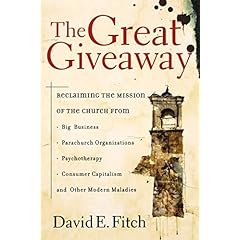
The Great Giveaway, Part 1

Standard

The Great Giveaway David E. Fitch’s The Great Giveaway: Reclaiming the Mission of the Church from Big Business, Parachurch Organizations, Psychotherapy, and Consumer Capitalism is the best Christian book I’ve read since Nancy Pearcey’s Total Truth. A fantastic primer discussing how the Church must live in a postmodern age, The Great Giveaway examines the ways the Church bowed the knee to modernism and gave away her soul. By allowing alternative scientific approaches to spirituality to trump the Gospel of Christ, the modern Church distanced itself from historic faithfulness. In keeping to this premise, The Great Giveaway does not attempt to critique postmodernism, but finds the everlasting truths of Christ and asks how they reveal themselves in this age.

If that sounds like emerging church rhetoric, trust me, it’s not. Fitch manages to step out of the emerging church versus traditional church battle and show where each is lacking. What makes The Great Giveaway better than all the books critiquing the American Church today is that Fitch not only sees the problems, he offers the best solutions I’ve encountered. (Much of what you’ve read on Cerulean Sanctum since the inception of this blog is mirrored in the pages of The Great Giveaway, so if it sounds like I’m tooting my own horn here, I’m trying to be as objective as I can under the circumstances.)

Is this a perfect book? By no means. Serious flaws spring up here and there. A couple months ago a commenter asked how I could recommend flawed books. (I had issues with some of the concepts in Randy Frazee’s two books, though I recommend them highly). I’d like to turn that around and ask what books besides the Scriptures are without flaws? Discernment, so utterly lacking in the Church today, necessitates that we read every book by every author—our favorites or not—with an eye toward error and truth. Real discernment is not blanket condemnation, but rather wrestling with ideas with the aid of the Holy Spirit and the Scriptures.

The Great Giveway features the following chapters, and I’ll deal with each in turn this week:

  1. Our Definition of Success
  2. Evangelism
  3. Leadership
  4. The Production of Experience
  5. The Preaching of the Word
  6. Our Understanding of Justice
  7. Spiritual Formation
  8. Moral Education


Our Definition of Success

Overview

Fitch begins his book with an easy target: “Megachurchianity,” as I call it. Numbers, he writes, do not translate into faithfulness. Church Growth Movement thinking owes more to business principles than Scripture. The result of working toward bigness is a consumeristic outgrowth of church that places rugged individualism and business efficiency at the core of church health rather than faithfulness to Christ. Faithful churches instead center their life in Christ and genuine community. That community is measured by real relationship with fellow believers that speaks hard truths into people’s lives, sees the need for confessing sin in a grace-filled local body, and calls on church members to partake in discerning prayer needs for each person’s life and the church as a whole.

Comments

Since most of the people who read Cerulean Sanctum agree that an obsession with numbers tends to curtail real discipleship, I have little comment. The Great Giveaway starts with an easy target and doesn’t add much to the discussion. We agree that consumerist Christianity fails. We know how megachurch religion missed the boat on every living and active part of the Church. Fitch doesn’t add much to the conversation. Think of this chapter as a touchstone for everything else that follows.


Evangelism

Overview

Fitch points out that postmodernism is the death-knell to evangelism that relies solely on apologetics. Postmoderns are not impressed by talk that does not follow walk. In fact, walk is proof of talk. Postmoderns are much more willing to listen to Bible truth when that truth is preceded with Bible walk.

Evangelical obsession with evangelistic methodology comes at the expense of real relationships with people. We’re more interested in getting someone saved than being their friend. The days of that thinking are numbered, though. What people today need to see in Christians is the actual living out of the evidence of Christ in us. This puts the evangelistic onus back on the community of believers rather than the individual. Individuals can still attest to Christ by their own life changes and Christ working through them, but the real power is in a transformed community. The early Church’s influence came about because people saw Christ in that community.

To that ends, hospitality, praying for others in need, showing mercy to those who desperately need it, and bringing justice to those without it are stronger evidences of the veracity of Christ than merely running through The Four Spiritual Laws or The Romans Road. Fitch by no means subjugates the Scriptures to experience, but instead shows that love overcomes roadblocks that enable the truth of Scripture to permeate the hardened hearts of people today. It’s the sun that melts the snow in Isaiah 55:10-11.

In an age when we in America have virtually no sense of real community, developing a worshipful community that embodies genuine relationships that alter how we live every day should fuel our evangelism. Fitch also seeks to recover the importance of our baptism into a worshipping community, stating that too much attention has been put on one singular act of conversion and not enough on the kind of long-term discipleship that Christ calls for in the Great Commission. He also sees Church planting as the healthy expression of a growing church rather than the tendency to grow into a megachurch.

Comments

We need to always be careful when someone states that God’s Word needs outside proof to be reconciled as true. Postmodernism’s obsession with avoiding absolute truth is infamous, but I don’t believe that Fitch is saying that walk makes talk true. God’s Word is true by itself. However, to a generation raised on hearing the Bible constantly—who can truly escape it in America?—but without seeing it practiced much by the Church, we need to consider how we walk out what we believe in front of others because our walk is supposed to be a reflection of the truth of the Gospel.

The failure of church bodies and individuals to live out what they believe is largely responsible for the mess we see both inside and outside our churches. Call it sin, unbelief, or laziness, but whatever the label, we blew it.

I agree with Fitch on most every comment and solution he offers in this chapter. We Christians do need to start living as an alternative community within the larger society rather than finding the church co-opting that society’s patterns of living and broken solutions to problems.

If I have one problem, I don’t believe that planting more churches is the answer. We have enough churches. Now if an existing church is growing so large that it naturally must subdivide, that’s a different response than simply planting churches. I think Fitch favors subdivision, but he doesn’t make that entirely clear when he discusses church planting.


The review of The Great Giveaway continues with Part 2 and Part 3 .
The Small Group Boondoggle

Standard

It’s hard to get away from the emphasis in some Christian circles on small groups. Just today, I was reading Brad Hightower’s excellent blog 21st Century Reformation and his post “Are the Popular Methods of Doing Church Working?” It’s a good question and good people are trying to answer it. Many of them are saying small groups are the answer, as does Brad. The bleeding edge of ecclesiology today runs red with the hope that house churches will be the salvation of the American Church.

I dunno.

We tend to forget that small groups in the church are not new. I’ve been in small groups since the 1970s. The modern roots of the small group movement predate even that time. Small group guysPsychologists of the 1950s had discussed the need for small encounter groups, but that idea didn’t express itself until the 1960s and the experimental groups of Big Sur. (The less said about them the better.)

In another attempt by Christians to co-opt what was going on in psychology circles, we started seeing a redemption of pop-psych methods by certain churches, parachurch organizations, and nationally-known Christian leaders. Who could impeach the argument that Jesus gathered twelve men around Himself? (True, yes, but that idea hadn’t been re-examined until pushed into the limelight by 1950s behavioral science.)

Since the 1960s, folks have been trumpeting the salvation of the Western Church through small groups. All I ask is this:

We’ve had 40+ years of small groups in churches, but are we any better for it?

I certainly would not say that the Christian Church in America is more devout, more mission-minded, more prayerful, or more effective for Christ now than before the small group push started. If that’s true—and I’m sure most of you reading this will agree we’re not better off—how then can we insist that small groups will somehow turn the tide in the future if they’ve failed to do so thus far?

Part of the reason I believe that small groups have resoundingly failed to deliver on their promise is that no one seems to look at them from the right perspective. We never view small groups as aiding the church as a collective body. Our model is more based on the idea that we’re helping individuals plug-in on a more granular level.

But that’s the typical Evangelical obsession with the individual. Meet the individual’s need on a very intimate level and you’ll build a wildly effective church from that core. Forty years later, that failed mentality still prevails.

We’ve got to stop viewing the world through the lens of the individual and start thinking more about the corporate Body of Christ. If small groups are not translating into a better church filled with better people, then perhaps we need to start thinking about making our entire church a small group, the whole assembled mass of people. Rather than fragmenting our assembled community into small groups, perhaps we can find ways to translate what small groups do well to an entire church.

For instance, we belong to two small groups that start their meetings with a shared meal. What if we decided that our churches would meet every week for a shared sit-down meal and serve communion at the same time? What if we made our Sunday messages open for whole church comment just like the discussions we have in small groups? What if…?

Obviously, megachurches will have some troubles with these things. But then maybe a 500-person church that acts like a small group is the better model than a 5,000 person church cookie-cuttered into 500 small groups.

All I know is that the small group model that was supposed to better our churches hasn’t. If the model’s broken, then we either fix it or dump it. Or we find a third way that considers the whole church a small group. Whatever the answer, pouring more energy into our current practice of small groups isn’t going to get us anywhere.

For more on the problem of small groups, see this previous post:  That Nutty Small Group Dialectic

Because We Can, We Should?

Standard

I'm not into today's CCM. The worship leader at our church must think me a pagan because I have a blank look on my face whenever she brings up the latest hot Christian band and their equally hot quasi-worship song that's blazing up the Christian charts. Who? What song? Let me guess; it has the same beat as all the others….

Today, I had one of those crazy days of endless errands. Oil change, allergy shots, soccer practice, a ten-item grocery list that necessitated trips to three different megagrocers just to get common items any ONE of them SHOULD have had. You know the drill. So desperate for a little spiritual refresher, I turned on the big Christian radio station in town to hear one of the afternoon teaching programs. Instead I got an earful of tedious music. 

Whither the teaching? Well, the station's booted all its teaching in favor of a non-stop music format. I guess every station wants to be just another vapid K-LOVE clone. In some corporate roundtable, station management decided to give the people what they want rather than what is best for them, thinking that 24/7/365 of the Pablum that passes for Christian music today better enlivens the masses than Ravi Zacharias talking about techniques for witnessing to Muslims.

Ugh. Maybe I'll call 'em up and request Keith Green's "You Love the World (And You're Avoiding Me)."

It's symptomatic of a gigantic problem. 

One of the most worldly concepts you'll find in our culture is this idea that "because we can, we should." Name a moral failing or a political ambition and I'll bet "because we can, we should" empowers it. Abortion and fetal tissue cultivation are the sick offspring of that thinking. You can probably come up with a million more.

Christians are not immune to this mistake. In fact, we rationalize a lot of  "because we can, we should" under the guise of redeeming things. Kids love Saturday morning cartoons? Well, let's make Christian cartoons! Your son wants an action figure? Why not give him a brand-spanking new Jesus action figure complete with a whip to drive out moneychangers and a glow-in-the-dark sword that springs out of his mouth to slay the wicked?

Almost all "Jesus junk" hatches from "because we can, we should."

Truth be told, I feel queasy walking into Christian bookstores. They're so utterly derivative and reactionary that if I were an unbeliever plunked down in one, I'd guess the first stage of being born again is losing one's sense of beauty, creativity, and charm.

Yet for all the WWJD paraphernalia floated over here from Shanghai, a more soul-killing expression of "because we can, we should" exists.

Mysecret.tv is a recent addition to the Web. Some Christian organization thought there weren't enough avenues for confession for Christians, Confession or Gossip?so because the Web exists and is (somewhat) anonymous, it's the perfect medium for confessing one's sins. 

Except it's not. Not in the slightest. Instead, Mysecret.tv stands as a warning to us all, the epitome of "because we can, we should"-ism in the American Church.  

The site raises my ire for a number of reasons:

1. It's pornography. Like some lurid afternoon TV talk show, the site parades sin as entertainment. By offering verbal voyeurism (consider the domain name), it's no different than a hardcore porn site. One click and you can read the details of someone else's failure before God. "But doesn't the Bible show great believers failing?" Sure, it does. But if anyone here's calling for adding Mysecret.tv to the canon, well….

2. It usurps the role of the local church. No doubt, Evangelicals have dropped the confessional ball. Too many Evangelical churches would rather judge than offer grace after a confession. But building a site like Mysecret.tv actually circumvents local churches improving their dealings with confession, sin, and grace. It provides a cheap excuse NOT to fix the problem in our local churches. It asks for none of the commitment inherent in a Christ-centered community, cheapening how we relate to each other in an age when real community in the church is already on its deathbed.

3. It asks for no repentance. Enough said. 

4. It offers no grace. Real grace doesn't come with a disclaimer. Jesus Christ gave us a model for how to dispense grace to the repentant. It's the church body of real people who hear confession, cry with the sinner, and offer grace by the Holy Spirit working through people. But Mysecret.tv expunges all face-to-face restorative human contact. Therefore, by removing the links in the chain of how grace should be dispensed, it offers no grace at all.

5. It offers no accountability. After people confess on Mysecret.tv, what follow-up occurs to help them work through the ramifications of their confession? None that I can see.

6. It offers no restitution. How does one walk out the end product of a confession on Mysecret.tv? Well, if nothing is asked of the people who confess on the site, then no restitution occurs. How that benefits the one confessing is beyond me. 

7. It demeans the death of Christ on the cross. If Mysecret.tv angles to be a Christian-sponsored site that takes confessions, yet offers none of the hallmarks of true Christian confession, repentance, accountability, and restitution, then it's not Christian in the slightest. That mocks the Lord.

I could name a half dozen more failings in Mysecret.tv, but its concession to "because we can, we should" speaks for itself. When considering this site's premise, it appears no one asked if it undermines everything the Church should be. They just plowed ahead and slapped it up on the Web. Alakazam, now you can confess to boinking your kid's babysitter and feel better about yourself for doing so. (And yes, all you grammar mavens, I intentionally wrote that last sentence for maximum {read ironic} ambiguity.)

Is anyone else disturbed that so much of what passes for Christianity in America displays the same hollow core as Mysecret.tv? A group sees a need in the Church, but instead of pursuing tough answers that might require a complete overhaul of how our churches live out the Gospel, they settle for the cheap and meaningless—because they can.

Cerulean Sanctum exists to find ways to better our churches and the people who comprise them. For this treason, I loathe cheap answers to the pernicious problems we face as Christians in America. I see a site like Mysecret.tv and my blood boils. When another blogger told me about the site, and I checked it out myself, my jaw dropped at the utter lack of discernment behind this online confession booth.

(If you're a regular reader of this site, you know I almost never single out a particular ministry or program for scorn. I don't like to name names because so much out there needs to improve, even on good sites. I know that Cerulean Sanctum lacks in some areas. I also know I'm not satisfied with cheap and easy.)

I pray this post gets us thinking about finding the narrow path, rather than the wide, destructive one behind "because we can, we should." Too many Christians trudge down that "because we can, we should" superhighway leaving the rest of us to wonder if we're the ones going the wrong way.

Our response to the problems of our day will cost us something precious. When we're not prepared to pay the price, we'll settle for the path of "because we can, we should."

But Jesus won't be waiting at the end of that road.