The F-World

Standard

As a musician (I'm a drummer and guitarist), I've got an ear for challenging or snappy music. As a writer, I've got an appreciation for witty or deep lyrics. It should be no surprise then that most contemporary music bores me to tears. It lacks charm, and most of it suffers from a dearth of both musicality and lyrical excellence. Doesn't matter what the genre is.

If I have any musical weakness, I'm overly fond of jangly, "sunshine" pop with monster hooks that'll have you singing along all day.  That Rickenbacker 12-string sound brings a smile to my face. Think bands like The Association, The Zombies, The Byrds, and—of course—The Monkees. Think AM radio's golden age. That style of music largely passed into lore. No one writes music like that anymore. Worse, no recent band has the cleverness to pull it off consistently.

I don't buy a whole lot of music like I once did. The last CD I purchased was Derek Webb's She Must and Shall Go Free, which has a sort of folk and roots rock feel. Good music, stunning lyrics.

The other day, I followed a link looking for some trivial fact and it led to a site that played a random selection of "baroque pop," contemporary sunshine pop music that has the feel of the real thing. The song was by Belle & Sebastian, a band I'd not heard before. Not only was the song "Another Sunny Day" absolutely right on sound-wise, but the lyrics abounded in perfect touches.

So I did something I've rarely done: I downloaded the song from iTunes. Played it over and over at full volume. For about a half hour I was immensely pleased by the find.

Only one problem…

When you get to be my age, lyrics run past you and you don't get them with the same precision you did as a teenager. I caught that first stanza, but a couple jumbled ones followed. The British accents didn't help. So being the kind of person who cannot gain full satisfaction from something without knowing every trivial detail about it, I summoned the lyrics from one of a bazillion lyrics sites.

Awesome lyrics, clever and witty. And I'm reading and…oh.

The effenheimer. The F-bomb. Right there. Third stanza. And not in any grammatical usage that I've ever encountered before.

Ugh.

How I'd missed it the first hundred times I played the song, I can't say. After seeing it there in the lyrics, it was if the singer now shouted the word right in my ears, helped along by the background chorus who repeats it with the same emphasis.

Dang. The Monkees wouldn't have talked like that. And where was the "Explicit Lyrics" tag at iTunes? Nowhere to be found. I guess in the bizarre context used in the song, someone deemed it "Non-explicit."

That's what Apple gets for cozying up to Bono. What's an F-word between friends, right?

Because I write for a living, I'm attuned to the issue of censorship. I think I can also make a case that the F-word has legitimate uses. Kevin Carter's Pulitzer-Prize-winning photoI just don't want to hear it in my sunshine pop.

In fact, I don't want to live in a fallen world. I don't want to hear the "old familiar suggestion" coming out of the mouth of a twelve-year old girl. I don't want to hear about fathers decapitating their toddlers. I want to close my ears and scream at the top of my lungs to drown out the news telling me that the sex slave trade is alive and well  in the world, mostly populated by teenagers and tweens.

But we live in a fallen world—the F-World, for want of a more clever ID. Everything around us reeks of sin, as if some quark-sized evil implanted itself in every atom in existence.

Yet consider how easily we Christians believe two lies:

  1. We can play with that evil and not have it consume us from within.
  2. We can keep that evil at bay and never have to confront it. 

I see far too many Christians making excuses for the sins they justify in their own lives. We might even come up with clever renderings of particular Scriptures to cover our shame, but in the end, it's only amplified.

Or we'll scoff at some contemporary leader we don't like who goes down in flames, while we pat our man on the back. Then we're shocked—SHOCKED—when our man's feet prove to be clay.

So many of us navigate the F-World poorly. We mindlessly jump from church to church, forever running from whatever it is that we despise in its operation, unable to come to grips with the truth that the Church must live in the F-World until Christ returns. Or we do the opposite and embrace every piece of garbage the F-World throws at us as if its manna from heaven. Both are foolish. Both come to ruination.

I hear Christians talking all the time about the F-World. Why then do we seem to be more at the mercy of the F-World than at the mercy seat of Christ? For all our theology on a fallen world, we lurch from extreme to extreme in the ways we deal with it. One day we're burning all our hard rock albums because they're evil, and the next day we're buying them all back off eBay because to the pure all things are pure. 

It's bad enough that our incoherent message on how to deal with the F-World confuses the lost, but it confuses Christians even more. I've been a Christian for thirty years and I can honestly say that I don't think I've met another Christian who understands the tension of living in the F-World to the point that he or she deals with it as Christ did. Finding that narrow path must be far more difficult than we believe.

Bunkers or Excess. In the F-World, neither one makes sense. 

{Image: Kevin Carter's Pulitzer-Prize-winning photo of a vulture stalking a starving Sudanese child. Shortly after winning the prize, Carter committed suicide.

Busting Myths About Christianity: Assessing Myths 9-10

Standard

Entering the homestretch of this series on myths believed about the American Church by those outside it, it's hard to avoid the cruel fact that several of these myths aren't myths. At one point, they may not have had one shred of truth to them at all, but something's happened to the Western Church—a very bad something. Sadly for us, those people who hold no pretenses to following Christ have noticed, yet we haven't. 

The myths: 

  1. Christians are more judgmental than non-Christians.
  2. Christians are stingier than non-Christians.
  3. Christians are more intolerant of other people than non-Christians.
  4. Christians are more short-sighted than non-Christians. 
  5. Christians don't know how to have fun. 
  6. Christians despise intellectuals more than non-Christians do.
  7. Christians prefer kitsch over important art.
  8. Christian subculture mimics the world rather than creating anything lasting.
  9. Companies run by Christians are as unethical as secular companies, and perhaps more so.
  10. Christianity causes more problems in the world than any other religion.

Today, we'll look at the final two.

9. Companies run by Christians are as unethical as secular companies, and perhaps more so

One of the most damning newspaper articles I've read in my life arrived in The Wall Street Journal shortly after the Enron and Worldcom scandals rocked the business world. In that article, the author took an in-depth look at the religious backgrounds of all the principal players in all the scandals. In nearly every case, those leaders were Evangelicals deeply involved in their churches as elders, teachers, deacons, and more.

I read that article about five times, attempting to find some way to reject what I was reading, but the truth shouted from the page.

My own personal odyssey dealing with Christian businesspeople is about as bad. When I look back on all the times I hired self-professed Christian professionals to help me resolve a problem, the number of times I got stiffed—and grossly, too, I might add—far, far, far outweighed the number of times the same happened with folks who made no pretenses to being Christians. Like 10:1.

So when I need an electrician to wire my house correctly so that the resulting "fix" doesn't burn it down, an ICHTHUS plastered on a Yellow Pages ad is my sign to hire someone else.

I hate saying that. As a Christian businessman myself, I would go sleepless for months if I knew I didn't turn in my best work. I'm a representative of Jesus Christ. My word and my work mean something deeper than putting food on the table. Doing outstanding work on every job I take is more than just the norm; it's my worship!

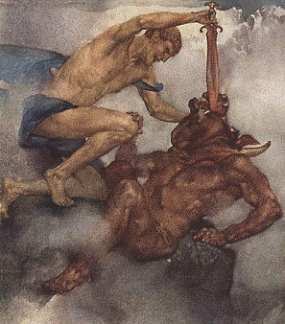
Why, then, do so many Christian businesspeople do such shoddy work—and under the guise of Christianity, too? Don't they know that's an anti-witness? Perseus slaying the MinotaurThat kind of carelessness may be the foot that stomps out the Holy Spirit, not only in the life of the businessperson, but in his or her client's life, as well.

Why does this happen? I think it may have something to do with a hyperinflated and mind-bogglingly poor notion of what grace entails. Some Christians must cover their atrocious work ethic with such a thick lacquer of "grace" that they convince themselves it will hide all the flaws. Or they're nothing more than cultural Christians, reflecting no true inner conversion, bereft of the Holy Spirit who would never let them rest for doing such poor work in the name of Christ. I have no other explanation.

At one time in history, Christians could be counted on to provide the best of every service and manufactured product available. I can't muster the historical proof to say that we're far worse now than then, but doesn't it seem like it? Sure, a real mythbuster would have the proof, but all I have is a lopsided series of encounters with Christian businesses that weighs heavily in favor of a negative assessment. That doesn't mean that millions of good Christians who would never lie, cheat, or steal from a client don't exist. But whatever the case, the scoundrels are making it tough on all of us.

So while Hebrew National Hot Dogs claims to answer to "a higher Authority," we Messiah-worshipers better do more than just answer.

Assessment: Plausible, and very likely Confirmed.

*** 

10. Christianity causes more problems in the world than any other religion

Let me make this simple: Bull.

If anything, the heritage of the Christian Church since its founding proves a history of God using believers to fashion every good we enjoy today. Anyone who believes that Christianity is more a problem than a solution long ago turned off the brain cells.

If no Church of Jesus Christ graced this planet, we would kiss goodbye…

…the majority of the world's greatest art, music, and literature.

…large portions of philosophy, science, and invention.

…nearly all charitable organizations that reach out to the least of these.

…virtually all hospitals and medical centers in the world.

…every concept of personal freedom in government.

…the hope of rescue of oppressed people everywhere.

In fact, I would guess that a world with no Church would be so hopelessly grim by now that a traveler through such an alternate Earth, if not already a Christian, would convert on the spot after returning to his Church-filled reality. And that's true of no other religion or thought system. 

For this reason, it's imperative that we Christians assess where we are today and ask if we're still making that kind of difference. If we're not on the forefront in every fruitful endeavor that Mankind enjoys, then we've failed to live as the Lord's fully redeemed people.

Our ancestors understood what Christ bought them by His blood, and they ran with that opportunity. They understood what it meant to live like wise Daniel did among the worldly, that it was more than just being pious. It meant learning! It meant expanding the horizons of what is known and what can be. Those wise men from the East called by God to visit the infant Jesus were the direct result of a godly man like Daniel who saw that serving God wasn't just a set of religious rituals separated from the whole of life.

Those Christians before us got it. Their devotion spawned countless benefits to us in every part of our lives. We can't drop the baton. To those who have been given much, much has been required.

Assessment: Couldn't be more Busted!

*** 

In the end, every single Christian in America should be a mythbuster. Too many of the myths held by unbelievers about Christianity today are shockingly closer to the truth than we care to admit. We can't continue to reinforce those myths.

If our passion for Christ is outweighed by our longing for entertainment, then we shouldn't call ourselves Christians. I'm afraid that in too many cases we're more concerned with our Tivo programming than reversing the mindset of unbelievers about the Church, and Jesus Christ, in particular. By living such worldly, meaningless lives, we only drive the lost away from their only hope.

Those Christians who gave their best to give us the science and arts we enjoy today took risks and God rewarded them. Many sinned boldly, yet loved God more boldly still. That kind of baldfaced living under grace seems foreign to us today. The modern American Church shies away from wrestling with angels. While some small-minded Christians point with pride to the fact they're not limping, it's also why so few of them go on to have their names listed among the heroes and patriarchs of the Faith. And it's why there's so little greatness in the American Church of the 21st century.

Christian, live in such a way that no myth hatched by the world applies to you.

Have a great weekend.

Entries in this series:

{Image: Perseus slaying the Minotaur

Busting Myths About Christianity: Assessing Myths 7-8

Standard

Odysseus blinding the cyclops PolyphemusOver the last week, we've been looking at commonly heard statements about Christianity that have taken on mythical proportions. It's hard  to be a Christian in the West and not encounter these myths: 

  1. Christians are more judgmental than non-Christians.
  2. Christians are stingier than non-Christians.
  3. Christians are more intolerant of other people than non-Christians.
  4. Christians are more short-sighted than non-Christians. 
  5. Christians don't know how to have fun. 
  6. Christians despise intellectuals more than non-Christians do.
  7. Christians prefer kitsch over important art.
  8. Christian subculture mimics the world rather than creating anything lasting.
  9. Companies run by Christians are as unethical as secular companies, and perhaps more so.
  10. Christianity causes more problems in the world than any other religion.

Today, we'll look at myths #7 & #8:

7. Christians prefer kitsch over important art

As the Church of Jesus Christ grew and expanded, it touched nearly every art form. The Gospel's revelation of the divinity of Christ and His human nature resulted in a synthesis that ultimately broke the back of gnostic religions. This, in turn, created an environment in which art flourished, as God's coming to Earth as Man hallowed imagery.

But while the important artists that forged the backbone of Western art identified as Christians, the 19th century saw an increasing backlash against the realism that undergirded Christian art up until that time. With the coming of German higher criticism in the late 19th century, questions about the veracity of Scripture led to questions about absolute truth. The resulting cultural decline reflected in art that deconstructed itself.

Christian artists, unable to fend off the trend, either stayed true to their art and faded into profitless obscurity, or they pandered to low culture in an attempt keep bread on the table. When modern marketing techniques raised advertising to the level of popular art, the culture rewarded ad icons. Those icons, when mass marketed, led to an even lower form of art now known as kitsch.

I suspect that the rise of fundamentalism on one side and higher criticism on the other, dealt a death blow to Christian art during the Great Depression. Fundamentalists, in an entrenchment move, lumped all contemporary art into the category of "potentially evil," and this spilled over into the Evangelical consciousness. As a reaction against the supposed judgment that fell upon this country for the Roaring Twenties, Fundamentalists pushed hard against all forms of profligacy, and art, as a whole, suffered in that wake. Art, in general, lay damned.

But God built a creative spirit into man, so that desire to create needed a channel. What it got was a version of art that combined advertising imagery with a new sanitized Christian "ideal." And popular art, especially by Christians, has not recovered.

In her seminal book, A Profound Weakness: Christians & Kitsch, Betty Spackman argues from two sides of this issue, at once decrying kitsch as poor art, while acknowledging that it can still carry meaning for Christians. More to the point, she makes a bulletproof case that much of what passes for Christian art today is more kitsch than art, and that recovering a true appreciation by Christians for more masterful art may be difficult given the current state of Christian subculture around the world.

When all of Evangelicalism in the West is considered, it's hard to escape the truth that kitsch dominates our expression. From our "His Pain, Your Gain" t-Shirts to "WWJD" jewelry to modern megachurches, Christian culture perpetuates kitsch over substantive works, the typical Christian bookstore replacing the secular museum. Worse yet, the average Christian today can rack his brain and not come up with the name of a contemporary Christian artist—with the possible exception of Thomas Kinkade.

The problem of Christians and kitsch extends to all parts of the creative life within the Church. As kitsch itself is a derivative form, so too many creative endeavors within the Christian community lack a true defining Christianity, instead adding a Christianized coating to secular forms. What a true Christian expression of the arts might look like in the 21st century is yet to be seen, but we all should hope to live long enough to witness its full blossoming.

Assessment: Confirmed

*** 

8. Christian subculture mimics the world rather than creating anything lasting

Our affinity for kitsch means Christian expression cannot avoid including it at the core of our subculture. As mentioned above, the derivative nature of kitsch means the art itself has come from some other source, itself often derivative. Christians attempting to create out of that limited pool come off as pseudo-sanctified mynah birds, rather than images of the Spirit as dove.

For this reason, contemporary Christian culture in the West lives more off a perverted form of its past than a vital present. When the Reformation is reduced to a derivative t-shirt, it's hard to argue that modern Christians care one iota about leading culture, preferring instead to be culture's dog on a leash.

Appealing to cultural relevance only worsens the problem, pulling the Church down into the world's cultural cesspool. Though not all of modern culture should be viewed at arm's length, sadly, the aspects deemed most usable by the Western Church are the ones most needful of discarding. Sure, it may be possible to erect something intriguing out of rusty tin cans, but is that redeeming the time we've been given by the Lord?

Until the Church in the West abandons its love affair with redeeming the sleaziest parts of our culture, most of what we redeem from it will be garbage. And derivative garbage, at that. Encouraging folks guided by the Lord to create new directions in culture—leading, not following—and backing their gifts wholeheartedly is our only hope.

Assessment: Confirmed 

***

Stay tuned, the final two myth assessments still to come… 

Entries in this series:

{Image: Odysseus blinding the Cyclops Polyphemus