The Jesus Love Revolution

Standard

For this very reason, make every effort to supplement your faith with virtue, and virtue with knowledge, and knowledge with self-control, and self-control with steadfastness, and steadfastness with godliness, and godliness with brotherly affection, and brotherly affection with love.
—2 Peter 1:5-7 ESV

Whenever I hear some smug sourpuss exclaim, “The word love isn’t mentioned anywhere in the Book of Acts,” I want to scream.

Why? Because the entire book is love! And not just Acts. Same goes for the other sixty-five books.

Sadly, the sourpuss understanding predominates in some of our churches. Too many Christians live as if love were the most foreign word in their vocabularies, and they’ll use any excuse not to say it, much less practice it.

This last year, if a lesson wrought in my life by the Holy Spirit has stuck more than any other, it’s this: Lead with love. Always.

And I’m not talking about tough love, because so-called tough love is the excuse of too many Christians to be tactless and self-righteous. I’m talking about this kind of love:

Greater love has no one than this, that someone lays down his life for his friends.
—John 15:13 ESV

Look who laid His life down for us, the ones He calls friends. Look who wept bitterly at the tomb of His dear friend, Lazarus. Look who purchased for Himself a Bride, a perfect, perpetual lover, one He bought with His own blood!

We sell Jesus short (and ourselves along with Him) when we give such short shrift to love.

God so loved us that He sent Jesus, whom He loved in divine fellowship with the Holy Spirit, to show us how to love perfectly. By love, Jesus served us, and died on a cross, choosing to prove His love for us and for the Father and the Spirit, by offering up His life. And from that spilled blood rose His Bride, the Church, whose entire language and practice is steeped in love.

No one had seen anything like that Bride. Jerusalem was shaken by this band of people whose first act after receiving the loving gift of the Holy Spirit was to ensure by love that none among them lacked for any good thing. That the orphan and widow, the two lowest forms of life in that society, be loved and served because God loved them beyond what any human could understand. The orphan became the child of God and the widow a bride! Because of love!

That group of believers loved so intensely they thought nothing of their own lives save that they through faith love their Lord unto death, facing a cross of their own for reaching out to anyone who did not already know their Lover. And when they flagged, their leaders roused them with these truths of love:

But God, being rich in mercy, because of the great love with which he loved us, even when we were dead in our trespasses, made us alive together with Christ—by grace you have been saved—and raised us up with him and seated us with him in the heavenly places in Christ Jesus, so that in the coming ages he might show the immeasurable riches of his grace in kindness toward us in Christ Jesus.
—Ephesians 2:4-7 ESV

See what kind of love the Father has given to us, that we should be called children of God; and so we are.
—1 John 3:1a ESV

Therefore, my brothers, whom I love and long for, my joy and crown, stand firm thus in the Lord, my beloved.
—Philippians 4:1 ESV

Put on then, as God’s chosen ones, holy and beloved, compassion, kindness, humility, meekness, and patience, bearing with one another and, if one has a complaint against another, forgiving each other; as the Lord has forgiven you, so you also must forgive. And above all these put on love, which binds everything together in perfect harmony.
—Colossians 3:12-14 ESV

And it is my prayer that your love may abound more and more, with knowledge and all discernment, so that you may approve what is excellent, and so be pure and blameless for the day of Christ,
—Philippians 1:9-10 ESV

You see, when Jesus Christ came, He brought a love revolution. The Jews were scandalized by this rabbi who loved tax collectors, whores, beggars, and even Roman scum who oppressed their nation. He loved the unlovable, and by that love forgave the unforgivable.

His birth was a sacrificial act of His own love.

His first battle with evil proved His unwavering love for the Father and for us, His mission.

His first miracle was an act of love for a couple in love.

His first public reading of the loving words of the Father attested to His love for those society deemed unlovable.
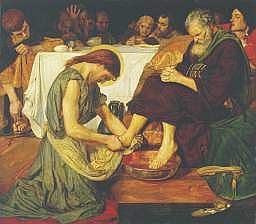
Ford Madox Brown--Jesus Washing Peter's Feet at the Last SupperHe delayed His love for a friend to show an even greater love that proved His love not only for His friend, but to His Father.

By His perfect love, His service to us was our model of love.

He only spoke the truth, and that because of His love.

Love empowered both His death and resurrection.

And when He spoke of the people He would love forever, He spoke of them as a Bride, the very image of love.

That Bride not only shocked the callous hearts of the Jews, people who had once understood the love of God (but who could not see when Love walked among them), she destroyed all pretense behind the false love shown by the pagans. For if the pagans thought they knew love through their religious sexual carnality and temple prostitution, the unblemished love Christ showed through His Bride shook their worlds. This was not a perverted love that loved only the young, strong, and beautiful, but also the old, weak, and ugly. The Church spread like wildfire through the Roman Empire, historians wrote, because the Christians loved people everyone else left to die. And an entire empire stood up and took notice.

Holiness didn’t make the rest of the world stare in amazement. No one was holier than the Pharisees. Doctrine didn’t make people wonder what this new sect was. No one knew their doctrine better than the Pharisees. When the last of the Pharisees exhaled for the final time, all their supposed holiness and doctrine amounted to not one whit of salvation wrought for the Kingdom of God.

Because they had no love.

Anyone who does not love does not know God, because God is love.
—1 John 4:8 ESV

In closing, the Bible says this:

Rather, speaking the truth in love, we are to grow up in every way into him who is the head, into Christ, from whom the whole body, joined and held together by every joint with which it is equipped, when each part is working properly, makes the body grow so that it builds itself up in love.
—Ephesians 4:15-16 ESV

He is the image of the invisible God, the firstborn of all creation. For by him all things were created, in heaven and on earth, visible and invisible, whether thrones or dominions or rulers or authorities–all things were created through him and for him. And he is before all things, and in him all things hold together. And he is the head of the body, the church. He is the beginning, the firstborn from the dead, that in everything he might be preeminent. For in him all the fullness of God was pleased to dwell….
—Colossians 1:15-19 ESV

If we are to grow up in every way into Christ, then because He is Love, our entire reason for being is to love. For if the universe is held together in Christ, He holds it together in love, because that is what He is, and that is what we are to be as well.

The Peter passage that opens this post says it all. Everything we are about as Christians culminates in love. Love is the fulfillment of what it means to follow Christ. As the Lord of Love replied when asked which command is greatest:

“The most important is, ‘Hear, O Israel: The Lord our God, the Lord is one. And you shall love the Lord your God with all your heart and with all your soul and with all your mind and with all your strength.’ The second is this: ‘You shall love your neighbor as yourself.’ There is no other commandment greater than these.”
–Mark 12:29-31 ESV

In everything, lead with love.

Always.

Snow, Wheat, Chaff

Standard

Sunday, we got our first heavy snow this winter. Usually, we have one under our belt by the start of December, but this year it took until two-thirds through January. I blame Al Gore.

As one of the worship musicians at our church, I'm compelled to make the Sunday worship. I called the worship leader and was told we were on. No time for sandbagging the pickup bed. Slip on the parka and go. Since I go in early for practice and the rest of the family comes later, I knew I'd be the only Edelen there. My wife's next car will be AWD to match my 4×4. Every car should be AWD, if you ask me.

I now live in one of those areas that mystified me as a kid tuned to school closings on the radio. "Man, those Western Brown School District kids are ALWAYS getting off, even when it's like a half-inch of snow!" was the familiar lament. I had no idea where Western Brown, Felicity Franklin or Betel Tate schools were located, but I envied the heck out of them for getting off school if a mere handful of flakes conglomerated. Now I live in one of those areas and I better understand. Twisty country roads infrequented by salt trucks and snowplows tell you all you need to know.

Five minutes from church, the snow turned to sleet. I wanted nothing more than to turn around and go back home. I can handle about two feet of snow in my 4×4 pickup, but ice remains the great equalizer. It makes everyone look stupid. Wheat

So the worship team all showed. We wondered as we looked out the church windows if it would only be us. The pastor walked in, his shoulders slumped, and he wore a sanguine, confused look. To call off the meeting or not. The ice came down. The clock hands spun.

Meet.

All told, maybe sixty out of our three hundred regular attenders showed. Twenty percent. The normal buzz that stirs right as the service started wasn't there. You could hear the echoes in the sanctuary. We were here, but it all seemed perfunctory.

From my vantage point behind the drums center stage, I couldn't help but ask if I was seeing a vision of the American Church circa 2025, when the glory days of Evangelicalism surrendered to tough times for Christians. I noted the faces in the pews and did a mental check of the 20/80 rule. Yep, the 20 percent of the church that did 80 percent of the work took up their regular positions in the pews. The faithful.

Who's left when the tough times come, when it's life-threatening to label oneself a Christian? What will your typical American megachurch look like when the penalties come down and meeting isn't as easy as it once was? Will that enormous building feel like an empty warehouse? Had it been an empty warehouse for a decade already?

Maybe we'd all flee to house churches by then, leaving behind the vast complexes that held the Starbucks and Lifeway shops, mute testament against presumption. Perhaps we checked out of Christianity altogether. It simply got too hard. We'd have to give up so much. Everything we worked for years for. Renounce and keep.

Or stay true to Christ and kiss the earthly goodbye. Make the choice. Now.

But this morning, snow explained the thinning. Stole some of the vibrancy, too, I think. If persecution, and not weather, faced us, I wondered if we'd be excited. The underground Chinese Church gets cited for its powerful testimony amid persecution. Could that be us, too, in the same circumstance, our faces beaming? If the sword replaced snow?

You've got to wonder who would fall away, who would betray the remnant, and who would instead die by the sword, the name of Jesus on their lips. The martyrs. Wheat.

It's so easy to be chaff.

21st Century American Evangelicalism: The Ne Plus Ultra of Christianity?

Standard

Out of Ur posed an intriguing question a few weeks ago. I intended on writing about it, but time got away from me. Since then, that post, "Have We Become Crypto-Christians?," has taken on a life of its own in the Godblogosphere. I've encountered it at a dozen or more sites.

The setup of the post follows the rise of Christianity in 16th century Japan and its subsequent brutal extermination by warlords. To survive, the handful of Christians who remained hid their faith and practice within Japanese culture so well that when Japan re-opened to the West in the late 19th century, that tiny remnant still remained. However, the centuries of dalliance with the culture had so metamorphosed the faith of those Japanese Christians that missionaries barely recognized it for what it was. This Crypto-Christianity, as it was called, bore little resemblance to orthodox Christianity.

It's a good story. Makes for an obvious warning, too.

But there's a problem.

Any scientist worth his PhD will tell you that an experiment is only as good as its control. Without a control in place, results can't be measured accurately.

For centuries, the idea that life sprang from non-living matter (spontaneous generation) ruled science. Put a piece of bread in a container and miraculously fungi would arise from within it. Where did the fungi come from? They spontaneously generated from the bread.

Obviously, any science devoted to studying biological systems would be hampered by this erroneous notion. That it took until the middle of the 19th century to finally lay it to rest showed the intractability of disproving it. Only through a well-conceived experiment (by a young Louis Pasteur) and a proper control could valid conclusions be drawn. Heat a flask with an ingenious S-shaped trap in its neck (to let in air, but trap external airborne microbes) and compare it against a flask without the trap. The first remained sterile, while the other allowed airborne microbes to settle, giving rise to life.

The problem with the Crypto-Christianity post and its troubling question of altered Christianity is the same that bedeviled scientists searching to disprove spontaneous generation: no proper control existed.

When missionaries returned to Japan in the late 19th century, were they the control? Was their Christianity the pure unadulterated form practiced by the first century Church?

Hardly. 

While this does not mean they had no ability to say that Crypto-Christians of Japan practiced an aberrant form of Christianity, their ability to judge was severely limited by their own conceit that they alone were practicing the pure Faith.

We Americans suffer from this delusion that we are the pinnacle of any particular cultural expression seen as worthwhile. Elliot Erwitt's "Felix, Gladys, and Rover" - 1974It's the very backbone of the concept of "The Ugly American." And we show few signs of abandoning this delusion.

Because the Church in America is made up of Americans steeped in this mentality, Christians here act is if we're the control for all of Christianity worldwide. Nowhere is this conceit more grounded than in Evangelicalism. For Evangelicals go to great lengths to assert their superiority over the rest of the American Christendom, creating a king-of-the-hill bravado. Needless to say, this not only bothers other Christian sects worldwide, but even other Evangelicals outside of America.

So we consider ourselves the control portion of the experiment. Any results we gain from any experiment in the Faith must be measured against us.

Does that bother anyone else? I'm livid over it, frankly, because it's so inherently self-centered. Not only this, but the tendency is to denigrate the Christians who came before us, as if they were practicing a kind of Preschool of the Faith. They were the devolved Australopithecines and us the fully realized Homo Sapiens. As such, they have nothing to teach us.

Oversimplification? Stay with me.

Let's consider Protestantism, especially those sects within it that trace their founding to the Reformation. When we encounter doctrinal discussions within those sects, it's as if a vast amnesia occurred between the time the Apostle John drew his last breath and Martin Luther pounded his 95 Theses to the cathedral door. Sure, a few councils dealt with Pelagianism and Sebellianism and a few other -isms, but for the most part, the Roman Catholic Church ruled for a thousand years, and we all know NOTHING of any theological worth happened in that millennium.

Mark Lauterbach recently posted excellent insights into this theological blindness. He decided to break the artificial barrier of the Reformation by reading many of the earlier Church fathers. In particular, he notes that Athanasius teaches using metanarrative and avoids the individualism we inherently lay over the Gospel message. Mark ends his post with a warning from C.S. Lewis to avoid reading these great men of God through any of our contemporary lenses lest we warp their teaching to fit our own.

Which is what we do all too easily.

In the end, the battle here resembles the one between the Chihuahua and the Great Dane over who is the real Canis lupus familiaris. When seen from the outside, neither looks much like the original dog they descended from.

Yet we American Evangelicals have these blinders on prevent us from considering that perhaps we are not the ne plus ultra of Christian expression. If we actually encountered a real first century Church practicing within our midst, I would say that many of us would consider it deviant. Not so? Look how easily some of us attack other Evangelicals who contend they're trying to get back to that first century ideal.

Have we become Crypto-Christians? I'd say that long slide toward some level of cryptic faith started just a few years after  Pentecost. The question of what is normative is a difficult one because culture intrudes so easily, especially in practice. Just witness the extremes of practice within orthodox Christianity today and ask why they deviate so wildly.

In the end, the question is a red herring. We American Evangelicals already are and probably have been Crypto-Christians for a very long time. Yet somehow, we continue to think of ourselves as the standard by which all Christianity is measured, both past and future.

Is that a Chihuahua I hear yapping?

{Image: Elliott Erwitt's classic Felix, Gladys, and Rover, 1974