
Fumbling the Torch

Standard

Our television died last weekend.

My parents had a 70’s-era Sony for 25 years. Our JVC lasted only 11. Bought it for my wife when we were engaged. (The vacuum my parents bought us for our wedding croaked this last summer. Thankfully, the marriage still holds up.)

Toward the end of our TV’s life, the favored fix for its tendency to scrunch the entire image down to a line a quarter-inch thick across the middle of the screen consisted of an authoritative whack to its cabinet. Kapow! and the picture would balloon to normal size. Over the last six months, it resembled a speed bag more than a television. Last Saturday, no amount of throttling on my part could bring it back.

Given that a new television compliant with the FCC-mandated digital requirements will set us back a minimum of $750, we may simply have to do without. It’s just the way things are right now.

Though I wish things were not that way, my television viewing’s fallen off to a limit approaching zero since The X-Files went off the air, anyway. Back during its network run, I taped nearly every episode, my devotion to the show evident in my inability to participate in any event that coincided with it, for fear some drunk would crash into a power line somewhere and erasing my carefully crafted programming of the VCR. That, of course, didn’t happen—except on the one night I had no choice but attend an event. The episode in question just so happened to be the infamous inbred family one, which FOX elected never to run again. Ever. Of course.

But that slavish devotion taught me never again to surrender time to TV. I haven’t followed anything since and probably never will.

(Readers: “So, Dan, where does this boring intro actually lead?”)

Imagine a campfire on the plains of Palestine circa 200 AD. A dozen people gather ’round its warmth, trading stories. At one point, the elder of the group stands up and tells of Jesus, His ways, and how those ways became the ways of their people. He talks for an hour, while the younger ones trade questions with him, learning, absorbing. Tomorrow night, the conversation will be similar, but varied enough to take others to a fractionally deeper place than the night before. The faces might be different this night, the main storyteller another of the wise ones, but what lingers in the cooling night air contains the same truth, the same life-giving wisdom.

On some nights, stories surrender to music. But the music doesn’t jar with the oral traditions. No, it reinforces truth, resembling what was taught and told, only in words set to rhythm and melody.

Night after night, this is how it unfolds for those people. This is their entertainment and their revelation.

My parents’ generation was the first to adopt television. I will argue that theirs was the first with a soundtrack from cradle to grave, too. They embodied the first completely media-savvy generation.

And for that reason, my generation got ripped off. My son’s generation will be, also. And his son’s.

Media stole the passed torch. It distracted those who came before us from their primary duty of ensuring the wisdom of the ages survived into the next generation. Whatever that wisdom may have been, that generation preferred the dull gray light of a cathode ray tube, or the voice of a box of transistors, to passing on the only things worth saving.

In time, their newly adopted habits combined with the islandization of the cities and the suburbs to destroy community as known by the denizens of Palestine 200AD. Work habits changed, and employment moved far from home. Every day. Connections withered. Who we were supposed to be in our souls got lost amid The Honeymooners and Little Richard.

My entire twenties consisted of the relentless drone of young Christians around me repeating the the same mantra over and over: “I wish I could find a mentor.” Sorry, but the mentor couldn’t pry himself away from Charlie’s Angels.

But who could blame him? He slaved in an office in some nondescript tower of glass and steel all day, had no one pouring life back into him, so what did he have to give at the end of the day? Better just to tune into Laugh In and tune out for an hour or two than to step out of the cultural programming and back into something older and more lasting.

I look around today and can’t help but think it’s infinitely worse. Cruise the Godblogosphere long enough and it seems like everyone’s glued to a 50″ plasma display OR an iPod OR a PS3 OR the two dozen flicks at the multiplex OR some pointless Internet distraction. Meanwhile, the next generation’s holding out their hands, dying for what little got passed on to us.

So the threads of tradition thin and weaken. Trivia replaces wisdom. Words lose to throwaway images.

Meanwhile, the thief breaks in to steal and destroy. And he plunders the entire house because the homeowner couldn’t pry his attention away from Lost or American Idol or 24 or some other pointless entertainment guaranteed to burn on Judgment Day.

Hey, I know that’s a tough word, folks, but we’re fiddling while America burns. It’s one thing for Christians to be culturally-savvy in cultural distinctives that last for generations, but quite another to be so enamored of pop-cultural artifacts that won’t stand up to a decade’s time.

If the best we can give our kids when they move away from home is the complete DVD collection of The Office or our Radiohead box-set, how is Jesus going to get a word in edge-wise?

But He’s Jesus, right? He’ll find a way to compete!

Can we hear ourselves? What life is going to flow into those kids? And into their kids?

My generation got mugged on the way to “maturity.” My parents did a decent job and were good people, but they still suffered from media distractions. They fell prey to disconnection and fractured community. My mother’s generational wisdom should’ve fed me, but by the time I realized I needed it, she was too far gone to help. And I didn’t know I needed it because I was too lost in my own media-driven stupor. Because the generation before me was, too. It was all I knew.

In the end, the torch I should be passing on to my child resembles a paper matchstick.

All that wisdom—gone. When my parent’s generation dies off entirely, so goes heritage, at least for many like me. We won’t remember all the second and third cousins. We won’t know how Christ changed that one great-uncle. Those salvation stories won’t be repeated around campfires any longer. The Bible passages that changed a generation will retreat into the book, to be remembered no more. And the hard-earned wisdom gained through decades of walking with Christ will blow away like dust along with the folks who learned it through bloody prayer, but took it to their graves.

What a grievous loss!

I wish we could grab our old people by the lapels and beg, “Don’t die before you instill in us what you learned about Christ. If you’ve been to the secret places, show us how to get there, too!” Don’t leave our generation to reflect on what might have been!

You know what I wish more of us did on Sunday? Rather than the same old, same old, why not begin a quarterly recollection Sunday (and center it around a full church meal and communion), where people tell stories of how Jesus changed their lives. How He came through and led out of the darkness. Have our kids hear those stories from people besides us for a change. Show them the relevancy of Christ from one generation to the next. And please God, send the fire on us so those stories burn with miracles and deliverance and the kind of supernatural power that proves to the next generation that “Awesome God” isn’t just a tired old song on the radio.


Because that’s the kind of thinking we must resurrect if the generation that follows us is going to have any sense of purpose and history to pass on to their children.

{Image: Rembrandt—Jacob Blessing the Children of Joseph, 1656}

Does God Help Those Who Help Themselves?

Standard

I waited patiently for the LORD; he inclined to me and heard my cry.
—Psalms 40:1 ESV

Franklin said it, I believe it, that settles it!For more than a decade, I’ve been praying about an issue in my life. It’s not a sin issue, but a general guidance question troubling me. In some ways, it extends back to my youth.
The number of counselors who’ve added their advice to the problem increases over time, but the one similarity in all their counsel comes down to the old aphorism attributed to Ben Franklin, “God helps those who help themselves.”

I don’t know what it is about American Christianity that forces every Christian to abide by this rule. Our collective “doing” fervor spills over into the way we live out our faith, as if waiting isn’t just the hardest part—it’s simply stupid.

One of the most neglected verses in American Christendom states:

Unless the LORD builds the house, those who build it labor in vain. Unless the LORD watches over the city, the watchman stays awake in vain.
—Psalms 127:1 ESV

We bristle at the notion that we can’t do it ourselves. Yet look around at the expediency that passes for ministry in large swaths of the American Church and you’ll spy plenty of ministry projects in which the ministry built the house, God having little say in the construction. People will ooh and aah at the pretty thing that arose from nothing. Perhaps years later, the same folks will wonder why the pretty thing failed miserably.

Jesus said this:

“Truly, truly, I say to you, the Son can do nothing of his own accord, but only what he sees the Father doing. For whatever the Father does, that the Son does likewise.”
—John 5:19 ESV

An uncommon principle in American Christianity, that we should do nothing unless we see the Lord leading. I wonder what Christianity in this country would look like if we did nothing except what we saw the Father doing? Might this not transform every aspect of how we live the Faith?

I’ve talked out my own issue with some well-known ministries and their response always concerns me doing something, anything, so long as I’m doing. Doesn’t matter if the Lord’s building the house or not. Just do. Because it’s how they operate their own ministry.

Talk to leaders in Third World countries, though, and they wait until the Lord moves. This idea of “God can’t steer a parked car” doesn’t exist in their Christian playbook. They seek God until he makes a way where there is no way. They don’t go around trying to dynamite doorways out of granite just to be doing something.

Of course, my encounters with these do, do, doers of the word always leaves me wondering if I’m the one in the wrong. But then I read passages like this and I wonder:

“…apart from me you can do nothing.”
—John 15:5b ESV

Now I know that the LORD saves his anointed; he will answer him from his holy heaven with the saving might of his right hand. Some trust in chariots and some in horses, but we trust in the name of the LORD our God.
—Psalms 20:6-7 ESV

There is a way that seems right to a man, but its end is the way to death.
—Proverbs 16:25 ESV

I also wonder if the doing zealots actually foul it up for those of us who wait—and vice versa. We’re the spanner in the works. Get us slothful waiters out of the way and maybe others could actually accomplish marvelous works for God the good, old-fashioned, American way.

I may be the nutjob here, but no way exists to avoid a verse like this:

Thus says the LORD: “Cursed is the man who trusts in man and makes flesh his strength, whose heart turns away from the LORD.
—Jeremiah 17:5 ESV

Go the arm of flesh route one too many times and the inevitable falling away occurs. And perhaps that’s the problem with the Church today. Too much dependence on singing Old Blue Eyes’ classic tune, “My Way,” got us into this jam.

Or maybe it’s just me.

Speaking the Truth…in LOVE!

Standard

Rather, speaking the truth in love, we are to grow up in every way into him who is the head, into Christ…
—Ephesians 4:15 ESV

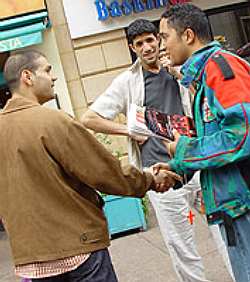
It’s one thing to speak truth. Any dimestore prophet standing on a streetcorner in an urban jungle can speak truth. That deranged guy shoving his poetry—only $2.00—in your face as you walk down the sidewalk can spout truth. Speaking the truth in loveA club-tie-wearing teacher commanding the front of a pasty-white classroom in an exclusive private school in Chevy Chase, Maryland, can instill truth. That young Hispanic lieutenant who saw the military as his way out of the barrio can yell truth at his soldiers.

You, me, our children—any of us can spew, whisper, and scream truth.

But only Christians speak truth in love. Because we know Love.

Which is why there’s no excuse for Christians to speak unlovingly to anyone. We do not speak fear, because in love, there is no fear.

God ordains that love be the envelope that holds His treasured words when we speak truth to others. When we preach, our message is love and our delivery is, too.

And when we confront error, it is not in anger, but in love. We rebuke lovingly, humbly, and gently:

Brothers, if anyone is caught in any transgression, you who are spiritual should restore him in a spirit of gentleness. Keep watch on yourself, lest you too be tempted.
—Galatians 6:1 ESV

Lest you too be tempted. Because we are dust.

The mature understand this. The immature rail and accuse, showing no love, no humility. No image of Christ, into whom we are to grow.

Paul again:

For you were called to freedom, brothers. Only do not use your freedom as an opportunity for the flesh, but through love serve one another. For the whole law is fulfilled in one word: “You shall love your neighbor as yourself.” But if you bite and devour one another, watch out that you are not consumed by one another.
—Galatians 5:13-15 ESV

How easily we fall into biting and devouring. Even now ministries composed of misguided people gnash and consume in an attempt to one-up each other in their mastery of what they believe to be truth. And it brings disgrace upon the name of Christ. Because there is no love in it at all. One side may very well be correct in their understanding, while the other succumbs to mistaken notions. However, everyone is at fault when love gets trampled underfoot, because love is the ultimate expression of what it means to walk in Christian maturity:

His divine power has granted to us all things that pertain to life and godliness, through the knowledge of him who called us to his own glory and excellence, by which he has granted to us his precious and very great promises, so that through them you may become partakers of the divine nature, having escaped from the corruption that is in the world because of sinful desire. For this very reason, make every effort to supplement your faith with virtue, and virtue with knowledge, and knowledge with self-control, and self-control with steadfastness, and steadfastness with godliness, and godliness with brotherly affection, and brotherly affection with love. For if these qualities are yours and are increasing, they keep you from being ineffective or unfruitful in the knowledge of our Lord Jesus Christ.
—2 Peter 1:3-8 ESV

The culmination of a God-pleasing lifestyle? Love. All those other godly traits serve as the bedrock upon which love rests.

I knew a man unlike any I’ve met. Gifts of the Spirit flowed out of him like water. But more than the power by which he ministered in Christ’s name, he loved. No person he encountered proved unworthy of his love. He gave love to everyone, no matter how small or important. And because his love flowed so readily into other people’s love-starved lives, when he spoke truth, people listened. He’d earned the right to be heard because he led with love. Even when he corrected others, they listened and obeyed because he’d already won their respect and admiration because he loved before all else.

When someone speaks hard-to-bear truth to you, would you rather they lead with love or lead with accusations?

I believe one of the most under-lived truths of the Scriptures today comes from an all too familiar Scripture:

And as you wish that others would do to you, do so to them.
—Luke 6:31 ESV

When we must hear truth, how do we wish it delivered? If we say, “With love,” do we speak truth to others the same way? Or do we bludgeon sinners and opponents, only to expect they use kid gloves with us?

It feels miserable to be on the receiving end of a tirade, doesn’t it? Tongue-lashings hurt, but they’re simple to yell, aren’t they? Any loudmouth can shout truth in our faces.

But to deliver a message in love isn’t easy. It demands we actually care in tangible ways for the people we speak truth to. It costs us something. It asks for genuine relationship. It means reaching out as one human to another.

And the greater truth of speaking the truth in love is the only person fully qualified to speak truth to another person is the one who fulfills this Scripture:

Greater love has no one than this, that someone lays down his life for his friends.
—John 15:13 ESV

If we’re not prepared to die for the people we speak truth to, then we should let others less infatuated with their own lives speak it instead.

Humbling. Speaking the truth comes with a price. When we fail to love before we speak truth, we come under the condemnation of the Golden Rule. We have not loved, therefore we should not expect love in return:

For with the judgment you pronounce you will be judged, and with the measure you use it will be measured to you.
—Matthew 7:2 ESV

Angry accusations beget angry replies. Biting. Devouring. And our anger burns hotter.

Here is truth:

We love because he first loved us. If anyone says, “I love God,” and hates his brother, he is a liar; for he who does not love his brother whom he has seen cannot love God whom he has not seen. And this commandment we have from him: whoever loves God must also love his brother.
—1 John 4:19-21 ESV

Nothing we do in the name of Christ comes apart from Him. Without Him we can do nothing. So when we minister out of any spirit other than love, we minister out of the flesh. The words we then speak scorch like strange fire, not the sweet, life-giving warmth of the Spirit. We Christians cannot say we love God if we do not love our brothers and sisters. Loving them means speaking truth. And the only way to speak truth is in love.

It’s costly. It’s demanding. It takes work. It asks the Spirit to blast away our easy, fleshly responses. Yet it speaks life, the very Spirit of our Lord.