
Does God Help Those Who Help Themselves?

Standard

I waited patiently for the LORD; he inclined to me and heard my cry.
—Psalms 40:1 ESV
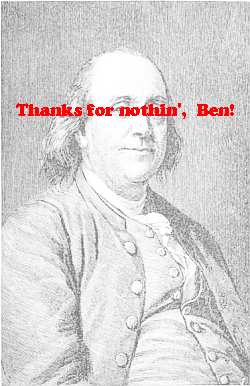
Franklin said it, I believe it, that settles it!For more than a decade, I’ve been praying about an issue in my life. It’s not a sin issue, but a general guidance question troubling me. In some ways, it extends back to my youth.

The number of counselors who’ve added their advice to the problem increases over time, but the one similarity in all their counsel comes down to the old aphorism attributed to Ben Franklin, “God helps those who help themselves.”

I don’t know what it is about American Christianity that forces every Christian to abide by this rule. Our collective “doing” fervor spills over into the way we live out our faith, as if waiting isn’t just the hardest part—it’s simply stupid.

One of the most neglected verses in American Christendom states:

Unless the LORD builds the house, those who build it labor in vain. Unless the LORD watches over the city, the watchman stays awake in vain.
—Psalms 127:1 ESV

We bristle at the notion that we can’t do it ourselves. Yet look around at the expediency that passes for ministry in large swaths of the American Church and you’ll spy plenty of ministry projects in which the ministry built the house, God having little say in the construction. People will ooh and aah at the pretty thing that arose from nothing. Perhaps years later, the same folks will wonder why the pretty thing failed miserably.

Jesus said this:

“Truly, truly, I say to you, the Son can do nothing of his own accord, but only what he sees the Father doing. For whatever the Father does, that the Son does likewise.”
—John 5:19 ESV

An uncommon principle in American Christianity, that we should do nothing unless we see the Lord leading. I wonder what Christianity in this country would look like if we did nothing except what we saw the Father doing? Might this not transform every aspect of how we live the Faith?

I’ve talked out my own issue with some well-known ministries and their response always concerns me doing something, anything, so long as I’m doing. Doesn’t matter if the Lord’s building the house or not. Just do. Because it’s how they operate their own ministry.

Talk to leaders in Third World countries, though, and they wait until the Lord moves. This idea of “God can’t steer a parked car” doesn’t exist in their Christian playbook. They seek God until he makes a way where there is no way. They don’t go around trying to dynamite doorways out of granite just to be doing something.

Of course, my encounters with these do, do, doers of the word always leaves me wondering if I’m the one in the wrong. But then I read passages like this and I wonder:

“…apart from me you can do nothing.”
—John 15:5b ESV

Now I know that the LORD saves his anointed; he will answer him from his holy heaven with the saving might of his right hand. Some trust in chariots and some in horses, but we trust in the name of the LORD our God.
—Psalms 20:6-7 ESV

There is a way that seems right to a man, but its end is the way to death.
—Proverbs 16:25 ESV

I also wonder if the doing zealots actually foul it up for those of us who wait—and vice versa. We’re the spanner in the works. Get us slothful waiters out of the way and maybe others could actually accomplish marvelous works for God the good, old-fashioned, American way.

I may be the nutjob here, but no way exists to avoid a verse like this:

Thus says the LORD: “Cursed is the man who trusts in man and makes flesh his strength, whose heart turns away from the LORD.
—Jeremiah 17:5 ESV

Go the arm of flesh route one too many times and the inevitable falling away occurs. And perhaps that’s the problem with the Church today. Too much dependence on singing Old Blue Eyes’ classic tune, “My Way,” got us into this jam.

Or maybe it’s just me.

When the Spirit Falls

Standard

This last Sunday, I was helming the drums during a worship song our lead guitarist had written, when the Holy Spirit fell on the church. His presence was palpable and from my spot on stage, I could see Him on people’s faces. By the time we segued into “The Beauty of Simplicity,” I was close to weeping. Let me say this: When you’re the timekeeper, it’s not wise to go all to pieces.

Come, Holy Spirit!Now I know some people reading this may not have experienced one of those beautifully sweet times when the Holy Spirit broods over worship. He’s light permeating the darkest recesses of your soul, warm oil anointing your head, and love overflowing your heart. No words fully describe the naked encounter of your person with the person of the Holy Spirit.

I attend a pentecostal church, so this experience of the Spirit isn’t out of the ordinary. I feel for folks who don’t regularly encounter Him. I can’t imagine living one’s life and not meeting the Lord in such a sweet way, surrounded by others who praise His name.

I’m no pushover for emotionalism, either. Anyone reading this blog long enough knows I don’t stand for that. If I’m overwhelmed, it’s because God Himself showed up, not because some favorite worship song tugs my heartstrings.

Sunday’s touch proved to be the real deal. I’d only wished I’d been better prepared to receive instead of dedicating so much brain power to each timekeeping limb and upcoming musical transitions.

If one thing troubles me about these visitations of the Spirit it’s that we may be wasting them. I don’t believe He comes just to make us feel warm and fuzzy for a few minutes.

When the Spirit falls, I believe we need to be ready to meet Him just like the five wise virgins, with lamps filled with oil and wicks trimmed. His real Presence must be met with ready hearts, otherwise I believe we miss the fullness of the blessing He’s prepared to lavish on us.

I won’t presume to understand the heart of the Spirit in all His manifestations, for He blows as He wills, but I feel He expects the following from us when we encounter Him:

  • Repentance – First and foremost, He is the Holy Spirit. We are to be a holy people.
  • Praise – He is Lord and must be worshiped as such.
  • Reception – We are to receive Him and receive blessings from Him with praise.
  • Transformation – We are to be bettered for having met Him in that moment.

For these reasons, I believe when we encounter the Lord in this way we should do the following:

  • Confess any known sin.
  • Ask the Spirit to search our hearts for hidden sin.
  • Confess hidden sin when He reveals it.
  • Praise Him for revealing sin in our lives.
  • Praise Him for who He is.
  • Ask Him to prepare us for what we might receive from Him.
  • Ask Him to fill us with Himself, His gifts, and His direction.
  • Thank Him for meeting those needs.
  • Ask Him to transform our lives so that we are better able to serve him, so we leave the church with a greater revelation of Him to share with the community of faith and those still outside the flock.
  • Thank Him and praise Him again.

I think if we take these ten steps in the presence of the Lord, He’ll bless us so much more than if we simply bask in Him then leave unchanged after the encounter. And all too often, we walk out those church doors with less than we ought simply because we did not know how to come before Him.

Think about these things. Like Samuel, if we desire to grow up into the fullness of service the Lord asks of us, we must be ready to meet the Spirit when He comes calling.

Be blessed.

21st Century American Evangelicalism: The Ne Plus Ultra of Christianity?

Standard

Out of Ur posed an intriguing question a few weeks ago. I intended on writing about it, but time got away from me. Since then, that post, "Have We Become Crypto-Christians?," has taken on a life of its own in the Godblogosphere. I've encountered it at a dozen or more sites.

The setup of the post follows the rise of Christianity in 16th century Japan and its subsequent brutal extermination by warlords. To survive, the handful of Christians who remained hid their faith and practice within Japanese culture so well that when Japan re-opened to the West in the late 19th century, that tiny remnant still remained. However, the centuries of dalliance with the culture had so metamorphosed the faith of those Japanese Christians that missionaries barely recognized it for what it was. This Crypto-Christianity, as it was called, bore little resemblance to orthodox Christianity.

It's a good story. Makes for an obvious warning, too.

But there's a problem.

Any scientist worth his PhD will tell you that an experiment is only as good as its control. Without a control in place, results can't be measured accurately.

For centuries, the idea that life sprang from non-living matter (spontaneous generation) ruled science. Put a piece of bread in a container and miraculously fungi would arise from within it. Where did the fungi come from? They spontaneously generated from the bread.

Obviously, any science devoted to studying biological systems would be hampered by this erroneous notion. That it took until the middle of the 19th century to finally lay it to rest showed the intractability of disproving it. Only through a well-conceived experiment (by a young Louis Pasteur) and a proper control could valid conclusions be drawn. Heat a flask with an ingenious S-shaped trap in its neck (to let in air, but trap external airborne microbes) and compare it against a flask without the trap. The first remained sterile, while the other allowed airborne microbes to settle, giving rise to life.

The problem with the Crypto-Christianity post and its troubling question of altered Christianity is the same that bedeviled scientists searching to disprove spontaneous generation: no proper control existed.

When missionaries returned to Japan in the late 19th century, were they the control? Was their Christianity the pure unadulterated form practiced by the first century Church?

Hardly. 

While this does not mean they had no ability to say that Crypto-Christians of Japan practiced an aberrant form of Christianity, their ability to judge was severely limited by their own conceit that they alone were practicing the pure Faith.

We Americans suffer from this delusion that we are the pinnacle of any particular cultural expression seen as worthwhile. Elliot Erwitt's "Felix, Gladys, and Rover" - 1974It's the very backbone of the concept of "The Ugly American." And we show few signs of abandoning this delusion.

Because the Church in America is made up of Americans steeped in this mentality, Christians here act is if we're the control for all of Christianity worldwide. Nowhere is this conceit more grounded than in Evangelicalism. For Evangelicals go to great lengths to assert their superiority over the rest of the American Christendom, creating a king-of-the-hill bravado. Needless to say, this not only bothers other Christian sects worldwide, but even other Evangelicals outside of America.

So we consider ourselves the control portion of the experiment. Any results we gain from any experiment in the Faith must be measured against us.

Does that bother anyone else? I'm livid over it, frankly, because it's so inherently self-centered. Not only this, but the tendency is to denigrate the Christians who came before us, as if they were practicing a kind of Preschool of the Faith. They were the devolved Australopithecines and us the fully realized Homo Sapiens. As such, they have nothing to teach us.

Oversimplification? Stay with me.

Let's consider Protestantism, especially those sects within it that trace their founding to the Reformation. When we encounter doctrinal discussions within those sects, it's as if a vast amnesia occurred between the time the Apostle John drew his last breath and Martin Luther pounded his 95 Theses to the cathedral door. Sure, a few councils dealt with Pelagianism and Sebellianism and a few other -isms, but for the most part, the Roman Catholic Church ruled for a thousand years, and we all know NOTHING of any theological worth happened in that millennium.

Mark Lauterbach recently posted excellent insights into this theological blindness. He decided to break the artificial barrier of the Reformation by reading many of the earlier Church fathers. In particular, he notes that Athanasius teaches using metanarrative and avoids the individualism we inherently lay over the Gospel message. Mark ends his post with a warning from C.S. Lewis to avoid reading these great men of God through any of our contemporary lenses lest we warp their teaching to fit our own.

Which is what we do all too easily.

In the end, the battle here resembles the one between the Chihuahua and the Great Dane over who is the real Canis lupus familiaris. When seen from the outside, neither looks much like the original dog they descended from.

Yet we American Evangelicals have these blinders on prevent us from considering that perhaps we are not the ne plus ultra of Christian expression. If we actually encountered a real first century Church practicing within our midst, I would say that many of us would consider it deviant. Not so? Look how easily some of us attack other Evangelicals who contend they're trying to get back to that first century ideal.

Have we become Crypto-Christians? I'd say that long slide toward some level of cryptic faith started just a few years after  Pentecost. The question of what is normative is a difficult one because culture intrudes so easily, especially in practice. Just witness the extremes of practice within orthodox Christianity today and ask why they deviate so wildly.

In the end, the question is a red herring. We American Evangelicals already are and probably have been Crypto-Christians for a very long time. Yet somehow, we continue to think of ourselves as the standard by which all Christianity is measured, both past and future.

Is that a Chihuahua I hear yapping?

{Image: Elliott Erwitt's classic Felix, Gladys, and Rover, 1974