A Hodgepodge of Thoughts on This July Fourth

Standard

Some things rolling around in my head:

Now that the business series is over, I’ll be the first to admit that a few things got left out. I should’ve talked more about the loss of rites of passage within the Church after the economy shifted from agricultural to industrial. I also did not go into detail about how individual Christians can further their careers by playing the business world’s game while not being destroyed by it. I’ll admit that as the series went on, my conclusions there became more grave and I felt I needed to back off, so this omission on that one issue was intentional. There are several Christian Web sites out there with those talking points, but honestly, they seem to me to be mouthing the same old same old that has not made one dent in a real Christian presence at the heart of business. Like I said in the series: you can gold plate a 1975 AMC Pacer and it’s still a lousy car.

I think our answers must be more radical. Even now I’m reading a book called Better Off: Flipping the Switch on Technology, and while the author is clueless as to the religious reasons that people abandon the hectic post-industrial lifestyle we have created for ourselves, his book does show the pervasiveness of healthy community found in those groups that have dropped out of the 21st century rat race. 'Miami' by Alex MacLeanI’m not entirely through the book, but I’ve already got a knot in my chest because he’s talking about the same deep need that I am for real community.

We invited some of our neighbors over a couple weekends ago for an impromptu hanging out in our backyard. No real plan. We supplied all the food and we just chatted as the sun went down. I hope that we can develop truly deep friendships with our neighbors, but I am unsure if it will ever live up to what I imagine it can be.

People are too isolated into little islands. If we can’t rely on the communities we form around us, then we are lost as a civilization. And I’m not just talking about a nod here and a wave there; we need to shoulder each other’s burdens in a way that we are simply not doing. The result over our isolation is overburdened lives completely stretched and stressed to the max. God did not make us to live that way. Should we wonder why so many people founder in it?

Maybe we’ve done it all wrong. The amount of money I pay in insurance alone is criminal, but I’m probably underinsured compared with most people. I spend money to make sure nothing happens to my stuff, to my wife, to my child, or to me. Almost every insurance man I know is a backbone in his church. We talk about wise stewardship of the things God has given us, for sure, but what if our insurance was meant to come from the community of Christ instead? Should my house burned down, what if it was that community—a community that lived directly around me comprised of the saints of God—that shouldered that burden with me. And what if I shouldered theirs? Doesn’t that make so much more sense than what we have now?

We reach out through copper wire and satellite feeds and spill our thoughts into the ether about this and that, but is that community? In my soul, it just doesn’t feel like the same kind of thing I get when my neighbor walks over with a newspaper clipping about a used book sale she thought would appeal to me. If I need a wrench, do I buy it from the Internet, or do I walk over to my neighbor’s and borrow one?

We almost never ask if there is more truth in one over the other. Our perpetual blindness to the way that systems erupt and take hold of us without our thinking bothers me, and I feel as if too many of us have stopped asking the hard questions. Every day lately I wonder if we are not trying to solve the core problems of what it means to live out a real Christian presence as a vital community of faith because we gave up trying to do so. Those problems are intractable, right? Better that the wave just carry us along than we question it.

I wonder if we are far more impoverished in the depths of our being than we understand. Perhaps the injuries we’ve suffered by uprooting the very good for what we initially perceived to be “the even better” has not turned around and bitten us—and we have yet to realize we are bleeding.

For the first time ever this year, I’ve had to reject medical treatments for my family because they were too costly, despite the fact that we have insurance. Did God offer a different kind of medicine, but we scorned it in favor of what grew to be the monolithic healthcare system we have now? At what part of the process did we fumble the ball?

Sales of iPods continue unabated and people risk being oddballs if they don’t have one. But what if we stopped working so hard to buy the massive overload of gadgetry we are told we must have in order to define ourselves or to keep us from being seen as out-of-step? Is out-of-step the worst label we could bear? Could we recover some portion of a life without these things, a life that has more of God in it and less Nokia or Sony or Dell? I’m still astounded at the fact that everyone seems to have a cellphone now when just seven years ago I had no friends who owned one. What did we do before frying our brains with unproven technology became de rigueur? Are our lives better for it? Does the cellphone on our ear replace something that God put in place but we in our desire for rocket packs elected to abandon?

The Church never seemed to question the Industrial Revolution and I can’t see how they could not. And yet we today with the benefit of seeing through the lens of history have the same tunnel vision. The recent post on psychology opened up huge wounds in a lot of readers and the comments on that post are the harshest this blog has ever seen. But are we better people because of psychology? Was the whole world nuts in 1835 compared to today? I’m not sure I see the absolute benefit, but I certainly see the harm psychology has caused the Church. Doesn’t it seem like we gained a handful of toothpicks and lost the entire forest? Isn’t that true of far too many things today?

Perhaps my great-great-grandfather was a better man than I am. Maybe for lack of all the gadgets and gizmoes, for want of THE LATEST KNOWLEDGE™, he was a more satisfied man, too. Could it be the community he lived in knew more about what it took to be a real neighbor?

I think the Church in America has to decide at some point when it will get off the treadmill. I think for our own souls’ sake, we have to. When that will be, I don’t know. I know that ultimately satisfaction is found only after we die, but I sure would like to see a lot more of heaven this side of it. Isn’t that why the Church exists?

Been rambling too long. Just looking out at the fireflies dancing just beyond my reach and wondering….

{Image: “Miami” by Alex MacLean}
Psychology a Pseudo-Science?

Standard

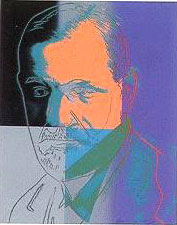
'Sigmund Freud' by Andy WarholDavid Wayne over at Jollyblogger takes Tom Cruise to task for trashing Matt Lauer in a discussion on the merits of psychology as a real science. Scientologist Cruise—he of the belief that evil space aliens control our minds—labeled psychology a “pseudo-science” and there was much rending of clothes and gnashing of teeth as a result.

I’m no apologist for Scientology or for Tom Cruise, but he’s right in one thing: psychology IS a pseudo-science. And Christians have swallowed and subsumed that pseudo-science to the point that it is wrecking the North American Church from the inside out.

Psychology and psychiatry are rooted in the exaltation of the Self. This is clearly at odds with the Gospel. Psychology and psychiatry possess a worldview of their own that conflicts with the truth claims of Scripture time and again.

If ever there was correct labeling of anything as a “pseudo-science,” psychology merits that label.

Arrogance, Ignorance, and “I Don’t Know.”

Standard

Nobody expects the Spanish Inquisition!Slice of Laodicea notes an Al Mohler article that brings up good talking points about the state of today’s Church in light of the proliferation of cults. Mohler’s basic comment is that poor doctrinal defense and an inability to nip error in the bud have resulted in Christianity being dogged by a plethora of pseudo-Christian cults all clamoring for legitimacy. Given that Eerdmans, long a stalwart in Evangelical publishing, just published a defense of Mormonism, fueling the growing desire of Mormons to be considered mainstream Christians (rather than gladhanders in bleached white Oxfords trying to dig up the remnants of a civilization as non-existent as Plato’s Atlanteans), Mohler may have a point.

But then again, nah.

Mohler’s piece is written as if no Church existed before 1800. Witness this assertion:

Writing early in the last century, J. K. Van Baalen argued that “the cults are the unpaid bills of the church.” Van Baalen’s influential work, The Chaos of the Cults, represented one of the very first comprehensive efforts to evaluate the various cults of the day from the vantage point of orthodox Christianity. Van Baalen’s survey considered movements and groups such as Spiritism, Theosophy, Christian Science, Rosicrucianism, Swedenborgianism, Mormonism, and the Jehovah’s Witnesses, among others.In Van Baalen’s analysis, orthodox Christianity had opened the door for the cults to emerge and to proliferate throughout the culture. Sidelined by pragmatism, distracted by divisions, and committed to a “smallest common-denominator faith,” the orthodox churches had left the larger culture, and even some of their own members, unprepared to meet the challenge of the cults.

If anything, the problem is more acute in our own day. The seductions of postmodernism and the complexities of a pluralistic culture compound the difficulty involved in engaging, understanding, and confronting the cults.

Is the problem more acute in our day? Well, if the Scriptures are to be believed, the first NT writings were not even dry on the page before the Church was confronting cults. We know that the Apostle John wrote to counter the nascent Gnostic heresies and that the Lord Himself called out the Nicolaitans in Revelation. In fact, as long as there has been Christianity there have been cults of Christianity. Paul was constantly squashing one heretical belief after another and even came into conflict with Peter over the Judaizers, a group that Mohler would be forced to tag as a cult if it existed today.

The list of heretical leaders and the groups that formed around them in the early days of Christianity’s spread could take up a leather-bound tome in itself. Mohler’s amnesia here is startling: Marcion, Pelagius, Apollinarius, Montanus, Arius, Nestorianus and on and on. Yes, the Church did put them down, but even today groups of pseudo-Christians cling to the remnant teachings of these heretics. Still, their ideas did not die; even a casual glance around proves Pelagianism is alive and well in the 21st century.

The issue of what constitutes a cult in the history of the Church is also difficult to ignore. To the orthodox Church (and Mohler makes much of what is “orthodox”), Martin Luther and his band of German ne’er-do-wells were a cult. Same goes for that Calvin guy and that fellow Knox. To those early Lutherans and Presbyterians, the Roman Catholic Church was a cult and plenty of Christians today still maintain that view.

In fact, you can trace every modern denomination in Christianity to a blistering reaction by that denomination’s adherents to an “apostate orthodox church.” Methodism, the Restoration Movement, the Quakers, the Puritans, all had a start as folks who came out of a church that was backslidden and given to cultic practices—at least as they saw it. How Mohler fails to consider this is beyond me.

Worse still, Mohler attributes the problem of cult proliferation in the last one hundred-fifty years solely to the Church’s inability to promote correct doctrine. To be honest, I don’t believe that this is the whole story, especially since Mohler lumps seeker-sensitive and Emerging churches in here. Again, an honest assessment shows that these two came not out of bad doctrine, but a reaction against an orthodox Church in America that simply wasn’t doing its job. A lot of denominations started out that way, but when they left their parent churches, the angry ones left behind were bellowing, “Heretics!” even as they smarted over the possible truth behind the breakaway group’s leaving. It was easier to blame them for bad doctrine than it was for being right about the status quo’s calcification and deadness.

Every doctrine of the Church is not nailed down. If we were honest with ourselves we would have to admit this. Get one hundred Christians of all “orthodox” persuasions in a room, and you’ll have at least twenty distinct eschatologies. And while some may say that eschatology makes no difference, many of the cults that arose in the mid-Nineteenth century did so because of eschatological beliefs. Nor does one’s eschatological view exist in a vacuum. The very way we live our lives every day is a reflection of how we think the world will end. If you don’t think that’s true, then compare and contrast Booth’s Salvation Army with today’s Christian survivalists.

I’m going out on a limb here and will certainly get angry comments, but even Paul didn’t have his theology crystal clear on all points—at least as many orthodox Christians might see it today. We know that Paul publicly confronted Peter over his falling in with the Judaizers, but Paul was not so sure of the issue of circumcision early on in his ministry (Acts 15), but then after it was decided that circumcision was not necessary, Paul went ahead in the very next chapter and circumcised Timothy in order to get a better opportunity to preach to the Jews who would have disqualified his testimony because of his uncircumcised co-worker in the Faith. Later on, we have Paul abiding Nazarite vows and ritual cleansings in Acts 21, acts that would drive batty those orthodox believers who eschew anything that looks like a ritual or smacks of legalism.

So just who is wrong here? And better yet, who’s willing to admit it?

It’s that latter sentence that may explain some of the reason why we have cults: dogmatism. Cults— and Christian denominations—exist in large part due to inflexibility of beliefs. They are all backlashes against a rock-solid dogma that chafed. Sometimes (and yes, I know, not always) we Christians must acknowledge some negotiables. Paul did so when he circumcised Timothy. Who here is willing to toss him out for that act? Was it a sin? Was he violating doctrine? Or was the Holy Spirit leading him outside the newly established boundaries just this once in order that some might be saved? That Paul also consented to a similar act (the vows) later on in order to win some to the Lord should give us pause.

Frankly, if Mohler were honest, he’d just skip to the punchline and say, “I’m a Baptist. From my perspective, anyone who baptizes infants is a heretic and their church is a cult.” The problem is, he can’t bring himself to say that because he mentally assents to some doctrinal “wiggle room” himself.

I’m not positive on a lot of points of established “orthodox” doctrine. I believe that because Man is made in the image of God, he’s a tripartite being, just as God is. Wayne Grudem, whose Systematic Theology is a work I deeply respect, does not share that belief. That makes one of us wrong. Applying the standard that Mohler asks, one of us is therefore a heretic.

The Holy Spirit will guide us into all Truth, as the Scriptures say, and yet we see through a glass darkly. I believe both those statements. I believe that the Holy Spirit will progressively make me more like the Lord and I will take on more of His Truth in doing so, but I also believe that I will not have all the answers in my lifetime. As Paul’s “man caught up into the third heaven” can attest, there are answers to questions we may never ask this side of eternity. And if we’ve never asked them, how then can we be perfect in our doctrine?

Arrogance led to erecting a gospel of stone, a weight that not only were the cultists not ready to accept, neither were the leaders of Christian denominations who broke off from the accepted teaching of the day and went down another path. On the other hand, there is no purity in ignorance. Certainly ignorance accounts for the cults and some of those same Christian denominations—ignorance of the Word and of sound doctrine.

Perhaps the reality we face this side of heaven is that on some issues the believer must be more humble, even to the point of saying, “I don’t know.” While I don’t ascribe to the belief that everything is a mystery, neither do I believe that everything is set in granite. I don’t believe that Jesus came to establish a set of dogmas used to crush ordinary people with, and yet He never tolerated erroneous teaching, either.

No matter what the case, we all need a bigger dose of humility when it comes to this issue of who is right and who is wrong. We use the word “heretic” far too often today. The Christian blogosphere is choking on the brutal arguing going on over who’s perfect and who isn’t. I don’t want any part of that anymore. It’s possible to call others to holiness without strangling them to death with a noose of righteousness. That’s the way I’m going to try to take, because in the end, I’m not perfect.

Now where’s my comfy chair?