Witch Hunt

Standard

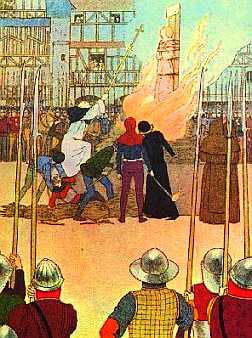
Joan's pyreI’m getting really fatigued. Mad, too. If this is all the Church is in this country, then we’ve lost the whole point.

What I am referring to is the increase in witch hunts that are breaking out in the Christian blogosphere. Don’t get me wrong; I don’t tolerate horrid doctrine. But neither do I tolerate people with perfect doctrine who can merely point fingers and do little else. Anyone (and I’m including myself here) can be a critic, but very few people can be a means of grace that helps people dying for help.

So here’s what I’m saying in a nutshell:

  • If you insist that people must be exactly {miscellaneous Christian necessity}, but you are doing nothing concrete to help them achieve {miscellaneous Christian necessity}, then SHUT UP.
  • If you believe that {miscellaneous Christian ministry/teacher/author/pastor} is doctrinally wrong in some area, take a moment to ask if what he/she/it is saying in another area is something you need to hear before you call him/her/it heretical, or else SHUT UP.

I’m not willing to do the millstone thing. Have I done it in the past? Even on this blog? Probably. But folks, if we are truly going to be the Church, then we have got to start burying the hatchet in something besides each other, especially if we can only point out problems, but have no solutions. That kind of hypocrisy gets us nowhere.

Here’s a case of what I am talking about.

I am no fan of the Emerging Church or Postmodern Christianity, or whatever you want to call it. It’s got profound flaws. But I am not going to rip them up one side and down the other just for existing because they have several points of contention that we should hear. You can point out every single lousy doctrine in the Emerging Church, but what about some of the issues they are raising in areas like Christian stewardship of God’s Creation, justice for the poor, simple living, making people a priority, or making choices to live in places that are not upscale or safe because they would have no Christian presence otherwise? Honestly, has anyone in the Evangelical, Reformed, Mainline, or Whatever Church who has ripped the Emerging Church lately taken one second to say, “You know, they do that a lot better than we do. Perhaps we need to improve in that area,” or is it just one tirade after another, with closed ears and a heart unwilling to take the correction God may be doling out through the equivalent of Balaam’s ass?

A simple pass through the Lord’s chastising of the seven churches in Revelation 2-3 shows that He rewarded both good doctrine and good works. He chastised those churches that lacked in either of those two. The lesson is clear: You have to have both good doctrine and good works. I see no lack of good doctrine in the Christian blogosphere, but many of us may be lacking in the works department. Like I’ve said before, Jesus does not call us to be a good apologist or a good servant of others, He calls us to be both. You may be the greatest Web apologist out there, but if you don’t clothed the naked, what good are you? Likewise, you may be out on the street every day doing good works, but if the Christ you’re sharing with someone else isn’t the Christ of the Bible, what good are you?

As for witch hunts, everyone reading this now is a (figurative) witch. Why? Because some Christian out there is going to find something wrong with your Christianity if he or she looks hard enough. Now how many of us want to be under that withering, soul-killing magnifying glass day in and day out? I don’t. I can’t possibly please every single faction or fraction of Christianity out there no matter how bullet-proof my doctrine or actions are.

Can we ease up on the witch hunts for a while? Can we start finding out what is good, perfect, noble, and pure and start emphasizing those things, making them happen in the lives of people who truly need them? Too often we come to those blessed things not for what they are, but for what they are not. If we can only think of “good” as being “not bad” or “pure” as being “not corrupted,” then we have lost the mind of the Lord.

God Is Still Speaking

Standard

IlluminationThis is a response to Steve Camp’s post “Worship Wars.” While I greatly respect Steve’s teachings in general, I believe there is a problem with his limited view of God’s speaking to people today. The underlying idea he expresses is that God ceased to speak to us once the canon of Scripture was closed. This perspective is very common and I hear it all the time in the Christian blogosphere, but I contend it makes Christianity into a dead religion that was codified in a book by a God who once spoke, but does so no longer.

At issue is this quote from Steve’s article:

Worship cannot be about my feelings or personal moorings based on what I think God is mystically communicating to me in a supernatural way.

While it is true that feelings cannot be the basis for worship, what God is communicating to us when we are communing with Him is critically important, especially if that communication is “supernatural,” as Steve puts it. Steve limits what God can say only to what He has chosen to have written down in the Bible.

I start my response with a man who intimately knew God in a way that few do today:

In the beginning was the Word, and the Word was with God, and the Word was God—John 1:1

An intelligent, plain man, untaught in the truths of Christianity, coming upon this text, would likely conclude that John meant to teach that it is the nature of God to speak, to communicate His thoughts to others. And he would be right. A word is a medium by which thoughts are expressed, and the application of the term to the eternal Son leads us to believe that self-expression is inherent in the Godhead, that God is forever seeking to speak Himself out to His creation. The whole Bible supports this idea. God is speaking. Not God spoke, but God is speaking. He is, by His nature, continuously articulate. He fills the world with His speaking voice. One of the great realities with which we have to deal is the voice of God in His world. The briefest and only cosmogony is this: “He spake, and it was done” (Psalm 33:9). The why of natural law is the loving voice of God immanent in His creation. And this word of God which brought all worlds into being cannot be understood to mean the Bible, for it is not a written or printed word at all, but the expression of the will of God is the breath of God filling the world with living potentiality. The voice of God is the most powerful force in nature, indeed the only force in nature, for all energy is here only because the power-filled Word is being spoken.

The Bible is the written word of God, and because it is written it is confined and limited by the necessities of ink and paper and leather. The voice of God, however, is alive and free as the sovereign God is free. “The words that I speak unto you, they are spirit and they are life” (John 6:63). The life is in the speaking words. God’s word in the Bible can have power only because it corresponds to God’s word in the universe. It is the present Voice which makes the written Word all-powerful. Otherwise it would lie locked in slumber within the covers of a book.
—A.W. Tozer, excerpt from the chapter “The Speaking Voice” from The Pursuit of God

Agree or disagree?

Does God not still speak to us? If He does not, then what is the purpose of having the Holy Spirit placed in us if God did not intend to continue to speak through His Spirit? The Spirit is more than a stamp of salvific approval on the Christian. If He were only that, then there would be no reason for Him to be a living Person. Stamps do not speak, only persons do.

And what of inspiration or the words of a preacher like Whitefield brought to life by the unction of the Spirit? If God does not still speak, then there is no sense for us to be Christians any longer, for all inspiration is lost. It may have been codified once, but there is nothing more to say, therefore there would be no reason for us to speak a single word to anyone, preaching going the way of the dodo. Anyone here believe that to be true?

While I greatly respect Mr. Camp, he may one day come up against a person who meets the very criteria Camp himself sets forth, someone who is delivering the voice of God. What then?

Why are we so very afraid that God may still be speaking? Why should we be afraid of the Voice today? The Spirit blows where He wills; does He do so no longer? If He still does, would He come without a message? By no means! Because it is the very nature of God to always be speaking.

You could open your Bible anywhere and find God speaking to His human creations, but the one I choose here is God speaking to His wayward prophet Elijah. After God’s trouncing of the prophets of Baal through Elijah and the subsequent destruction of the Baalites, Elijah fears for his life and takes off into the wilderness, hiding from King Ahab and his wicked wife Jezebel:

Then Jezebel sent a messenger to Elijah, saying, “So may the gods do to me and more also, if I do not make your life as the life of one of them by this time tomorrow.” (3) Then he was afraid, and he arose and ran for his life and came to Beersheba, which belongs to Judah, and left his servant there. (4) But he himself went a day’s journey into the wilderness and came and sat down under a broom tree. And he asked that he might die, saying, “It is enough; now, O LORD, take away my life, for I am no better than my fathers.” (5) And he lay down and slept under a broom tree. And behold, an angel touched him and said to him, “Arise and eat.” (6) And he looked, and behold, there was at his head a cake baked on hot stones and a jar of water. And he ate and drank and lay down again. (7) And the angel of the LORD came again a second time and touched him and said, “Arise and eat, for the journey is too great for you.” (8) And he arose and ate and drank, and went in the strength of that food forty days and forty nights to Horeb, the mount of God. (9) There he came to a cave and lodged in it. And behold, the word of the LORD came to him, and he said to him, “What are you doing here, Elijah?” (10) He said, “I have been very jealous for the LORD, the God of hosts. For the people of Israel have forsaken your covenant, thrown down your altars, and killed your prophets with the sword, and I, even I only, am left, and they seek my life, to take it away.” (11) And he said, “Go out and stand on the mount before the LORD.” And behold, the LORD passed by, and a great and strong wind tore the mountains and broke in pieces the rocks before the LORD, but the LORD was not in the wind. And after the wind an earthquake, but the LORD was not in the earthquake. (12) And after the earthquake a fire, but the LORD was not in the fire. And after the fire the sound of a low whisper. (13) And when Elijah heard it, he wrapped his face in his cloak and went out and stood at the entrance of the cave. And behold, there came a voice to him and said, “What are you doing here, Elijah?” (14) He said, “I have been very jealous for the LORD, the God of hosts. For the people of Israel have forsaken your covenant, thrown down your altars, and killed your prophets with the sword, and I, even I only, am left, and they seek my life, to take it away.” (15) And the LORD said to him, “Go, return on your way to the wilderness of Damascus. And when you arrive, you shall anoint Hazael to be king over Syria. (16) And Jehu the son of Nimshi you shall anoint to be king over Israel, and Elisha the son of Shaphat of Abel-meholah you shall anoint to be prophet in your place. (17) And the one who escapes from the sword of Hazael shall Jehu put to death, and the one who escapes from the sword of Jehu shall Elisha put to death. (18) Yet I will leave seven thousand in Israel, all the knees that have not bowed to Baal, and every mouth that has not kissed him.”
—1 Kings 19:2-18 ESV

Notice a few things concerning Elijah and the Lord here:
1. Elijah was consecrated to God in the same way as we read in Romans 12:1 (“I appeal to you therefore, brothers, by the mercies of God, to present your bodies as a living sacrifice, holy and acceptable to God, which is your spiritual worship.) He was a true worshiper of God.

2. Even though Elijah trusted God, he was afraid and depressed enough to die. While we don’t associate fear and depression with faithfulness, there was no doubt that God still considered Elijah faithful and still spoke to Him in a personal way.

3. God spoke to Elijah through the exact means needed to reach him. God’s tenderness is shown to the prophet. And while we are not to base our worship on feelings, God is mindful of the emotional state of His prophet and takes this into account in the way that He deals with His servant.

In light of this encounter, should any of us believe that God does not speak to us in the same way that He spoke to Elijah? As true worshipers, is the depth of relationship we have with God somehow capped so we can never experience the level of intimacy that Elijah experienced when God spoke to him in the whisper? Are we somehow perpetually lesser servants of God? I see nothing in the Bible that says that God cannot speak to me in the same way that He spoke to Elijah, even when I am afraid or depressed, just like the prophet. Why should we limit God? In fact, with the Spirit of God actually indwelling us, I believe that our potential for intimacy with God, to have amazing conversations with Him, are even greater than in the days of the Old Testament when God would periodically dwell on people rather than remaining in them.

Therefore, not only does God speak, but He speaks personally. He speaks to each one of us. His intimacy is with each one of His children, those who bear the Holy Spirit within. And not only does He still speak, but He speaks to our need, our place in Him, and in measure to our ability to respond. If Steve Camp has any fair remark it’s that too many self-appointed and highly immature “mouthpieces for God” want to talk when they should be listening, allowing God to mature them to the point where He will truly use them to speak if He wills. However, that fair criticism is used in a blanket way to establish a rule by which no one can ever relay the voice of God for an individual or group in the moment. By Steve’s rule, God would never speak in the way that He does here:

While they were worshiping the Lord and fasting, the Holy Spirit said, “Set apart for me Barnabas and Saul for the work to which I have called them.”
—Acts 13:2 ESV

If that kind of speaking is out today, then how are we to function as a Church?

Lastly, as the bearers of His Light, that Light speaks out from us to those in the darkness. Even our lives can be the words of God to mankind. Because God is still speaking, we should not be surprised when the person sitting next to us on the bus hears the Lord’s voice in our very countenance.

So if God is still speaking, the only question that remains is, Are we listening?

Overflowing

Standard

Today is Pentecost, the birth of the Church and the fruition of the Old Testament prophecy of Joel declaring that the Spirit of God would personally indwell men and women.

El Greco's PentecostHow sad then that the Holy Spirit is barely a presence at all in our meetings or in American believers in general.

Yesterday, I wrote to a faithful reader of this blog about my experiences in camping ministry. Ruminating further on what I wrote her, I want to literally and figuratively talk about two camps. I'll let you decide which one was more Spirit-filled and had a more effective ministry.

The camp in Southern Wisconsin had everything that an Evangelical camp could want—multi-million dollar budget, national recognition, much-copied programming, an enormous staff filled with well-known names in camping, and superior food and accommodations. They had all the right doctrinal stances and perfect theology. The director of the camp was also the sitting director of Christian Camping International.

The camping program in Southern Ohio had a minute fraction of that money and was part of a Mainline denomination that had been losing members to churches like the one that supervised the Evangelical camp. They didn't own their own campgrounds and the camping program was largely funded by one church. There was no national recognition and the leaders, while respected, weren't being asked to speak at Christian Camping International conventions.

The Wisconsin camp was a stickler for rules, even those that made it hard for summer staff members to attend church on Sundays. The camp didn't provide for the spiritual needs of the staff, going so far as to oppose a volunteer, staff-run, mid-week church meeting (organized by yours truly.) Year-round staff made it clear to summer staff that they were just there for a few weeks and the camp really didn't belong to them in the same way that it did for the resident year-rounders. Resident staff almost never let summer staff into their homes.

The Ohio camp made every allowance for the spiritual lives of staff. When leadership saw that the staff was getting tired, they poured their lives back into the staff and made certain that each staff person was getting fed by the Lord. Although many of the summer staff were not local, almost everyone on staff decided to attend the sponsoring church and time was made for staff to attend church and even enjoy fellowshipping afterwards. People from the church housed the staff in their own homes when camp was not actually in session. Relationships were forged for a lifetime.

The Wisconsin camp believed that God came first, campers came second, and staff came third. The Ohio camp believed that God came first, staff came second, and campers came third.

The Wisconsin camp poured out their staff until they were bone-dry and used-up. The Ohio camp got their staffers into the waterfall of the Holy Spirit and let them minister out of the overflow.

By summer's end, the Wisconsin camp staff had nothing more to give, while the Ohio camp staff was still ready to serve. The staff of the Wisconsin camp limped out of camp with long faces and few tears. The Ohio camp staff walked away empowered for service, and there were long farewells and many tears. Many of the people from the Ohio camp are still friends almost twenty years later.

I tell the tale of those two camps because today's Church in America falls into the same two camps. Our ministry is either a pouring out of people until there is nothing left to give or it happens out of the overflow of the hearts of people filled with the Holy Spirit.

Unfortunately, I believe that too much of our ministry today is taking what little of the Spirit of God is in those ministering and pouring Him out until people are dessicated.

A simple look around the United States will reveal the following:

1. We have more seminarians than ever and yet people are starving for good preaching.
2. More people have taken evangelism courses than ever and yet there is no revival in this country.
3. We have more books on Christian topics than ever, yet the ignorance of the Word of God is growing.
4. We have more Christian conferences and seminars than ever, and yet the world around us thinks Christians have nothing to offer.
5. We have snazzier, more consumer-oriented programming in our mega-mall-churches than ever before and yet every poll shows more and more people staying away from our churches.

Folks, we cannot do this by our own strength and yet that is all we seem to offer people. Is it any surprise that people stuck in this kind of dry, manmade Christianity are bored and restless? And for those who labor within those congregations, should we scratch our heads when they burn out and go elsewhere?

There is no substitute for the Spirit of God! We cannot build Christ's Church by any other means than by His Spirit! Our programming won't do it, our happy faces won't do it, our seminaries won't do it, our bookstores won't do it. Nothing builds the Church but the Spirit. We're wasting our efforts and wasting God's time if we think otherwise.

I've said here before that you never have to advertise a fire. If each believer in Jesus was filled to the brim until they overflowed with the Spirit we'd have people begging us to know what our secret is! We'd sit down on a plane and the people in the seats next to us would be clamoring to know how it was possible that they could actually sense our contentment and inner joy. Anyone who is empty would want a piece of Who we have!

I wish that everyone who reads this blog will take time today to read the entire Book of Acts in one sitting. Read it all the way through—your translation doesn't matter. Just read it. Now ask yourself if what you read there bears any resemblance to your own experience. If not, then why not?

The simple answer is that we are not serious about ministering out of the power of the Holy Spirit. But can I tell you something? You will burn yourself to a cinder of you minister to others in the way that most of you have been taught. But if you minister out of the overflow of the Holy Spirit, ministry becomes so effortless that you'll wonder why you wasted so much of your sweat trying to do it by your own strength!

My favorite passage in the Bible is Acts 4:23-31:

When [Peter and John] were released [from prison], they went to their friends and reported what the chief priests and the elders had said to them. (24) And when they heard it, they lifted their voices together to God and said, "Sovereign Lord, who made the heaven and the earth and the sea and everything in them, (25) who through the mouth of our father David, your servant, said by the Holy Spirit, "'Why did the Gentiles rage, and the peoples plot in vain? (26) The kings of the earth set themselves, and the rulers were gathered together, against the Lord and against his Anointed'— (27) for truly in this city there were gathered together against your holy servant Jesus, whom you anointed, both Herod and Pontius Pilate, along with the Gentiles and the peoples of Israel, (28) to do whatever your hand and your plan had predestined to take place. (29) And now, Lord, look upon their threats and grant to your servants to continue to speak your word with all boldness, (30) while you stretch out your hand to heal, and signs and wonders are performed through the name of your holy servant Jesus." (31) And when they had prayed, the place in which they were gathered together was shaken, and they were all filled with the Holy Spirit and continued to speak the word of God with boldness.

Did you catch that last verse? The place they were in was shaken! When was the last time that the Holy Spirit showed up so powerfully on Sunday morning or Wednesday night that your gathering place was shaken? Or how about you? When was the last time the Spirit go so ahold of you so fully that you were shaken? Those folks in that place already had the Holy Spirit in them since it was a gathering of believers, but look how God filled them to overflowing. And notice what follows from that massive empowering of the Spirit: the people went out filled with the Spirit, ministering the word of God boldly out of that overflow of their hearts! Do you think that they could NOT talk about the Lord after being filled like that? They didn't go out timidly, nor by whipping themselves into an emotional frenzy, nor by whatever they'd learned in a two day Evangelism Explosion session, but they went out in the utter confidence of the Holy Spirit! How could they NOT impact their environs if God Himself was dwelling in them so richly?

You can't buy the Holy Spirit; people have tried unsuccessfully (Acts 8:18-24.) The only way we can experience that filling is to humbly repent of our sins, travail before the Lord in prayer (and I don't mean for five minutes, either), praise His Holy Name by the Spirit already living in us, and wholly offer up our lives as a living sacrifice to Christ—our spiritual worship. We also need to surround ourselves with others who have the same single-minded devotion to Christ. And lastly, we need to be around mature Christians who have tasted the Lord in His fullness. They know what is possible and they believe, even when others don't.

The Lord never intended us to live any other way than overflowing with His Spirit. His promise in Joel was not half-hearted; He promised radical lives, radically changed, and radically equipped by Him to radically speak to shattered people in a shattered world. He alone makes this happen. And no matter how hard we try to manufacture results, without Him we can do nothing. N-O-T-H-I-N-G.

Now do we believe that?

{Image: "Pentecost" by El Greco, 1600. One of my favorite artists.}