
A Look Back at “Judgmental Christians…”

Standard

My final post of 2004 was “‘Judgmental Christians’ and The Way of Christ for 2005,” wherein I wondered if we Christians were more defined by our judging the lost than by our service of others in the name of the Lord. While I believe it is one thing to cling to Truth, it is quite another to cling to Truth AND serve others in love. A helping handWhen we only do the first part well, being labeled “judgmental” is rightly applied; we function as the holder of the lifebuoy, but refuse to throw it to the unworthy.

As they say at other blogs, read the whole thing.

I believe that 2005 saw no improvement to what I blogged about in the post above. We are still highly judgmental. We continue to judge the lost, people who lack the moral compass Christ provides. Frankly, that’s a waste. It’s like working at an orange grove in Florida and wondering why the trees there don’t yield cherries.

Because of this, I believe that the Godblogosphere recognized that judging the lost was a waste of online time. I don’t know if we bloggers took our judging the lost completely offline or not, but I noticed that online the rants diminished. I still see plenty of non-blogged Christian handwringing over what the heathens are doing. Lots of press releases from Christian organizations talking about the next new perversity to rise in the ranks of the perverted, but still no real service in love to those same people—at least none of the kind that Jesus exhibited in His earthly ministry to prostitutes, cheats, liars, crooks, and sinners of all flavors. We talk about Jesus Our Model, but we still don’t really serve or love like He did.

What happened in the Godblogosphere this year, however, was a reconcentrating of our judgmental ire on each other, not only on other Christians in general, but other Christian bloggers specifically. While I’m amused at the timing of many of the wars that broke out after I stepped out of my blogging shoes for a few days (only to return to chaos in the Godblogosphere), I was consistently disheartened by the level of attacks and the sheer unwillingness of opponents to listen and seriously ponder what each side was saying. Sometimes, we don’t even hear the acid in our own words even as we’re running a litmus test on what the other side just uttered.

More than anything else, it seems that 2005 was characterized by witch hunts and finger pointing. I can’t believe how many times I blogged on this issue, but a few posts come to mind:

I hate to sound like a Christian version of Rodney King, but “can’t we all just get along?” And if the rift is so wide that getting along isn’t possible, can’t we at least treat each other humanely? Let the secular bloggers resort to vitriol. Our default mode is supposed to be love, not acid-throwing. It is possible to disagree without beating each other over the heads with a baseball bat. The teams in an NHL battle may check someone into the boards with enough fury to crack Plexiglases, but the two teams still shake hands at the end.

For 2006, it is my wish that all of us Godbloggers consent to the following when dealing with those whose views differ from ours: Love, lisitle=

Peace, Not “Not War”

Standard

Peace on EarthOne of the oddest duets in the history of music occurred in 1977 when Bing Crosby was in London to film his final Christmas special. Looking for a young local musician with whom to share a song, Bing's people settled on David Bowie. That's Ziggy Stardust-era David Bowie—about as avant garde as was humanly possible in 1977.
And so the unlikely duo performed "The Little Drummer Boy" with Bowie singing a counterpoint, "Peace on Earth," over Crosby. Bing died less than a month later, but the show was broadcast. TV Guide in 1999 proclaimed the Bowie/Crosby duet—a true study in contrasts—one of the Top 25 musical TV events of the 20th century. (Click here to see the TV excerpt.)

Peace on Earth is a continual theme during Christmastime. If you want to send a Christmas card with a religious theme that is considered universally "acceptable," you can't go wrong with one depicting a dove carrying an olive branch.

Unfortunately, pinning down what peace is proves to be as large a study in contrasts as Bing and Bowie. One of the odd things about the idea of peace is that we tend to think of it not as was it is, but what it isn't. Peace is viewed as being "not war."

Christians, the ones who follow the Prince of Peace have just as difficult a time thinking about the positive aspect of peace rather than what it represents in reverse. Pull your average Christian off the street and ask him or her about Philippians 4:8:

Finally, brothers, whatever is true, whatever is honorable, whatever is just, whatever is pure, whatever is lovely, whatever is commendable, if there is any excellence, if there is anything worthy of praise, think about these things.

You're just as likely to get a definition of Paul's list of concepts as not lies, not dishonor, not unfairness, not corruption, not ugliness, and not triviality or cheapness, either. The positive side of ideas like peace or purity get lost in our tendency to work toward the good by thinking of an absence of the bad.

What we are left with in many cases is a deficient idea of what kind of peace Christ has purchased for us by His death and resurrection. We tend to think of peace in 2005 as an absence of stress or conflict. Because of this, we fall prey to the world's peace, a man-made utopian ideal that pursues peace by removing anything that interferes with the goal of total tranquility. Again, negation is what drives us, not true peace.

Unshakable peace is not the absence of something, it is the presence of someone: Jesus Christ. The contrast with the world's peace versus the peace that Christ alone can give could not be starker, yet how poorly so many of us perceive the difference, even in the Church.

Peace I leave with you; my peace I give to you. Not as the world gives do I give to you. Let not your hearts be troubled, neither let them be afraid.
—John 14:27 ESV

I have said these things to you, that in me you may have peace. In the world you will have tribulation. But take heart; I have overcome the world."
—John 16:33 ESV

The peace Christ gives is Himself. We overcome strife because He did and He dwells in us. The peace He gives has teeth because it stands in stark contrast to the peace the world gives, overcoming it by faith.

Therefore at that time certain Chaldeans came forward and maliciously accused the Jews. They declared to King Nebuchadnezzar, "O king, live forever! You, O king, have made a decree, that every man who hears the sound of the horn, pipe, lyre, trigon, harp, bagpipe, and every kind of music, shall fall down and worship the golden image. And whoever does not fall down and worship shall be cast into a burning fiery furnace. There are certain Jews whom you have appointed over the affairs of the province of Babylon: Shadrach, Meshach, and Abednego. These men, O king, pay no attention to you; they do not serve your gods or worship the golden image that you have set up." Then Nebuchadnezzar in furious rage commanded that Shadrach, Meshach, and Abednego be brought. So they brought these men before the king. Nebuchadnezzar answered and said to them, "Is it true, O Shadrach, Meshach, and Abednego, that you do not serve my gods or worship the golden image that I have set up? Now if you are ready when you hear the sound of the horn, pipe, lyre, trigon, harp, bagpipe, and every kind of music, to fall down and worship the image that I have made, well and good. But if you do not worship, you shall immediately be cast into a burning fiery furnace. And who is the god who will deliver you out of my hands?" Shadrach, Meshach, and Abednego answered and said to the king, "O Nebuchadnezzar, we have no need to answer you in this matter. If this be so, our God whom we serve is able to deliver us from the burning fiery furnace, and he will deliver us out of your hand, O king. But if not, be it known to you, O king, that we will not serve your gods or worship the golden image that you have set up."
—Daniel 3:8-18 ESV

Two stark contrasts are depicted in this passage. The world's peace is for the trio of Shadrach, Meshach, and Abednego to bow down to the idol. It is the peace of worldly conformity. However, they chose the peace of God, letting Nebuchadnezzar know that there is a peace that passes understanding, the peace that Christ modeled for us when He went as a lamb to the slaughter, the devil's lie ringing in His ears, "Come down from the cross; you are the King of Israel, are you not?"

Death brings peace. Not a funeral goes by that someone says of the deceased that he or she is at peace. But one of the reasons Christ endured crucifixion was to offer a peace that comes only by death on a cross. And so He showed us the way as we too join in saying that we would rather die at the cross than worship the idols of this world. Only the dead to the world know the peace an exchanged life brings at Gethsemane, Christ's for ours.

This Christmas, let us rightfully consider what peace is. It is not the absence of war, conflict, stress, and turmoil; it is the overcoming presence in our lives of the God-man born in a stable, who grew to maturity, learning obedience, and dying so that we might bear the seal of His peace.

May we have more of Him and, in turn, know godly peace.

Hidden Messages of American Christianity: Correctness Before Love

Standard

This is the third in a series of posts covering the hidden messages that sneak into American churches' proclamation of the Gospel. For more background, please refer to this post.

And behold, a lawyer stood up to put him to the test, saying, "Teacher, what shall I do to inherit eternal life?" He said to him, "What is written in the Law? How do you read it?" And he answered, "You shall love the Lord your God with all your heart and with all your soul and with all your strength and with all your mind, and your neighbor as yourself." And he said to him, "You have answered correctly; do this, and you will live." But he, desiring to justify himself, said to Jesus, "And who is my neighbor?" —Luke 10:25-29 ESV

We all know about love. Those of us who came of age in the Seventies heard "God is Love" so many times it must have been drilled into us via some clever ad campaign. Remember, the crying Indian? Somebody must've had a "God is Love" public service ad just as catchy.

For all the talk of love, you would think our churches would have that message down pat by now. And even if we don't love perfectly, we should at least understand the priority the Lord gave to love. No need to pull out 1st Corinthians 13 and 2nd Peter 1: 5-8, right? The love message percolates in everything we do.

Well, supposedly.

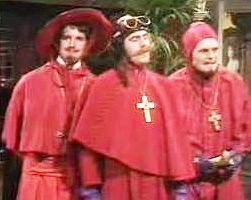
Somehow, we Christians in the West have this affinity for misprioritizing love below faith, hope, and everything else. Nobody expects the Spanish InquisitionThe very people of a God who is characterized by His Fatherly Love talk a good game about love, but the message we send out rarely starts with love. And when we end with it, that love's usually in the form of "Sorry about ripping your still-beating heart from your chest, but I did it in love."

Listen, our interaction with the brethren and with the lost shouldn't always take on the form of an intervention. It doesn't have to be a bare lightbulb, a hard wooden chair, and a cult deprogrammer we hired out of the Yellow Pages.

Too often our attitude is that of the lawyer who confronted Jesus. A master of splitting hairs, he swiftly noted how well he'd followed the love rules of the Law, but showed his true colors by adding his final element of personal correctness: "And who is my neighbor?" You can almost see the smirk.

Having been on a blogout last week, I evidently missed an enormous brouhaha that erupted over something Michael Spencer said over at BHT. At this point, I don't even want to know the specifics. All I know is that a lot of normally sane people forgot that love comes before correctness. The idea of leading with love first before tactfully addressing a fault got buried in a rush to judgment.

Can we see why the lost have no deep desire to join our little temples of pettiness? "Oh, shocking statement, Dan! 'Temples of pettiness'? Isn't that being a tad harsh?" All I can say is that our message of the love of Christ is being trumped by our desire to be correct. Love must come before correction. Love must come before EVERYTHING, folks. The mature Christian leads with love first and follows with everything else.

And yes, I know that love must be tough sometimes. My argument here is that it doesn't have to be tough all the time, nor does it have to be tactless. Our sense of proportion is out of whack when a few comments on a blog cause the strongest voices in the Godblogosphere to turn shrill and unloving.

Here's a little "Count to 10" anger management idea when we stumble across some inflated comment: Let's ask ourselves, How can I be a true example of love to my brother before I confront him?

I know a couple who were driven out of their church by folks who were more concerned about being correct than being loving. That couple's crime? They thought it was okay to read the Harry Potter books. When this opinion was expressed in a group of believers who did not share that belief, things turned ugly. To make matters worse, the couple was fairly young in the Lord and were new to that church. Now those final two elements aren't generally in themselves a reason to let things slide, but love should still have come first, then the acknowledgment that perhaps it is best to remark and let the Lord work it out in the lives of this couple. The result, however, was a bludgeoning, tears, anger, despair, and two fine people leaving the church.

It breaks my heart that we are too often concerned with being correct than being loving. And for all those who would accuse me of being soft on doctrinal stances for thinking that way, I would ask if the spirit in which anyone corrects another truly flows out of love and not self-justification. I would also ask that any of us who correct consider our own faults first, then consider if we are functioning more like the lawyer in the passage above than in the Spirit of Christ. Even in those passages where Jesus corrects sinners, he starts off by letting them know they are loved before He adds, "Now go and sin no more."

Which message do we lead with when we encounter others? Correctness or love? Only one is the way of Christ.