
The other day, we looked at three myths that dog Christianity, particularly the form found in America. Today we'll examine three more.
The ten myths:
- Christians are more judgmental than non-Christians.
- Christians are stingier than non-Christians.
- Christians are more intolerant of other people than non-Christians.
- Christians are more short-sighted than non-Christians.
- Christians don't know how to have fun.
- Christians despise intellectuals more than non-Christians do.
- Christians prefer kitsch over important art.
- Christian subculture mimics the world rather than creating anything lasting.
- Companies run by Christians are as unethical as secular companies, and perhaps more so.
- Christianity causes more problems in the world than any other religion.
Let's look at numbers four through six…
4. Christians are more short-sighted than non-Christians
You won't find a church with a Fifty Year Plan. Or a Twenty, for that matter. Long-range goals don't figure into much of what we do in American Christianity. In many way, we American Christians resemble a school full of amnesiacs, always learning, but never remembering the past well enough to build toward a future.
Somehow, we've allowed the first half of one passage to subsume the rest of Scripture:
Come now, you who say, "Today or tomorrow we will go into such and such a town and spend a year there and trade and make a profit"– yet you do not know what tomorrow will bring. What is your life? For you are a mist that appears for a little time and then vanishes.
—James 4:13-14 ESV
While most of us would deem "Live for today for tomorrow you die," to be the ultimate self-centered expression of a culture hellbent on hedonism, we've somehow aligned it with the James passage. We get all dispensational and start talking how "it's all going to burn." Our lives take on "So what?" sheen.
That so many people who call themselves believers fall into this trap should bother us. But it doesn't.
Jesus said this:
"Do not lay up for yourselves treasures on earth, where moth and rust destroy and where thieves break in and steal, but lay up for yourselves treasures in heaven, where neither moth nor rust destroys and where thieves do not break in and steal. For where your treasure is, there your heart will be also."
—Matthew 6:19-21 ESV
We need to look at James in light of Jesus. The Lord tells us that our mist-like life here and now has eternal purpose that will carry over into the afterlife. 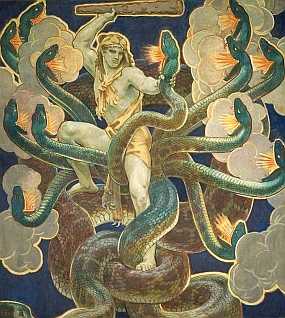 It is one thing to live for the day, but quite another to live for the day so eternity is richer.
You don't hear enough sermons about storing up treasure in heaven. I hear plenty about living the good life now, yet the only correct way to understand "it's all going to burn" is not as an excuse to cover profligacy this side of heaven, but as the means of testing every man's and woman's work after we die.
Who can blame a non-Christian for going for the gusto now? He or she's got nothing else to look forward to. Some will move beyond the "live for the moment" lifestyle that plagues America, opting for the concept of a "legacy." Even that may be wishful thiking, hoping our typical three-month collective memory will somehow stretch out to a century or more.
But when a Christian adopts "grab all the gusto' as a personal motto? That's the most pathetic short-sightedness of all. Yet how much of modern Christianity in the United States lives by that mantra? Better that we all be poor wretches considered the scum of the earth by non-Christians than we build a Camelot now that will only succumb to moths and rust.
Are all Christians that short-sighted? No. But increasingly, our churches fill with folks looking for the good life stamped by the Holy Spirit's seal of approval. When our preaching says nothing of building a true legacy that we will actually play out in eternity based upon what we do now, our short-sightedness damns us to a future as the shoe-shine boys of heaven, buffing the sandals of saints who laid it all down, even unto death.
We know we have an eternal future. What is more short-sighted than living as if that doesn't matter?
Assessment: Confirmed
***
5. Christians don't know how to have fun
When it comes to amusing ourselves to death, I think American Christians find as many ways to do it as non-Christians, albeit with fewer F-words and less full-frontal nudity.
We demanded, and seem to have received, more movies geared to Christians. And while the finished products haven't been all that spectacular, our craving for more will ensure they keep coming–with increasing regularity.
I plan on writing more about this topic in the near future, but in many ways, we Christians in the United States traded sanctification for entertainment. When God Himself no longer seems to excite us, we surround Him with our little cultural dog and pony shows, praying someone will pay attention. How else do we explain the entertainment complexes we used to call "churches." At one point in time, we went to see men on fire for God, but now preachers have to literally pour gasoline over themselves and light a match to get anyone to sit up and take notice.
Oddly enough, this fifth myth may be a remnant from the Seventies, before Christians got hip to their entertainment choices. I'm not sure non-Christians today hold the opinion that Christians don't have fun. That's been replaced with the concept that Christians don't really care about the life and death belief system they hold, practicing those beliefs more as a hobby than a way of life. If anything, it's the non-Christian who's grown more serious about life, while too many of us Christians worry that our new 60" TV still isn't big enough to show all the fine detail in the latest Left Behind video game we bought after reading the book and seeing the movie.
It's quite sad that in so many instances the one thing that separates us from non-Christians isn't the amount of entertainment we consume, but the randomly-sterilized nature of the entertainment we spend millions of dollars buying. Sure, their violent video game has swearing, but our violent video game doesn't.
If we think we're fooling God with that kind of subtlety, we're only fooling ourselves.
Assessment: Busted—perhaps too Busted
***
6. Christians despise intellectuals more than non-Christians do
It would be safe to say that I don't personally know any Christian intellectuals. On the other hand, while I do not know any non-Christian intellectuals, either, I know a few who have convinced themselves they are. And as we all know, an audience that only consists of one's self is usually an easy audience to please.
First Things has a couple online articles covering Mark Noll's seminal book on this issue, The Scandal of the Evangelical Mind (found here and here). Dr. Noll researched that book during my tenure at Wheaton, and though I never took any classes from him, I had a few other profs I'd classify as intellectuals. Unfortunately, like most intellectuals, those profs congregated in very tight circles. The less intellectually rigid of us rarely encountered them "in the wild." And so it is today.
I knew an Old Testament scholar who attended the same church I once did. Sadly, that church never seriously appreciated the kind of study that scholar pursued. Though they trotted him out on occasion as a kind of "please take the witness stand, Doctor" expert, he eventually left the church. I suspect he tired of being a sort of intellectual freakshow amid people who'd rather be watching Fear Factor.
So whither the Christain intellectual? Do any still exist?
Say what we will about history, but it's loaded with Christians (and people who mentally assented to Christianity) who drove the arts, philosophy, literature, and science—and in large numbers.
But what happened to them all? Where did they go? Sure, you see a Plantinga here, and a…uh, hmm. I'm not coming up with any names for contemporary Christian lit authors. Artists? Nope—no one comes to mind. In fact, I suspect that most Christians, even if their lives depended on it, couldn't name one contemporary Christian intellectual or artist.
Are we so bereft today that all we can remember are those great Christian intellectual luminaries of the past? Christianity nurtured Western civilization into being, yet in the 21st century we Christians gave it all away.
Perhaps we missed the point of this verse:
Where is the one who is wise? Where is the scribe? Where is the debater of this age? Has not God made foolish the wisdom of the world?
—1 Corinthians 1:20 ESV
Rather than understanding that cleverly invented myths from the world's wisemen don't trump the eternal truth of God correctly handled God's wise men, we threw all the wisemen—and their wisdom, no matter the source–out.
That this ignores most of the rest of Scripture, and also makes a fine distorted case for tearing all the wisdom books out of the Bible, eludes far too many people. In the end, Christianity never calls anyone to turn off his mind. To insist it does only results in the kind of brain-dead emotionalism that leads to error. Hoisting godly wisdom by it own petard makes the Church look vacant in the cranium.
While the non-Christian may ignore the intellectuals, I suspect precious few of them are hauling out treatises to discredit the life of the mind. We Christians of the 21st century, unlike our predecessors of long ago, seem to be the ones intent on slaying the intellect.
If the few Christian intellects left decry the problem, perhaps there's some truth to the rumor. But then, we don't listen to anything they say anyway.
Assessment: Confirmed
***
More myth assessments in days ahead…
Entries in this series:
- Busting Myths About Christianity
- Busting Myths About Christianity: Assessing Myths 1-3
- Busting Myths About Christianity: Assessing Myths 4-6
- Busting Myths About Christianity: Assessing Myths 7-8
- Busting Myths About Christianity: Assessing Myths 9-10
{Image: Hercules and the Hydra by John Singer-Sargent — Simply awesome.}
 Last year,
  Dying to self is another thing altogether, and that "all in" kind of tithe better represents the truth that we've been bought with a price and are not even our own.