Some things rolling around in my head:
Now that the business series is over, I’ll be the first to admit that a few things got left out. I should’ve talked more about the loss of rites of passage within the Church after the economy shifted from agricultural to industrial. I also did not go into detail about how individual Christians can further their careers by playing the business world’s game while not being destroyed by it. I’ll admit that as the series went on, my conclusions there became more grave and I felt I needed to back off, so this omission on that one issue was intentional. There are several Christian Web sites out there with those talking points, but honestly, they seem to me to be mouthing the same old same old that has not made one dent in a real Christian presence at the heart of business. Like I said in the series: you can gold plate a 1975 AMC Pacer and it’s still a lousy car.
I think our answers must be more radical. Even now I’m reading a book called Better Off: Flipping the Switch on Technology, and while the author is clueless as to the religious reasons that people abandon the hectic post-industrial lifestyle we have created for ourselves, his book does show the pervasiveness of healthy community found in those groups that have dropped out of the 21st century rat race.  I’m not entirely through the book, but I’ve already got a knot in my chest because he’s talking about the same deep need that I am for real community.
We invited some of our neighbors over a couple weekends ago for an impromptu hanging out in our backyard. No real plan. We supplied all the food and we just chatted as the sun went down. I hope that we can develop truly deep friendships with our neighbors, but I am unsure if it will ever live up to what I imagine it can be.
People are too isolated into little islands. If we can’t rely on the communities we form around us, then we are lost as a civilization. And I’m not just talking about a nod here and a wave there; we need to shoulder each other’s burdens in a way that we are simply not doing. The result over our isolation is overburdened lives completely stretched and stressed to the max. God did not make us to live that way. Should we wonder why so many people founder in it?
Maybe we’ve done it all wrong. The amount of money I pay in insurance alone is criminal, but I’m probably underinsured compared with most people. I spend money to make sure nothing happens to my stuff, to my wife, to my child, or to me. Almost every insurance man I know is a backbone in his church. We talk about wise stewardship of the things God has given us, for sure, but what if our insurance was meant to come from the community of Christ instead? Should my house burned down, what if it was that community—a community that lived directly around me comprised of the saints of God—that shouldered that burden with me. And what if I shouldered theirs? Doesn’t that make so much more sense than what we have now?
We reach out through copper wire and satellite feeds and spill our thoughts into the ether about this and that, but is that community? In my soul, it just doesn’t feel like the same kind of thing I get when my neighbor walks over with a newspaper clipping about a used book sale she thought would appeal to me. If I need a wrench, do I buy it from the Internet, or do I walk over to my neighbor’s and borrow one?
We almost never ask if there is more truth in one over the other. Our perpetual blindness to the way that systems erupt and take hold of us without our thinking bothers me, and I feel as if too many of us have stopped asking the hard questions. Every day lately I wonder if we are not trying to solve the core problems of what it means to live out a real Christian presence as a vital community of faith because we gave up trying to do so. Those problems are intractable, right? Better that the wave just carry us along than we question it.
I wonder if we are far more impoverished in the depths of our being than we understand. Perhaps the injuries we’ve suffered by uprooting the very good for what we initially perceived to be “the even better” has not turned around and bitten us—and we have yet to realize we are bleeding.
For the first time ever this year, I’ve had to reject medical treatments for my family because they were too costly, despite the fact that we have insurance. Did God offer a different kind of medicine, but we scorned it in favor of what grew to be the monolithic healthcare system we have now? At what part of the process did we fumble the ball?
Sales of iPods continue unabated and people risk being oddballs if they don’t have one. But what if we stopped working so hard to buy the massive overload of gadgetry we are told we must have in order to define ourselves or to keep us from being seen as out-of-step? Is out-of-step the worst label we could bear? Could we recover some portion of a life without these things, a life that has more of God in it and less Nokia or Sony or Dell? I’m still astounded at the fact that everyone seems to have a cellphone now when just seven years ago I had no friends who owned one. What did we do before frying our brains with unproven technology became de rigueur? Are our lives better for it? Does the cellphone on our ear replace something that God put in place but we in our desire for rocket packs elected to abandon?
The Church never seemed to question the Industrial Revolution and I can’t see how they could not. And yet we today with the benefit of seeing through the lens of history have the same tunnel vision. The recent post on psychology opened up huge wounds in a lot of readers and the comments on that post are the harshest this blog has ever seen. But are we better people because of psychology? Was the whole world nuts in 1835 compared to today? I’m not sure I see the absolute benefit, but I certainly see the harm psychology has caused the Church. Doesn’t it seem like we gained a handful of toothpicks and lost the entire forest? Isn’t that true of far too many things today?
Perhaps my great-great-grandfather was a better man than I am. Maybe for lack of all the gadgets and gizmoes, for want of THE LATEST KNOWLEDGE™, he was a more satisfied man, too. Could it be the community he lived in knew more about what it took to be a real neighbor?
I think the Church in America has to decide at some point when it will get off the treadmill. I think for our own souls’ sake, we have to. When that will be, I don’t know. I know that ultimately satisfaction is found only after we die, but I sure would like to see a lot more of heaven this side of it. Isn’t that why the Church exists?
Been rambling too long. Just looking out at the fireflies dancing just beyond my reach and wondering….
{Image: “Miami” by Alex MacLean}

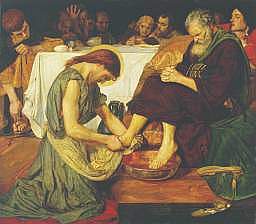
 This is in response to a couple comments in my Love Feast post. Matt and Andrew both brought up footwashing. Originally, I was responding as a comment in that thread, but decided to turn this into a post.