

Holy Man, Earthy Man

Standard

'Wellies are stripey for a reason' by Dan FoyReaders of this blog know that I write about down-to-earth subject matter. More than just about anything, I hope to see the Kingdom of God increasingly oust the kingdom of this world (and its chthonic ruler).

But it strikes me as odd that so many of us American Christians, as much as we assimilate the world’s methods of operation and thinking, still erect sacred/secular divides. Many of us think nothing of spending an entire weekend browsing for yet more stuff at the local mall, but should anyone talk of helping the world’s poor find economic justice, that poor soul gets branded as a minister of the “social gospel” or part of some sect of Christianity somehow gone to theological seed.

I guess I don’t understand the hypocrisy of the typical heavenly-minded suburban Christian loading up her shopping cart with pre-Black-Friday deals that only tie her to the world, then having her say, “You’re taking your eyes off Jesus if you talk about fighting for people’s jobs.” Talking about earthy truths somehow can’t be viewed as having any relevance to the Church’s ultimate mission.

Yet I can’t read the Bible as some kind of gnostic document that imagines the physical world doesn’t exist. Most of the Law consists of bringing truth into the everyday earth-bound problems people faced. I can’t read the compelling tales of the early Church in action and not see that right away they’re addressing the down-to-earth problems of simple people. So the Hellenists complain that their widows aren’t getting the same attention as the rest. Do the apostles blow them off as social gospel advocates or worldly advocates of taking one’s eyes off Jesus to stare at the mundane? No, they do something about the problem.

Hey, I can pray for hours on end if need be, but come Wednesday night, I still must take a garbage can down to the curb. I can’t pretend while in some spiritual swoon that I can just forget about paying my taxes. As much as Jesus might love me, I’d still wind up in jail for tax evasion. And I’m sure that instead of being immaterial, those cold, steel bars would feel plenty solid in my hands.

Jesus didn’t think it was too smart to build one’s house on sand, and I’m sure His hearers agreed, even if they didn’t initially get the deeper spiritual point being made. That parable of the heavenly world makes sense only because Jesus tied it to the earthbound world. In fact, Jesus perpetually ties the spiritual and secular together. He Himself embodies the dissolving of the sacred/secular divide. He is the God Man.

I’m sorry, but when I hear people superspiritualizing Christianity, disconnecting it from its dust-laden incarnation, it makes me want to scream. I don’t get how people can spend all weekend in church, pray and read the Bible for hours on end, drop Jesus into every conversation they have with the lost, yet somehow think it’s too worldly to consider helping the down-and-out neighbor family get their car fixed.

I’m making no apologies: I’ll expose that kind of hypocrisy every opportunity I get.

It’s not enough to think we’ve got our vertical relationship (with God) down pat. We’ve got to get the horizontal one (with people) fixed, too. And being horizontal means that we graciously fix the problems here on this skubalon-encrusted world—and we do that fixing in Jesus’ name armed with Holy Spirit power.

As we go into the week of Thanksgiving, just what are we thankful for? God knows that I am thankful for Jesus and all He did for me and for you. I’m thankful as all get-out for every spiritual truth God surrendered His Son to live and die for. I’m thankful that Christ embodies all that I can every want or need. But I’m also thankful for the wooden roof over my head and the clothes in my drawer. I thank God for the flesh-and-blood woman He saw fit to give me and the little package of snips, snails, and puppy-dog tails that is my son. I thank Him for the land outside the four walls of this house, land that provides us food, and reminds me in its tree-pounding woodpeckers, slimy-cool salamanders, and sky-tickling walnut trees that God is Creator and King of All.

And I thank God that He saw fit not to take me up to heaven in a fiery chariot the second I placed my faith in Jesus. He has a mission for me here. Sometimes that mission will include helping a lost person find his way to salvation in Christ. Sometimes that mission will find me pounding a nail in the frame of a house destined for someone who couldn’t afford a home unless Christians like me stepped in and made it possible. It means I get to pray on behalf of a brother. And it means that the prayer I pray may be that this brother and his wife find more opportunities to get away from the kids so they can get wild in the sack without interruption. It may even mean my wife and I watch those kids to make that possible.

I can be a holy man of God by being an earthy man of God. There is no distinction:

But we have this treasure in jars of clay, to show that the surpassing power belongs to God and not to us. We are afflicted in every way, but not crushed; perplexed, but not driven to despair; persecuted, but not forsaken; struck down, but not destroyed; always carrying in the body the death of Jesus, so that the life of Jesus may also be manifested in our bodies.
—2 Corinthians 4:7-10

Church, this week, manifest Jesus to someone else. And do so any way that seems right by the Holy Spirit’s leading.

I’ll be taking the rest of the week off from blogging. See you all here on Monday the 26th. May our Lord bless you abundantly this Thanksgiving.
Radical Thoughts, Real Community

Standard

Sunday night, my church shared a Thanksgiving feast together. And while some may believe Lutherans have cornered the market on potluck dinners, my Pentecostal church did a fine job.

So I went off my diet for a day. Sometimes you have to savor the moment with friends.

When I think about one area of our lives as Christians where our walk doesn’t match our talk, it’s in building real community. The word community lingers on the lips of so many  Christians today, but when I look around I don’t see much community. At least not real community that bursts ungodly societal constraints.

In talking with a friend from church, Don, we both commented on how dependent we have become on technology in our lives. Don mentioned that one finely placed electromagnetic pulse over the United States, crippling most of our electronics, would have a destabilizing effect on our society. In many ways, we have made ourselves so dependent on our cell phones, computers, cable TV, and even the simple electronics that run a stoplight, that to lose them for an extended length of time would wreak utter chaos.

I believe Don is correct. When I lived out in California, an intersection lost a stoplight for a few minutes and someone who didn’t like the snarl that occurred got out a gun and started shooting. With people wound so tightly by our modern society, should we be surprised?

Even if society should fail to collapse without our tech gadgets, those electronics have changed us in profound ways. Call me a neo-Luddite, but I believe that many of those devices have already had a destabilizing effect on our society, especially when it comes to experiencing genuine community.

The items we buy, especially advanced machinery and electronics, may make our lives simpler, but they also make us self-sufficient to the exclusion of others. We live in an age dominated by the idea that we do not need each other. Our machines have made it possible for us to exist apart from other people. Many would consider this a positive, but when it comes down to how God made us, it’s clear that the very foundations of community are specters of their former selves.

The result? We have become a disconnected and depressed people.

One of the radical truths of the Gospel we can’t escape is that Jesus is NOT so much a personal Savior as He is a a Savior of a people, a people He is drawing to Himself. The Marriage Supper of the Lamb will not be you alone in a room with Jesus, but with the whole host of believers from all time. If we are being fitted to heaven by our time on this blue orb, then that fitting must be thought of in terms of community.

Yet we do little this side of eternity to live in community.

Our problem stems from our inability–to use a much overused phrase–to think outside the box. I remember many years ago how my old neighborhood experienced a power outage that blackened TVs, silenced video games (Atari 2600s back then), and stilled the bits and bytes of computers (Commodore 64 and Apple IIe).  Right after supper, the electronics stilled, the soft voice of that beautiful summer night  called to people. The next thing I knew neighbors were chatting in each other’s yards, kids were playing impromptu games of Kick the Can and softball, and the neighborhood came alive. But when the power kicked on an hour or so later, the neighborhood took on the feel of a tomb. People had trudged back to their electronic distractions, each homeowner shutting on the door on his or her personal fortress.

We’re still locked up today. Perhaps more so.

But the Bible is a story of God and the community He is creating. The Gospel exists for people and is meant to be shared between people, to be celebrated in community. Christ’s clarion call in the Great Commission is Christ’s call bids us, his people, to go out and bring in more people to the Church. We exclude no one. The widow, orphan, and immigrant are to be welcomed in our midst. Jew and Gentile, all are welcome. What Christ is building has no limits and no boundaries, save for our own unwillingness to participate in the work.

This is why we Christians MUST rethink how we view the Gospel and the Kingdom. Every effort we make, the very way we live, must be oriented toward outreach. Even when we play, we don’t play alone, but with others. It’s our mandate.

Do we see how this is at complete odds with our societal constructs? We talk about relevancy in the Church, but the truth is that most of how we are to live cannot be shoehorned into society and culture. Instead, they must conform to the ideals of Christ. This means we Christians must learn to think like Christians and not like the world.

Well, no duh, right? We all know this.

Do we?

Think about a common activity we enjoy today: listening to music on our iPods. We Christians should ask ourselves how this solitary activity connects us in community to other people. Truth is, it accomplishes quite the opposite effect. Worse, it disempowers the listener, forcing him or her into a consumer mode. The music is disconnected from the hearer and from the community. Something is ultimately lost in the process.

So what is the truly Christian response, the one that works toward community and sharing among people?

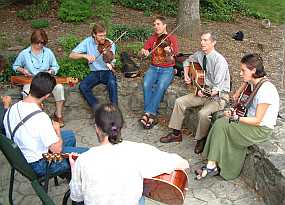
What would happen if instead of reaching for the iPod, we make music ourselves? And what if we make it in community, getting together with others to play and sing? Just hanging out together and jammingSuch a move makes us less dependent on consuming and more dependent on each other. Not only this, but we encourage others to use their gifts. We provide an example to the young and to each other. The musical talents we share uplift the community that forms around our music.

When we keep community in mind, we form relationships that build networks of dependency that shatter our self-reliance and return us to God’s ideal interaction. He walked with Adam in the garden because He is a relational God. How then do we approach all of life with this mindset?

Why do our families eat alone? What if the rarity was to eat just by ourselves? Should we not have others eating in our homes on a regular basis? Wasn’t this one of the unusual hallmarks of the early Church? I believe we Christians must start opening our homes on a regular basis so that few of our meals are eaten just with our own nuclear family. What better way to talk with others about what God is doing in our lives than in this kind of atmosphere?

How would this kind of thinking change our culture?

What if Christians were at the forefront of the slow food movement, taking time to prepare good food made without extreme processing, and always share that food with a group? What if we set aside our evenings for being with other people around a table of homemade food? How would that transform our understanding of community?

Even if we were to go out to eat at a restaurant, why not pay the way of some people we don’t know well so they might join us and begin to share in our community?

What would it mean for the Christian community to live in such a way that we share what we have rather than buying redundant copies of everything we believe we need? Would we be able to work fewer hours and devote more time to the Gospel and to others?

Consider what might happen if we begin to forgo purchasing more junk for ourselves so that we might consider the needs of others. Watch this video to see how one church thought better of building a new building and decided to put that money to a more Christ-centered use. Then consider how saying no to extravagance might change the lives of others. What if we lived that way every day?

Think about what might happen to us and those around us if we turned off the TV. What would we do with that free time that would place us in the lives of other people?

What might come about if truly esteemed others better than ourselves?

If we begin to ask how we might be more others-centered, I suspect that we’ll eventually change how we live and, ultimately, change the world for Christ. It doesn’t take much more than making a few decisions differently each day. If we do that long enough, our lives are transformed. Hospitality doesn’t become so frightening to us anymore. People aren’t left on the vine to wither. The Gospel goes out into new venues. Others see that Christians really care, rather than just talking about caring.

Radical thoughts lead to real community.

Readers, what are some of your suggestions for taking the worldly way of looking at a situation and turning it into a godly means by which we encourage interaction with others and build community?

In My Little Kingdom (and Yours)

Standard

In my little kingdom, I ride my little pony over my little rainbow. Every day is my day, every event my event.

In my little kingdom, we build on a foundation that is me. We do this because only I am worthy.

In my little kingdom, I never have to sacrifice, though you do. You’re a peasant, remember, but I’m a king.

In my little kingdom, the easiest way to make things happen is to throw a tantrum. My castle in my little kingdom. Isn't it fab?Because nothing beats a spectacle when attempting to prove one’s royal lineage.

In my little kingdom, the littleness of it all means there’s just enough room for me. Let’s not even consider making room for those people.

In my little kingdom, nothing is more important than making me feel good about myself. Of course, this means that I will have to make other people feel bad about themselves. (That’s just the way it works. Sorry.)

In my little kingdom, we do what I want and not what you want. In fact, in my little kingdom, as far as I’m concerned, there is no you.

In my little kingdom, I’ve heard peasants talk of being “the bigger person.” I have no idea what that means, though.

And sometimes, the best place for me to pull out my little kingdom for all to see is when I interact with other people. Funny thing is, when I’m with others, it seems like each person has his own little kingdom. Except those other little kingdoms don’t matter as much as mine.

I once heard of a place where another Kingdom reigned.

In that other Kingdom, everyone is a servant, yet no one complains. In fact, people serve gratefully.

In that other Kingdom, people aren’t peasants, but children of the King. And the children treat each other as if each is the most important person in the world.

In that other Kingdom, no room for little kingdoms exists. That’s not because the Kingdom is too small, but because it’s too large.

In that other Kingdom, in times of lack, all lack together, and in times of plenty, all enjoy plenty together. The children even believe that giving their blessings away is better than keeping them all to themselves.

In that other Kingdom, it isn’t about living, but about dying. And no one would have it any other way.

In that other Kingdom, when one rejoices, all rejoice. Also, as unbelievable as it may sound, when one hurts, all hurt.

In that other Kingdom, all can become children of the King. Even those people.

In that other Kingdom, helping others become part of the Kingdom drives the children. Some even die so that others might come to live in the Kingdom.

In that other Kingdom, the foundation is the King. And He is love.

In that other Kingdom, one glimpses true meaning. Some even say that eternal life is found in the King of that Kingdom and in surrendering all to Him.

Hmm…

Sometimes, when all is quiet and I have to be alone with myself, I think about that other Kingdom and mine doesn’t seem so wonderful anymore.