
Who’s to Blame for the Prosperity Gospel?

Standard

The LORD makes poor and makes rich; he brings low and he exalts. He raises up the poor from the dust; he lifts the needy from the ash heap to make them sit with princes and inherit a seat of honor.
—1 Samuel 2:7-8a

Yesterday, a reader left this comment:

It’s even worse, it seems, on the black gospel music stations where most of the teaching and much of the music is infected with the widely popular health/wealth/prosperity “gospel.”

I’d like to comment on this by asking why it might be that so many black Christians find prosperity teachings attractive. Money, money, money , money...moneySadly, that’s not a question too many opponents of the “prosperity gospel” dare ask because the ultimate answer strikes a little too close to home.

Consider a similar scenario. Evangelicals who went ballistic over the Emerging Church lacked the nerve to ask why the Emerging Church existed. Many times here, I discussed why: It was a reaction against Evangelicalism’s many blinders, especially on issues of nonexistent community, a lack of social justice for the oppressed, and rampant consumerism.

Yet rather than consider the possible truth of even one scrap of the Emerging Church protest, the loudest voices in Evangelicalism let loose with a tirade about the bad theology in the Emerging Church (and hey, let’s be honest, it was atrocious theology in many cases). Rarely, though, was there any Evangelical self-examination.

I find it both dispiriting and amusing that the very same Christians who idolize the Reformation revert to Catholic theology when it comes to these types of battles.  It’s always their own sins that are venial, while their opponents’ are the most vile, wicked, mortal sins imaginable.

And the same is true of this battle over the so-called prosperity gospel.

It’s not for no reason that the prosperity gospel exists. This may only be my experience, but it seems to me that the loudest voices crying out against the prosperity gospel come from those people who never wanted a day in their lives for anything. They never went to bed hungry. Never saw all the other kids get nice toys for their birthday while they got busted up junk those others threw away. The people who complain loudest against prosperity teachings are most likely to be the same people whose money could buy them out of every problem, and whose lifestyles define prosperity, God or not.

You see, it’s darned easy to come down against someone’s misplaced hope of escaping poverty when you’re already prosperous. In many ways, that viewpoint is the same one that seeks to keep “those people” down, lest “those people” rise up and end the party. And that’s reprehensible self-righteousness and pride.

However, it’s equally reprehensible that many of the proponents of prosperity teaching get rich off the backs of their poor followers. Those false teachers and leaders deserve a special place in hell and may actually find that their hoped for heavenly mansion of gold ends up looking more like a lake of fire.

Yet for all the anti-prosperity-gospel talk out there, the Bible contains more words about prospering this side of heaven than the opponents care to address. The patriarchs were not a poverty-stricken lot. The Lord promises hundreds of times that He will pour out plenty on those who are obedient to Him. He rewards those who seek Him, and not just with spiritual gain, but also material. God leads His people into a land of milk and honey. The reaper overtakes the plowman.

I’m not going to try to proof text this point. If you must, just look up the word prosper in a concordance. God prospers his people both spiritually and materially. It’s there, really; I’m not making it up.

On the other hand, people who put all their trust in the material, who build huge barns to store all their accumulated worldly wealth, often run into an impoverishment of the soul. And that’s a state of being God is none too happy about.

Whether you’re a prosperity gospel fan or foe, whether you can trot out battling Bible verses to bolster your position, the solution to this theological war is found in an achingly simple response. You see God already shows us how to live in a way that satisfies both sides of this issue:

So those who received his word were baptized, and there were added that day about three thousand souls. And they devoted themselves to the apostles’ teaching and the fellowship, to the breaking of bread and the prayers. And awe came upon every soul, and many wonders and signs were being done through the apostles. And all who believed were together and had all things in common. And they were selling their possessions and belongings and distributing the proceeds to all, as any had need.
—Acts 2:41-45

Now the full number of those who believed were of one heart and soul, and no one said that any of the things that belonged to him was his own, but they had everything in common. And with great power the apostles were giving their testimony to the resurrection of the Lord Jesus, and great grace was upon them all. There was not a needy person among them, for as many as were owners of lands or houses sold them and brought the proceeds of what was sold and laid it at the apostles’ feet, and it was distributed to each as any had need.
—Acts 4:32-35

Folks, the point is moot. When the Church is living this way, no matter which side you are on in the prosperity gospel battle, you will find your answer here.

But you see, we don’t want to deal with those two passages in Acts because they stand as an indictment against how we live, whether we’re rich or poor. The greed and hard-heartedness that keeps us from fulfilling these passages in Acts today afflicts both those with and those without.

When I mention these verses and ask why we’re not living this way, a million excuses come out. I know; I’ve heard them all. It gets a little depressing.

So maybe in the eyes of God it doesn’t matter if we’ve gone off into “Lord, I name and claim a Lexus—a gold-colored one with goatskin leather seats,” or into the rich, young ruler’s perfect theology framing a heart of cold selfishness. The answer to the problem of the prosperity gospel is staring us in the face.

We simply don’t want to obey God and live it.



Wandering Away

Standard

Our neighbors had a 17-year-old dog, Hickory. I say had because while they were on vacation and the dog was being cared for at home by others, Hickory wandered off and has not been seen since.

It’s common for sick and dying animals to wander away. They separate themselves from their normal world and find a quiet place elsewhere to lay down and die. We all suspect that’s just what Hickory did.

While it’s a sad thing to lose a beloved pet that way, it’s even more heartrending when a person wanders off to die. When people wander away, it’s not usually to due to a terminal illness or decrepitude. Instead, they wander off to die emotionally or spiritually.

I’m sure if God gave me eyes to see the numbers of people I’ve encountered in my life who have wandered away from Him, I’d be staggered. As it is, I already know too many.  I’m sure you do , too. (If not, consider reading this past post and follow the main link in it to see if your memory gets a refresher.)

Jesus had this to say:

What man of you, having a hundred sheep, if he has lost one of them, does not leave the ninety-nine in the open country, and go after the one that is lost, until he finds it?
—Luke 15:4

I’ll go even farther than Jesus does with his illustration, which is about seeking the unsaved, and say that while a lost sinner who remains lost is a tragedy, nearly as bad is a believer who wanders away.

And what is our responsibility to those nameless people in our churches every Sunday who are there for a few months and then are gone, never to be seen again? What is their story? Do we even care to know it? Perhaps if we had, they would not have wandered away.

We live in a world that would prefer that the weak, the disabled, the stunned, and the emotionally shattered would just wander away and die like some animal on its last legs. Better that they do it out of sight than we have to bear with their prolonged downhill slide.

Yet it was those very people, the ones the Romans (who valued youth and virility) ignored and left to die, who were cared for by the early Church. Most historians agree that the exponential growth of the early Church in Rome came because it refused to let the marginalized and weak go ignored in their time of need.

Consider the Best Picture winner of 1978, The Deer Hunter (Spoiler Alert!):

Nick, Mike, and Steven are close friends from a steel town in Pennsylvania. All three ship off to fight in Vietnam, with all three captured and tortured by the Viet Cong. The method of psychological torture? All three are forced to play Russian roulette for their VC captors. When the trio create an opportunity to escape, only Nick is able to board the rescue ‘copter, with Mike and Steven left behind. In the attempt, Steven’s legs are badly damaged. The enemy on their tails, Mike manages to carry Steven to safety in friendly territory. Nick, meanwhile, vanishes.

At war’s end, Steven winds up in a home for disabled vets. Mike wanders the seedier side of Saigon and glimpses Nick in the gallery of a gambling hall where people play Russian roulette for money. The two don’t meet.

Eventually, Mike returns home. He reunites with Steven, only to hear that Nick has been sending Steven huge amounts of money. Mike knows how. Desperate to save his friend, he returns to the gambling hall where Nick is playing Russian roulette. To speak with Nick and convince him to come home, Mike must play Russian roulette too.

I’ll leave the ending for you to see.

Mike wouldn’t let Nick wander away. He risked his life just to speak with his friend, The Deer Hunterwho had, by then, been reduced to a shell by his handlers and the psychological torment he’d endured.
If anyone in this world is equipped to go into the hellholes of life and reach those who have wandered away, it’s the Christian.

Yet what is the answer most often given by Christians to the question Why do other people wander away? I know I have heard the most common answer more often than I can count: “Because their faith is weak.”

It’s a simple enough answer, isn’t it? The only problem is that it’s a simplistic answer, the kind that bears little of the humility of genuine Christian love and more of spiritual pride. It’s the answer of dispassionate church boards, elders who only love status, distracted church members, and tired pastors who long ago stopped caring.

In the Kingdom of God, what is true to the heart of the Lord runs counter to conventional wisdom and simplistic answers. When posed with the same question of why other people wander away, the true Christian responds not only in humility, but also with an answer that begs a deeper question: “Because my faith is weak.”

See, anyone can rationalize why other people fail, leaving them to wander away unmissed, but it takes someone who believes in a big God to put a figurative gun to the head to ensure one of God’s lost sheep doesn’t wander away to die.

Greater love has no one than this, that someone lay down his life for his friends.
—John 15:13


The Medium of True Blessing

Standard

The medium is the message.

Marshall McLuhan

Times have been rough here of late. When the homefront reels under attack and the newspaper screams out worrying headlines, sometimes it’s all one can do to get out of bed.

Last Sunday in church, our pastor spoke on entering God’s rest. That’s a difficult message to hear right now. I’m working 60-hour weeks and my family faces some tough expenditures in light of recent illnesses. Even with the private health insurance we carry, the costs will be considerable. Finding rest when that “final straw” may lurk in each new day proves easier said than done.

Amid one of the most difficult weeks of my life, I noticed that a back tire on our car was badly out of balance. After yet another visit to the doctor, I tried to squeeze in a free tire balancing at the store that sold us the tires. Free.

Sitting in the waiting room at the tire store, I watched the clock tick and wondered how we would live in the light of illness. God, what does this mean for us? How will we go on?

When the hands of the clock clicked past a few too many minutes, I investigated and found three mechanics huddled around our car. Then came the dire words: “Sir, there’s a problem.”

That problem amounted to $850 worth of repairs, not including two new tires. Hadn’t I come in for a free tire balancing? My wife and I walked out of the store, estimate in hand, stunned. We drove off in our wounded car, wondering how we could possibly pay for this pressing repair.

So I sat in church that last Sunday with the wheels coming off of life, no rest in sight.

After the service, I walked up to a man in my church whom I respect for his spiritual insights and his nearly thirty years experience in the car care field. He’s retired from the car repair business now, but he knows far more than I can ever hope to know. I asked what he thought I should do. He said he’d call a few people.

The next day, he knocks on our door. He had to run an errand in another part of the city and wanted to take our car to some folks he knows.

That night, he returns with our car. His people had taken care of the $850 problem and the tires. When I asked him how much I owed him, he said, “Don’t worry about that. I took care of it.”

Joe Carter at the Evangelical Outpost asked this question this week:

If the medium affects the message, how will the Christian message be affected by the new media?

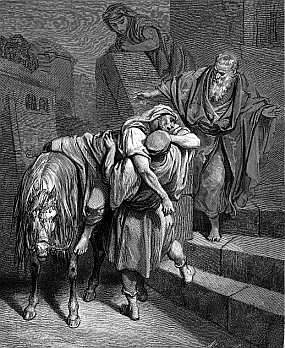
When I reflect on my life, I can’t remember many sermons that stick out. Even the words of my favorites hymns don’t always surface in memory when I need them. Gustave Doré - 'The Arrival of the Good Samaritan at the Inn'I can’t remember more than hazy concepts from the blogs I’ve visited. Viral videos? Web 2.0? Dancing 3-D holograms? Heck, I can’t even tell you the movies I’ve seen in the theater in the last five years.

But I can vividly recall every single time when life beat me up and left me for dead by the side of the road and someone in the name of Jesus took me up, cleansed and bound my wounds with his or her own hands, and made certain I was cared for.

The medium of the Christian message is you and it’s me. It’s the cup we hand in person to the parched and thirsty soul.

Fifty years from now, no one will remember the name of that blogger, the genius behind that YouTube video, the author of the Web 2.0 site. Nor will we remember what all the hoopla was about.

What we will remember are those people who were there for us in tough times. Those people who invested their lives in ours by showing up on our doorstep in our bleakest hour. Those people who took the time to be Jesus for us when we needed Jesus the most.

Because 2,000 years later we still tell of the Good Samaritan. May his message—and his medium—always be our example.