

Banking on God: Crisis, Part 1

Standard

Woe unto the grasshopper!That I’m still under the weather makes today’s post all the more apt. Feeling lousy may be a state many of us will better understand in the days ahead.

The fifth largest investment bank in the United States collapsed Monday. Please read that again.

Now read this: 60,000 homes in my state of Ohio are in the process of foreclosure as of last quarter. That’s the worst in the nation.

When I first read a nondescript, well-hidden article in The Wall Street Journal last May concerning problems in the sub-prime mortgage industry, I told my wife, “This is it. The ripples are going to be devastating.”

Long-time readers of Cerulean Sanctum know that this is one of the few Christian blogs out of thousands that talks about economic issues facing the Church in America. I’m no prophet, but it didn’t take a seer to read the handwriting on the last recession’s wall. My church’s number one prayer request was for meaningful work. Number one. Sadly, many of those who lost jobs in the last recession could not find jobs that paid as well as the ones they lost. This is a serious concern that many people, including economists, ignored.

The chance that we would suffer another economic meltdown worse than the one that hurt us for nearly five years seemed lost on all the stampeding bulls when the US economy supposedly turned the corner sometime in 2004-2005. Sadly, though, that corner turn didn’t trickle down to many people. Every economic survey known to man showed that real wages only improved during the last “rebound” for those in the top one or two percent of wage-earners. The rest of us could not keep pace with inflation. But those dour, yet real, numbers got lost in the giddiness over the fact that the ultra-rich got ultra-richer, and their continued ultra-richness drove up all the positive economic figures disproportionately.

Now the greed of many of those ultra-rich, particularly those who drove ludicrous speculation in investment sectors, is threatening the entire world economy.

Once again, the question must be asked: How has the Church prepared for any of this?

Perhaps this poll figure will show us:

[poll=35]

Answer? Not at all, it seems. Once again, we’ve been caught napping.

And this is patently sad, as I see it. One can’t read the Bible and not note that God blesses people who are prepared. Imagine a world where Noah failed to build the ark. Think on Joseph ignoring God’s counsel, leading to an Egypt ill-equipped to handle seven years of famine. Scratch those and there is no story of salvation, folks. The world grinds to a wet, watery end. Or it starves to death.

So which of our churches stored up for seven years of famine during the few years of “plenty” we supposedly just experienced? Just two percent by the poll responses. As far as I see it, every “unknown” response might as well be a “false,” because if it’s not obvious we’re preparing (and our preachers aren’t talking about it), then we haven’t been.

[poll=39]

Half of us said we could help a family in need up to a month’s worth of groceries. I figure that’s good for a one-time gift of $200-$300.

My concern here, though, is whether this will be enough when the need moves from being a lone family in your church and mine to dozens. Or in the case of some megachurches, hundreds.

[poll=38]

While it looks as if this poll shows a drop in what respondents thought would be the largess of their church versus what they would give themselves, it balances out because some believed their churches would handle more expensive needs. That’s a positive answer. Let’s all pray that it reflects reality.

[poll=37]

The last recession lasted three to five years, depending on which economists you read. The news for this poll question, though, deals with the increasing length of time it takes job searchers to find decent jobs lost during an economic downturn.

On average, the last recession saw the unemployed enduring ten months of nada before finding replacement work. Considering that most unemployment payments end after six months, it’s a four month shortfall on income. That’s all that half the respondents had set aside. God help us if things should be worse this recession.

About five years ago, I sat in a church amid 2,500 or so people and raised my hand when the pastor asked how many had at least six months income set aside. I looked around that massive auditorium filled with people and a grand total of six hands were raised. My wife and I counted for two of those hands.

This was not a throwaway poll by that pastor, either. He beseeched people to be honest. What was most scary was I would deem the majority of people sitting in that church that night to be middle to upper-middle class. These weren’t poor people already scraping by, but the ones who should know better.

How is it that we are not better savers? Why is the savings rate in this country in the negative numbers? I was playing a trivia game a couple weeks ago and a question asked, “What percentage of Americans spend more in a year than they earn in wages?” I guessed around 30 percent. The answer? Closer to 75.

Yeah, you read that right.

Folks, we Christians need to be better prepared than that and far more serious about money than we appear to be.

[poll=41]

If this answer were truly the case, then why are our churches unprepared to take care of people, both members and outsiders, if and when the economy tanks?

[poll=42]

A CNN poll today said that three out of four people believe we’re in a recession. I wonder what the poll above would show today versus three weeks ago if I re-ran it.

[poll=40]

In the church finances poll, most respondents said that staff salaries comprised the largest chunk of financial outlay for their churches. Fortunately, clergy positions are exempt from payroll taxes. Same for property taxes for churches.

Now imagine if those were removed on a church on thirty acres of land that had a dozen exempt-clergy positions. That’s a mighty big resulting ouch.

I would not be surprised if in my lifetime churches lost their tax exemption. Increasingly, city governments are fighting harder to keep churches out of any area deemed business-worthy. Why? Because the locality can’t draw taxes from that church, and the church keeps one more business from locating on prime, taxable turf. You can bet that sooner or later someone, somewhere, is going to run the numbers on all that uncollected tax money and somebody’s not going to be happy with failing to get a cut.

This issue becomes even scarier when we realize that the Fed position on church tax exemption considers it a privilege rather than a right. A series of court rulings in the 1970s formalized that “privilege, not right” position legally. And what is labeled a privilege is typically taken away when it seems most expedient to do so. Like in a deep, protracted recession. Just the kind that economic experts at the University of Michigan claim we now face.

Wouldn’t it be dispiritingly ironic if the American Church lost its tax exemption in order for the government to fund social services the Church should’ve been handling anyway?

[poll=43]

Pascal’s Wager is a famous apologetic that states it is far wiser to believe that God exists than to bet that He does not and be forced to pay the consequences of His existing. In other words, if God doesn’t exist, then it doesn’t matter who believes in Him or not, the end of all humans is the same. But if He does exist (and particularly if the Bible establishes His rules for living), then those who don’t believe in Him are in one world of hurt when they die. Better then to believe in Him.

Describing the Church’s position on the End of All Things poses the same problem, except for Christians. It’s nearly impossible to gather a room of noted theologians and get them to agree on issues like the Rapture, the millennial reign of Christ, and the meaning of the symbols and events of Revelation. Eschatology divides more Christians than just about any other issue.

In that case, would it not behoove Christians to prepare for the worst possible end times scenario rather than the least? If so, the worst would be that the Church goes through the entire Great Tribulation. If the Church gets raptured out of here at the first sign of trouble, then great! We avoid the Great Tribulation altogether. But what if that’s not the way it works? (And no one thought it worked that way until the late 19th century, so what does that tell us?)

Where then is our preparation? How will our churches handle persecution? What alternative economic systems are church leaders developing so Christians can exist outside the corrupted world economic system? Have we identified people in our churches with specialized skills? Are we doing anything at all to weather even a few months of the storm? Anything?

We simply are not ready and have no excuse for our lack of preparedness.

[poll=44]

Almost a third of poll respondents said they believed that Jesus would return in the next 5 to 25 years. That’s a pretty astounding number, though not unusual. I believe that most Christians throughout history have believed that the Lord’s Second Advent would come in their lifetimes.

Still, if one person out of three believes this, where is the evidence of our preparation for His return? One out of ten of you believe Christ will not only return soon, but that the Church will persist through the Great Tribulation. Where then is the evidence that one church in ten is prepping for that reality?

What we say we believe and how we live that belief MUST align or else we deceive ourselves.

I don’t want to sound like a broken record here, but it’s hard not to see today’s Church in America as the grasshopper in Aesop’s tale. We need to be more like the ant—or should I say that we needed to be more like the ant. Because if winter is indeed already upon us, it’s going to be a brutal and savage cold like we’ve never experienced before.

***
Banking On God: Series Compendium

Banking on God: Church Finances, Part 2

Standard

Yesterday, I mentioned the problem of cost overhead in our churches. It’s a big problem, too, as many of you thought your church should spend its money on more important things than mortgages and office supplies.

Let’s not talk about those first. Instead, I want to alienate every pastor who reads this blog by tossing out one word: bivocational.

I look at it this way: We should most definitely pay our pastors. We should also pay the head of the children’s ministry. In fact, we should pay a lot of people, because, let’s face it, the church secretary is truly the one who runs the church. Next to the Lord, that is.

I think those folks are worth money. However, I also think we spend too much money on staff salaries, especially at these massive churches that have 100+ people on staff. That’s nuts. And it’s a big drain on the mission of the church.

How so? Well, we somehow found a way to separate the lowly from the priestly class, a sort of sequel to the Old Testament’s temple system, the very system Christ fulfilled and therefore put to rest.

That separation gave us a full-time clergy and the “well, someone else is doing the ministry for me, so I’ll concentrate on everything that isn’t ministry” laity, an artificial distinction that pretty much denies the idea of the priesthood of all believers. As George Orwell wrote in Animal Farm, some are “more equal than others.”

In many ways, this has been a train wreck for pastors because no one treats them like a fellow brother in Christ. They are not one of us, so to speak, a view that facilitates all manner of craziness (cults of personality, depression, marital infidelity, and so on) that derails churches left and right.

Still, the greater hurt comes when those who aren’t “professionals” decide to lay down and do next to nothing to advance the cause of Christ. Sadly, under the bifurcated system of ministry we have today, that’s all too often the outcome.

Which is why I believe that pastors need to have a job outside the church. Even if it’s only a small part-time job, the pastor needs that dose of reality, that connection to the life his flock leads. Talk to some pastors and it’s all too clear they have no idea what goes on in the cubicles today. (I know. I read books by pastor/teachers talking about the modern work world and they just have no idea.) That works against them in many ways. I remember a pastor who preached that it didn’t matter what you looked like or how old you were, yet at the same time there were people in his congregation who were getting Botox injections so they wouldn’t be the old-looking one in the office and therefore subject to the first pink slip when the next round of downsizings came.

But more than that disconnection with the world of their congregations, having pastors work in the “real” work world affords churches the chance to have more than one pastor. A church could hire two pastors for the cost of one if both worked outside the church a few days a week. For a lot of churches who can afford only one pastor, having two bivocational pastors for the price of one full-timer would open up many more options and better broaden the giftings of the leadership in that church.

I also think that having bivocational pastors forces the people in the seats to step up. And that’s always a good thing. No one should be irreplaceable, even a pastor, and the more the congregation takes over the roles it should be handling apart from the lone office of the pastor, the better for their church.

Like I said, that won’t curry me any favor with the pastors who read this blog, but that’s my stance and I’m sticking with it.

I’m also going to quote this:

And Peter said to Jesus, “Lord, it is good that we are here. If you wish, I will make three tents here, one for you and one for Moses and one for Elijah.”
—Matthew 17:4

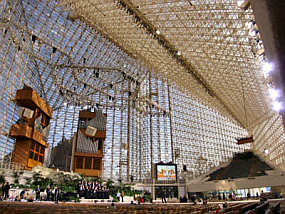
Our tendency in the Church is to want to pitch that tent. This is why we have so many church buildings. In 2007 dollars, the price tag would have been $55 million...That tendency is also why the Lord Himself oversaw the destruction of the temple in 70 AD. He wanted the Church to get out there. To move. To not be tied to one place, to a building that can so easily become like cement shoes.

When it comes to church finances, for many churches, that church building has become the impediment that keeps them from running. Its very convenience slows them down, keeps the people thinking small, keeps them stuck in one place, imprisoned by a multi-million dollar mortgage.

But the temple? Well, you are the temple and so am I. Wherever we are is where the Church is. The Light moves where we move.

Track revivals around the world. Those revivals last until someone decides to pitch a tent, until the building committee comes together. Then it quietly peters out. That’s why revival burns bright in Chinese house churches and not so much here. It’s why God is using the poorest of the poor in today’s world to be the best evangelists of the message of Christ. They don’t even have the money for the tent so many others want to pitch. Somehow, making do with what they have is good enough for them. Because they’ve got another paradigm, a heavenly one.

I can’t help but think that our churches can be better by making do with less. By not being tied to the earth by wealth any more than a lone individual should be. Yet you look at so many church building projects and they seem a lot like this:

And he told them a parable, saying, “The land of a rich man produced plentifully, and he thought to himself, ‘What shall I do, for I have nowhere to store my crops?’ And he said, ‘I will do this: I will tear down my barns and build larger ones, and there I will store all my grain and my goods. And I will say to my soul, Soul, you have ample goods laid up for many years; relax, eat, drink, be merry.’ But God said to him, ‘Fool! This night your soul is required of you, and the things you have prepared, whose will they be?’ So is the one who lays up treasure for himself and is not rich toward God.”
—Luke 12:16-21

I look at that passage and it’s all too easy to see a church enamored of numbers talking about even bigger numbers and a place to store them all. Tearing down the old church building to build an even bigger one, and in the process losing sight of what really matters to God.

As Americans, I think it’s knit into our DNA to have a building. The American Dream’s foundation is built on home ownership, and I suspect that ideal translates into our compulsion to erect a church building. And just as nature abhors a vacuum, a church abhors being plain. Funny how expensive it is to rig up a church building for maximum entertainment and comfort value nowadays.

Between paying staff and paying for a building (and its upkeep and utilities—ask to look at the electrical and heating bills sometime), a big chunk of cash goes away from fulfilling the overall mission of the Church, especially as it pertains to the world outside the walls of that very building.

I think a church that ran without a full-time pastorate and a semi-utilized building would find itself less burdened by titles and mortgages and more burdened by the lost. It would be a church that cornered on a dime rather than running up on the sidewalk like a semi.

It’s a hard sell, though.

I keep hoping some day that we get a flat-tax or value-added tax in this country, but then you’ve got an entire industry of tax-prep and legal people screaming bloody murder that their livelihood—based as it is on the arcane, cryptic mess our tax code is—will up and go poof. I’m sorry, but it needs to up and go.

And so it is with the way we do church, especially when it comes to spending too much of our money on things that may not be advancing the Kingdom. Too many people are deeply invested in the crusty institutions our churches have become. They’ll find a way to hang on kicking and screaming, resisting what may be better for us in the long run, so that they can maintain the status quo.

Unfortunately, the status quo ain’t doin’ all that well for us anymore.

***

Banking On God: Series Compendium

Banking on God: The Tithe, Part 2

Standard

See Acts 4:34-35Today’s post is a tough word that may anger a few people. Asking people to give is always a tricky proposition. In the Church, it’s an even more sensitive issue because we have tied giving with our spirituality. Plenty of churches still exist where one’s piety is measured by how readily one ponies up the moolah.

And that brings us to the tithe.

My belief on giving money within the church is what I call “The Quick, Dead Priest” model. And nope, you won’t be hearing anyone else labeling what follows by that name. I believe, though, that this model best represents the true New Testament model of giving.

The first truth: Christians have been crucified with Christ and are now dead to the world.

The Bible is full of legal truths, the kind lawyers love. And one universal legal truth is that a dead man can’t own anything. Whatever once belonged to the deceased must be passed on to heirs. You can’t take it with you. End of story.

For you have died, and your life is hidden with Christ in God.
—Colossians 3:3

As Christians, we have been united to Christ in His death. The stamp of the death certificate on your life and mine is the cross. Being in Christ means being in no one or no thing else. You, therefore, are not your own. You have been bought with the price of Christ’s death.

Outcome? You own nothing, not even yourself.

Therefore, all this talk of “what is mine” is just that, talk. Christians have no legal precedent to claim they own anything. God may indeed bless you with property and possession, but under the legal system of the Kingdom of God, you are merely stewarding what belongs to someone else. And that someone is God.

The second truth: The death and resurrection of Jesus permanently ended the temple system instituted in the Old Covenant.

This understanding is critical. We no longer perform sacrifices because Christ, the perfect sacrifice, died, satisfying the demand of blood as a covering for sin. Because Christ satisfied all conditions of the Law in Himself, if we are in Him, then we no longer must strive to fulfill the Law. (Don’t believe me? Sit down and read the entire book of Galatians in one sitting. Then read it again for good measure! Follow that up with the entirety of Hebrews.)

One of the hallmarks of the old temple system was the Aaronic priesthood. The giving of tithes in the Old Testament went to support the work of the Aaronic priesthood. The temple economy, based on the tithe of one-tenth, existed to keep the temple system running, to care for the priests (who were allowed no other forms of income under the Law), and to ensure the purity of the people before God through the sacrifices.

But Christ eliminated the old temple system. The sacrifices are gone. The flawed Aaronic priesthood and all that pertained to it, including the mandatory one-tenth tithe used to support it, was put aside, surpassed by the perfect priesthood of Christ. To prove the case even more thoroughly, the Sovereign God oversaw the destruction of the temple itself in 70 AD.

The old has passed away. The new has come.

Under that new priesthood of Christ, you and I are the priests. For all you Protestants out there, the Reformation was built, in part, on the idea of the priesthood of all believers:

But you are a chosen race, a royal priesthood, a holy nation, a people for his own possession, that you may proclaim the excellencies of him who called you out of darkness into his marvelous light.
—1 Peter 2:9

But our priesthood is radically different. It’s a priesthood of equals. It’s a priesthood of community. It’s a priesthood that has God living inside each priest, not in a temple built by human hands. And that truth radically transforms how we must view giving.

The third truth: Each priest in the Kingdom of God in Christ is quickened by the Holy Spirit and that quickening informs giving.

The priests of the Old Covenant did not have the Holy Spirit’s indwelling, hence the need for a man-made temple. The priests of the New Covenant, however, do have God living inside them. We see how that plays out immediately after Pentecost:

And all who believed were together and had all things in common. And they were selling their possessions and belongings and distributing the proceeds to all, as any had need.
—Acts 2:44-45

That concept is expanded two chapters later:

Now the full number of those who believed were of one heart and soul, and no one said that any of the things that belonged to him was his own, but they had everything in common…. There was not a needy person among them, for as many as were owners of lands or houses sold them and brought the proceeds of what was sold and laid it at the apostles’ feet, and it was distributed to each as any had need.
—Acts 4:32, 34-35

Upon being filled with the promised Holy Spirit, the first thing the new priests of Christ did was to ensure that no one among them lacked for anything. They sold houses, properties, whatever, to ensure that the new priests were provided for. The difference in this priesthood, though, was that everyone was a priest, so all were entitled to the largess of the community, not just a certain tribe or class. All. And the payment? Everything, to the point that no one claimed personal entitlement.

Another truth emerges. The new priesthood did not build on the ashes of the old. It was and is a new thing that God has done. It relies not on Law, but on the indwelling Holy Spirit.

God created a new economy and with that economy comes a radically transformed idea of giving:

The one-tenth tithe has been abolished. Totally. It does not persist in any way in the new Kingdom economy.

As the Bible says:

In speaking of a new covenant, he makes the first one obsolete. And what is becoming obsolete and growing old is ready to vanish away.
—Hebrews 8:13

The new standard of giving has replaced the old. The old was for men and women who did not have God dwelling inside them. The old was for men and women who had not been crucified with Christ and therefore dead to the world. The new asks everything of us. It asks for our houses, our possessions, our jobs,our kids, our spouses…even our very lives. It’s all on the table and can be used for the purposes of the Lord any way He chooses, even if that means that we must be martyred so as to accomplish His goals for the Kingdom.

How will you know how much to bring and whether His call on you is to simply give $20 or go so far as to sacrifice your life?

The Bible tells us:

“When the Spirit of truth comes, he will guide you into all the truth….”
—John 16:13a

And

For all who are led by the Spirit of God are sons of God.
—Romans 8:14

The mark of our acceptance into the new economy of God, into His new Kingdom, is that we are led by the Spirit of God. The truth revealed by the Spirit will show us exactly what we should be doing with the money He’s given us to steward.

So how is it that far too many of us cling to patterns of given obsoleted by God’s new economy? Why do so many continue to endorse a ten percent tithe?

Because it’s easy.

It’s easy because it requires so little of us.

It’s easy because it asks nothing of going before God to inquire of Him by the Spirit to know what we should be giving in any and all situations

It’s easy because it doesn’t require us to live by “Give us this day our daily bread.”

It’s easy because it doesn’t ask us to give until it hurts, to take up our cross daily and follow Christ.

And that’s the problem in a nutshell. The old economy asked very little. The new economy in which dead men and women made alive in Christ are priests in a new Kingdom…that economy looks messy, fuzzy, and difficult compared with the old economy. However, the new is one thing the old is not: perfect.

If we want to see the Church be what She is intended to be by Her Bridegroom, then we MUST start living under the new economy of His Kingdom. Not the old economy, but the new.

Now if only more of our churches in America understood this.

***

Banking On God: Series Compendium