

Busting Myths About Christianity: Assessing Myths 1-3

Standard

Cellini's "Perseus with the Head of Medusa"Last week, I proposed ten common myths about Christianity after watching a marathon of the TV show Mythbusters on Christmas Day.  I floated the myths to you readers to see what you thought about them, and also asked how they might be scientifically labeled as busted, plausible, or confirmed.

The Ten Myths:

  1. Christians are more judgmental than non-Christians.
  2. Christians are stingier than non-Christians.
  3. Christians are more intolerant of other people than non-Christians.
  4. Christians are more short-sighted than non-Christians. 
  5. Christians don't know how to have fun. 
  6. Christians despise intellectuals more than non-Christians do.
  7. Christians prefer kitsch over important art.
  8. Christian subculture mimics the world rather than creating anything lasting.
  9. Companies run by Christians are as unethical as secular companies, and perhaps more so.
  10. Christianity causes more problems in the world than any other religion.

I wish I could say that I have the same kind of rigorous scientific data to correctly analyze those myths, but I can't. Like the mythbusters in the show, the best I can come up with is my own personal experience after encountering those myths in my own Christian walk of 30 years. I've personally tested some of those myths in my own life, or I've watched them play out in other people's. Whatever I come up with here will therefore not necessarily apply everywhere. In other words, Your Mileage May Vary.

Onto the first few myths… 

1. Christians are more judgmental than non-Christians

Though the old show All in the Family is rapidly fading from public consciousness, Archie Bunker lives on in the lives of plenty of people. If there's one thing that can be said about Americans, it's that we have an opinion on everything—and we aren't afraid to let others know it. 

Both non-Christians and Christians have their share of Archie Bunkers who compartmentalize everything in life and assign an opinion. The Blogosphere provides a window into the American judgmental mentality as one blog after another (including this one) waxes poetic about the meaning behind everything from commercials for diapers to politics.

Judgments fill the air.

On the whole, though, we Christians can't escape being judgmental. In the end, we're far more judgmental than non-Christians if for no other reason than the Bible commands us to be so:

Beloved, do not believe every spirit, but test the spirits to see whether they are from God, for many false prophets have gone out into the world.
—1 John 4:1 ESV

Now our definition of what constitutes a "spirit" might vary, but if we believe that ideas have spiritual forces (both good and evil) behind them, then a true Christian worldview demands that we constantly judge. Non-Christians can follow the spirit of the age, but we're called to make judgments that keep us off the broad road that leads to destruction.

But what of this?

"Judge not, that you be not judged. For with the judgment you pronounce you will be judged, and with the measure you use it will be measured to you."
—Matthew 7:1-2 ESV

The problem for us comes when we fail to discern the difference between ideas and people. The Lord doesn't ask that we judge people. He alone judges people because only He can correctly judge someone's heart. We're to test spirits. We accept or reject spirits, not people.

Christianity in America can't seem to understand this distinction. This leads us to a bunker mentality at odds with our Lord, the One who ate with prostitutes and tax collectors

In that way, our judging comes back to haunt us. I suspect that one of the main reasons the Church in the United States is so critically unproductive concerns our inability to judge correctly, even though we're hyperactive about labeling and judging others. The outstretched arm we use to keep "evil" at bay also holds others back from knowing Christ.

So yes, Christians are supposed to be more judgmental than non-Christians. Our problem is the way in which we judge and our judging people rather than spirits. It is one thing to make godly decisions, but quite another to be a Christian Archie Bunker.

Assessment: Plausible

***

2. Christians are stingier than non-Christians

A new book entitled Who Really Cares by Arthur C. Brooks tackles the liberal/conservative battle over charitable giving. Brooks details the reality that while liberals talk about helping others, conservatives actually do it. At least they show they do it by the amount of money they give to the less privileged.

Who Really Cares postulates that those people who truly give tend to possess at least three of four distinctives:  a religious devotion, strong families, personal entrepreneurship, and a skepticism about the government's role in economic life. Those traits seem to come right out of Focus on the Family's promotional material, but they underscore the author's point.

What then to make of the perpetual grousing from wait staff at restaurants that Christians are the worst tippers? A few blogs jumped on the fact that wait staff bemoaned the cheapness of attendees at a recent Southern Baptist Convention conference. I had lunch with a pastor a few months ago and he asked our waiter what his least favorite time to work was. "Sunday" was the answer. And I'm sure you know why.

Our generosity—or lack of it—says much about the state of our souls. In too many Christian circles, I believe the prevailing verse might be

The poor you always have with you….
—John 12:8a ESV

That verse becomes an excuse not to help. We gave our ten percent at church, so don't ask anymore of us because, hey, the poor will always be there. In some circles we also hear that the poor deserve to be poor because they're out of God's will (or they're right in God's will and God is simply punishing them right now) or that they simply have not put strategic biblical principles in play to seed wealth and prosperity.

If anything, the call to genuine Christianity entails this:

And all who believed were together and had all things in common. And they were selling their possessions and belongings and distributing the proceeds to all, as any had need.
—Acts 2:44-45 ESV

Does anyone see this actively practiced in most Christian churches in America? I certainly have seen little of that kind of practice on the whole, though I've encountered a smattering of families who truly believe to that level of commitment. On the whole, though, our American mindset of wealth accumulation trumps that Acts passage.

So while Arthur Brooks's study may be true, it's sadly not true enough. The bar the Lord set for giving outstrips our timid attempts, proving us far stingier than we're called to be.

In the end, whether Christians outgive non-Christians isn't really the issue, but whether Christians are giving as much as they should be. In that regard, we're falling down on the job.

Assessment: Wrong question.

***

3. Christians are more intolerant of other people than non-Christians.

This issue parallels #1 since judging people leads to shunning them.

It's hard not to think that we Christians today lead sanitized lives. Certain Evangelicals, in particular, are prone to erecting the kind of suburban Camelots where keeping that "one brief shining moment" from brevity demands one's attention 24/7/365. One day, that kind of idolatry may very well have a name. (I'm lobbying for "Osteenism" for its apt similarity to Onanism.)

Should we be surprised then that messy people bother us? We like our sinners converted and with a side of Prada. Nevermind some hooker who smells like the confluence of a twenty-year-old bottle of Charlie and the back booth of an adult bookstore. We'll erect a ministry to take care of her and man it with new college grads, their idealism still intact. But invite her into Camelot? Puhleeze!

Maybe it's not so much that we're intolerant, but that we've trumped the rest of Scripture with this one verse:

Do not be deceived: "Bad company ruins good morals."
—1 Corinthians 15:33 ESV

Yes, if we go alone into the world of filth, we may be compromised. But if we bring the lost into a community of faith, that's entirely different.

Our inability to accomplish this simple task reflects in the American Church's poor showing in evangelism. By all accounts, the church in this country is not growing. As pollster George Barna notes, 9/11 did nothing to swell our ranks. We're still asleep in the light.

What does this have to do with intolerance? Nothing is more intolerant than letting someone pass into a Christ-less eternity. Yet the knowledge that eternal damnation greets those whose name is nowhere to be found in the Book of Life no longer distracts us from preserving our little Camelots.

"Intolerant" doesn't mean that we have to actively crusade against some evil group or another to win that label. What it does mean, though, is that we simply don't care enough to see beyond some group's perceived evil to the real lost souls behind it.

So while non-Christians may not tolerate others, their intolerance comes to nothing. It simply doesn't matter.

On the other hand, our intolerance means people wind up in a lake of fire without end.

Last month, I quoted the following from Leonard Ravenhill's classic Why Revival Tarries, but it fits here again:

Charlie Peace was a criminal. Laws of God or man curbed him not. Finally the law caught up with him, and he was condemned to death. On the fatal morning in Armley Jail, Leeds, England, he was taken on the death-walk. Before him went the prison chaplain, routinely and sleepily reading some Bible verses. The criminal touched the preacher and asked what he was reading. "The Consolations of Religion," was the replay. Charlie Peace was shocked at the way he professionally read about hell. Could a man be so unmoved under the very shadow of the scaffold as to lead a fellow-human there and yet, dry-eyed, read of a pit that has no bottom into which this fellow must fall? Could this preacher believe the words that there is an eternal fire that never consumes its victims, and yet slide over the phrase with a tremor? Is a man human at all who can say with no tears, "You will be eternally dying and yet never know the relief that death brings"? All this was too much for Charlie Peace. So he preached. Listen to his on-the-eve-of-hell sermon:

"Sir," addressing the preacher, "if I believed what you and the church of God say that you believe, even if England were covered with broken glass from coast to coast, I would walk over it, if need be, on hands and knees and think it worthwhile living, just to save one soul from an eternal hell like that!

It's all how you look at it. And from where I sit today, I don't see us doing much about it.

Assessment: Confirmed, in far too many cases. 

***

Stay tuned the rest of this week for more assessments of supposed myths about Christianity. 

Entries in this series:

{Image: Perseus with the Head of Medusa by Benvenuto Cellini}

Because We Can, We Should?

Standard

I'm not into today's CCM. The worship leader at our church must think me a pagan because I have a blank look on my face whenever she brings up the latest hot Christian band and their equally hot quasi-worship song that's blazing up the Christian charts. Who? What song? Let me guess; it has the same beat as all the others….

Today, I had one of those crazy days of endless errands. Oil change, allergy shots, soccer practice, a ten-item grocery list that necessitated trips to three different megagrocers just to get common items any ONE of them SHOULD have had. You know the drill. So desperate for a little spiritual refresher, I turned on the big Christian radio station in town to hear one of the afternoon teaching programs. Instead I got an earful of tedious music. 

Whither the teaching? Well, the station's booted all its teaching in favor of a non-stop music format. I guess every station wants to be just another vapid K-LOVE clone. In some corporate roundtable, station management decided to give the people what they want rather than what is best for them, thinking that 24/7/365 of the Pablum that passes for Christian music today better enlivens the masses than Ravi Zacharias talking about techniques for witnessing to Muslims.

Ugh. Maybe I'll call 'em up and request Keith Green's "You Love the World (And You're Avoiding Me)."

It's symptomatic of a gigantic problem. 

One of the most worldly concepts you'll find in our culture is this idea that "because we can, we should." Name a moral failing or a political ambition and I'll bet "because we can, we should" empowers it. Abortion and fetal tissue cultivation are the sick offspring of that thinking. You can probably come up with a million more.

Christians are not immune to this mistake. In fact, we rationalize a lot of  "because we can, we should" under the guise of redeeming things. Kids love Saturday morning cartoons? Well, let's make Christian cartoons! Your son wants an action figure? Why not give him a brand-spanking new Jesus action figure complete with a whip to drive out moneychangers and a glow-in-the-dark sword that springs out of his mouth to slay the wicked?

Almost all "Jesus junk" hatches from "because we can, we should."

Truth be told, I feel queasy walking into Christian bookstores. They're so utterly derivative and reactionary that if I were an unbeliever plunked down in one, I'd guess the first stage of being born again is losing one's sense of beauty, creativity, and charm.

Yet for all the WWJD paraphernalia floated over here from Shanghai, a more soul-killing expression of "because we can, we should" exists.

Mysecret.tv is a recent addition to the Web. Some Christian organization thought there weren't enough avenues for confession for Christians, Confession or Gossip?so because the Web exists and is (somewhat) anonymous, it's the perfect medium for confessing one's sins. 
Except it's not. Not in the slightest. Instead, Mysecret.tv stands as a warning to us all, the epitome of "because we can, we should"-ism in the American Church.  

The site raises my ire for a number of reasons:

1. It's pornography. Like some lurid afternoon TV talk show, the site parades sin as entertainment. By offering verbal voyeurism (consider the domain name), it's no different than a hardcore porn site. One click and you can read the details of someone else's failure before God. "But doesn't the Bible show great believers failing?" Sure, it does. But if anyone here's calling for adding Mysecret.tv to the canon, well….

2. It usurps the role of the local church. No doubt, Evangelicals have dropped the confessional ball. Too many Evangelical churches would rather judge than offer grace after a confession. But building a site like Mysecret.tv actually circumvents local churches improving their dealings with confession, sin, and grace. It provides a cheap excuse NOT to fix the problem in our local churches. It asks for none of the commitment inherent in a Christ-centered community, cheapening how we relate to each other in an age when real community in the church is already on its deathbed.

3. It asks for no repentance. Enough said. 

4. It offers no grace. Real grace doesn't come with a disclaimer. Jesus Christ gave us a model for how to dispense grace to the repentant. It's the church body of real people who hear confession, cry with the sinner, and offer grace by the Holy Spirit working through people. But Mysecret.tv expunges all face-to-face restorative human contact. Therefore, by removing the links in the chain of how grace should be dispensed, it offers no grace at all.

5. It offers no accountability. After people confess on Mysecret.tv, what follow-up occurs to help them work through the ramifications of their confession? None that I can see.

6. It offers no restitution. How does one walk out the end product of a confession on Mysecret.tv? Well, if nothing is asked of the people who confess on the site, then no restitution occurs. How that benefits the one confessing is beyond me. 

7. It demeans the death of Christ on the cross. If Mysecret.tv angles to be a Christian-sponsored site that takes confessions, yet offers none of the hallmarks of true Christian confession, repentance, accountability, and restitution, then it's not Christian in the slightest. That mocks the Lord.

I could name a half dozen more failings in Mysecret.tv, but its concession to "because we can, we should" speaks for itself. When considering this site's premise, it appears no one asked if it undermines everything the Church should be. They just plowed ahead and slapped it up on the Web. Alakazam, now you can confess to boinking your kid's babysitter and feel better about yourself for doing so. (And yes, all you grammar mavens, I intentionally wrote that last sentence for maximum {read ironic} ambiguity.)

Is anyone else disturbed that so much of what passes for Christianity in America displays the same hollow core as Mysecret.tv? A group sees a need in the Church, but instead of pursuing tough answers that might require a complete overhaul of how our churches live out the Gospel, they settle for the cheap and meaningless—because they can.

Cerulean Sanctum exists to find ways to better our churches and the people who comprise them. For this treason, I loathe cheap answers to the pernicious problems we face as Christians in America. I see a site like Mysecret.tv and my blood boils. When another blogger told me about the site, and I checked it out myself, my jaw dropped at the utter lack of discernment behind this online confession booth.

(If you're a regular reader of this site, you know I almost never single out a particular ministry or program for scorn. I don't like to name names because so much out there needs to improve, even on good sites. I know that Cerulean Sanctum lacks in some areas. I also know I'm not satisfied with cheap and easy.)

I pray this post gets us thinking about finding the narrow path, rather than the wide, destructive one behind "because we can, we should." Too many Christians trudge down that "because we can, we should" superhighway leaving the rest of us to wonder if we're the ones going the wrong way.

Our response to the problems of our day will cost us something precious. When we're not prepared to pay the price, we'll settle for the path of "because we can, we should."

But Jesus won't be waiting at the end of that road. 

The Character of Christian Characters

Standard

Right now, I’m deeply enmeshed in edits for my novel. My whole being seems wired to the craft of writing at this moment, so I’m reading more fiction in order to stimulate my own chops.

So here comes the off-topic, obligatory writing post.

Having been sick most of last weekend, I finished three novels:

Monster by Frank Peretti

Presumed Guilty by James Scott Bell

Eleanor Rigby by Douglas Coupland

The first two are by Christian authors who typically fall into the Christian market. I can’t say anything about Douglas Coupland’s faith, but he sure can write.

I have some pretenses to being a novelist some day. Hoping to be listed as a novelist who is a Christian as opposed to the standard Christian novelist moniker, my current work is aimed squarely at the secular marketplace. However, having a Christian main character forced my book into the Christian marketplace. Any pretenses I had at being a “bridge” author collapsed the second most secular publishers decided to jump on the Christian bandwagon. With the Christian fiction marketing growing faster than any other (and with sales to match), I suspect I’m typecast. “Your character’s a Christian, well, that’ll be great for our new Christian imprint!”

Ugh.

But I digress…

After reading a book like Monster or Presumed Guilty, I’ve finally concluded why I read so little Christian fiction. It’s not that the writing isn’t good (it’s improving daily), or the stories aren’t interesting (the creative dam has burst in that regard), but I just can’t get past the characters.

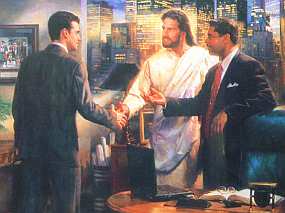
Every time I read a work of Christian fiction, I struggle immensely with the characters. A secular novel like Coupland’s Eleanor Rigby lives or dies by the quality of its characterizations and the quasi-magic-realism that enlivens that author’s works. Hey, Bob, shake hands with the Lord of the UniverseBut every time I pick up a Christian novel, the same question comes through: Who ARE these people?

I feel like the characters in most Christian novels dropped to Earth from another planet light years away from my normal existence.  They don’t resemble any Christians I’ve ever met in my life. If identifying with the characters grabs a reader, each time I read a work of modern Christian fiction, I’m tempted to haul out my old college anthropology texts to see if they can shed some light on the humans that inhabit these books.

Not to pick on Bell too much, but he writes a pastor’s wife with a semi-lurid past who’s been neglecting her husband in the intimacy department. When she hears he just sold a big book deal worth millions, she decides to slither into her  tight jeans and frilly blouse, then put out a couple of glasses of sparkling apple cider. What she doesn’t know is that her husband’s in a motel room getting a few intimacy lessons from a pornstar.

Now I don’t know about you, but I read that and just scratch my head. Never mind that pastors all across this country are supposedly struggling with the issue of how to keep from succumbing to the temptations of the pornstars they counsel. What’s the deal with the tame response of a wife trying to save her marriage? I can’t speak for every Christian woman out there, but is that realistic—even in the slightest? Tight jeans and a couple of glasses of fizzy apple cider? Now one could assume that Bell’s not trying to titillate here, so he plays to the censors and keeps it tame. But then the husband’s out having an affair with a pornstar, so what’s the titillation factor on that one?

This illustrates the problem of plastic characterization that’s the bane of most of the Christian fiction I read. The people in these books don’t talk, pray, romance, play, or act in any way that seems real.

In contrast, when Coupland talks about the peace his protagonist’s made with her loneliness, man, I’m right there inside her head:

We cripple our children for life by not telling them what loneliness is, all of its shades and tones and implications. When it clubs us on the head, usually just after we leave home, we’re blindsided. We have no idea what hit us, We think we’re diseased, schizoid, bipolar, monstrous and lacking in dietary chromium. It takes us until we’re thirty to figure out what it was that sucked the joy from our youth, that made our brains shriek and burn on the inside, even when our exteriors made us as confident and bronzed as Qantas pilots. Loneliness.

Now you may not agree with all that, or fail to identify with each point, but I’ve got to believe that some of that got through and resonated on some level with you. More so than a wife hoping to spice up her marriage with a bottle of sparkling apple cider.

The curse on all Christian fiction is not that Christians are a diverse lot and not every characterization is going to work, but that Christians are a diverse lot, yet we seem to be ashamed of our own diversity. We don’t tend to enjoy living all that much, either. There’s dying to self and then there’s asceticism.

If I wrote that pastor’s wife, I’d have her go out and buy a fake fur, a bottle of good port, and then have her greet the husband holding two full glasses, wearing the fur, a smile, and nothing else. Why? Because it’s more real, more alive, more human. And most of all, it’s more joyful.

But here’s where the shame at our diversity comes in. As real as that might be as I choose to pen it, too many Christians would howl. And they’d probably howl as much about the port as they would the naked pastor’s wife in a fur. Others would have no problem with a scene like that. But to make all characters palatable to all persuasions of Christians, we have to whittle them down until they’re unrecognizable.

What that leaves is characters who are curiously two-dimensional, free of zest, and who epitomize a sort of barrenness that should never be part of a grace-filled life. Worst of all, it salutes characters who were more interesting prior to meeting Christ than afterwards. What a sad statement to make!

Perhaps we Christian readers are too easily offended. I know so many Christians who watch a show like Desperate Housewives on TV, then turn around and shout out, “Well, I never!” when reading a Christian work that deals with the same content, albeit with true redemption offered. Maybe we like plastic characters who endorse our particular brand of Christianity, even if we ourselves don’t resemble those characters.

Several Christian novelists read this blog, and if you’re reading this now, I hope that I haven’t offended you in any way. Truthfully, I feel for the situation we’re in, always trying to please all of the people all of the time. I know that I’ve struggled with that immensely in my novel, where the characters enjoy wine with a meal, have never read Joshua Harris’s I Kissed Dating Goodbye, enjoy dancing, and grow in the Lord by ditching sanitized Evangelical stereotypes of what two twenty-something Christians must be.

We can do better if we move beyond appealing only to the widest audience. Christian fiction is growing, but if we’re to truly write redemptive works, we’ve got to take more chances. The call is out to be “grittier,” yet Presumed Guilty is as gritty as it can be, while still giving us characters whose Christianity is so odd that we can’t relate at all. Nor do we need to foul up our Christian characters until they’re just one smidgeon away from being considered unregenerate. Just make them real people, even when they’re facing unreal circumstances.