

The Pastor: Not One of Us

Standard

Blood on the collar?Does the title of this post bother you? It bothers me.

I’ve known pastors in my life who crashed and burned. They flamed-out, transgressed, or a combination of both. In each case, he faded into the ether like some double-agent, either by choice or by his ex-congregation expunging his name like he’d never been in the pulpit.

No vulture-like obsession with the carrion once known as Ted Haggard washed over me, but reports that he’s hightailed it out of Colorado Springs still caught my eye. Made me shake my head, too, but not for the reasons one might think. Everywhere one looks in Evangelicalism, the story’s the same: pastor falls, congegation responds by acting like he never existed, and he’s out of town on the next red-eye to Obscurity.

Time and again the unintended message we Evangelicals send to the world shows that we don’t truly bury our wounded, as goes the common in-joke. Instead, we act is if they were never part of us to begin with. “Our wounded? No, someone else’s wounded.”

You encounter a lot of handwringing in some sectors of the American Church from those upset at a lack of church discipline. Why is it then that this group typically consists of those who fire their fallen pastor, kick him while he’s down, and run him out of town on a rail? They decry the fact the Church can’t seem to discipline, but is it “discipline” for them to toss their pastor’s carcass on the burn pile and wipe their hands clean of the whole mess? What kind of church discipline is that?

The way we operate in American Evangelicalism forces our pastors into a no-man’s land of fellowship. We may crow about our renowned community, our loving fellowship, and on and on, but if we were honest with ourselves we’d have to admit that holds true for everyone BUT the pastor. He’s different. He’s not truly one of us.

Part of the problem comes from our shocking inability to raise up pastors within our own congregations. I would venture to guess that at least 90 percent of churches are pastored by the product of some other church’s educational system. He didn’t grow up in the church he pastors. Has no real familial ties to the church, either. He’s already an outsider from the second he takes the call. This disconnection of history and relationship only further aggravates the tendency to affix him to the pyre the second a problem arises.

In some churches, we’ve also developed this wacky idea that the pastor is Wholly Other, like some enlightened paraclete who transcended to a lofty plane inhabited by the rarefied likes of Paul, Moses, Peter, and Elijah. His decision to leave Abraham’s Bosom to visit us poor mortals is almost shocking in its humble bravura. So when he finally stumbles like a normal human being, we—like some cannibal tribe no longer impressed by our white-fleshed gods who descended to us out of the belly of a metal bird—cook the poor sucker and eat him.

But any quick perusal of the New Testament makes it pretty clear that the Lord Jesus wanted his Church to be brothers, not lords over each other. The pastor is not first among equals; we’ve made the mistake of equating him with Christ Himself. No, the pastor’s a fallen human just like you and just like me.

In that case, why is our discipline for pastors so radically different from what we mete out to others in our congregations?

Perhaps we need an adjustment of how we view pastors. Not that we hold them to some slack standard, but that our dedication to restoration match our swiftness to discipline.

Restore a fallen pastor? What a novel idea! I’d love to see it happen. In truth, I’ve never seen it happen. I’ve seen pastors blackballed from their denominations, but I’ve never truly witnessed one restored to his own congregation.

It shouldn’t be that rare. In fact, it should be the norm—at least the way I read the Scriptures.

As long as we’ve got this pedestal we put Church leaders on, we’ll continue to see assaults on the pedestal and the persons atop it. What happens when the whole thing comes crashing down should be something we address in a healing community. Instead, we heat up the tar and feathers. No wonder these guys vanish like smoke.

Sure, once in a while a real con artist dons a clerical collar, but I suspect that most guys who get into the ministry do so because they genuinely love the Lord and love other people. If all have sinned and fallen short of the glory of God, then there’s not a guy preaching today who’s not guilty of something. If we blackballed them all, we wouldn’t have a Church. Still, people line up to cast the first stone…

In the end, the messages we send to those in the pews when we run guys off like this should cause us some real soul-searching. I could post on those messages for the next week, but I’ll leave you to think about the between-the-lines preaching we do to the impressionable in cases like these.

Oh, well, why not just one: Don’t you ever mess up or we’ll treat you like toxic waste, too. Doesn’t sound very Christ-like, does it?

I’d love to see a Church that treats pastors as fellow laborers and saints, not grand exalted poobahs. A Church that deals wisely with a pastor’s sin, rather than marking him like Cain before he’s driven off into the wilderness. But to get there, we need a total paradigm shift in how we view THE MINISTRY or else we’ll perpetually fall into the mode of shooting first and asking questions later.
Words, and How Not to Use Them

Standard

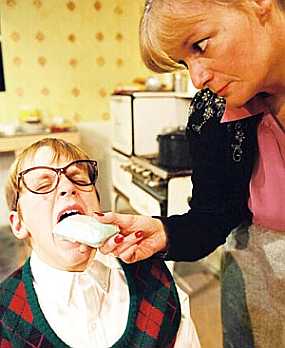
I'm going to wash your vulgar mouth out with soap!

“Heh, heh, heh, heh, Beavis, John Piper said, ‘ass.'”

On the heels of my post yesterday about confronting the F-word comes my response to the hubbub about Pastor John Piper’s comment at a conference that sometimes “God kicks our ass.” Wayne Grudem felt led to jump into the fray concerning Pastor John’s potty mouth. And, of course, half the Godblogs in my sidebar links could not resist the compulsion to comment.

I guess I can’t, either. My reaction: yawn.

This is the kind of Evangelical rathole that makes Christians the laughingstock of the world. We’re not seen as a joke because we follow a risen Christ, but because we’re so obsessed with filtering out gnats while gorging on camels. When the lost can see it and we can’t, does that honor God at all?

The Bible says this:

And the tongue is a fire, a world of unrighteousness. The tongue is set among our members, staining the whole body, setting on fire the entire course of life, and set on fire by hell. For every kind of beast and bird, of reptile and sea creature, can be tamed and has been tamed by mankind, but no human being can tame the tongue. It is a restless evil, full of deadly poison. With it we bless our Lord and Father, and with it we curse people who are made in the likeness of God.
–James 3:6-9 ESV

Reread that italicized portion. Therein lies all you need to know about “those words.”

You see, real profanity is not contained in a word found in a dictionary. Words only have power when they possess intent and direction. The very fact that many Evangelicals equate cursing with saying a naughty word shows how we’ve lost all wisdom. A true curse has the intent of damaging another person. It’s a wish the sayer hopes to see come to fruition. In a way, it’s a kind of magical incantation designed to wound.

That we’ve so fully jettisoned that understanding is why people get upset about Piper’s comment.

Let me make myself clear. Piper saying that sometimes “God kicks our ass” isn’t profanity, by any means. On the contrary, if I need to hear that God’s going to kick my ass, then please tell me and use the strongest words possible! The word ass here doesn’t matter one way or another. What matters is whether we are cursing our brother. And Piper clearly was not doing so.

This is why many of the very people who get all flustered over a word like ass are the same people who are likely to say, “You’re a wicked heretic, and God is going to punish you.” No “bad words” uttered, but the direction and intent of the words are meant to attack another human being. If those words are true and inspired by the Holy Spirit who can see into the hearts of all men, then no foul. But if they are not, they bring destruction upon a person made in the likeness of God. They are a curse.

We Evangelicals simply do not grasp this. Any casual glance around the Godblogosphere every day shows one Christian cursing another. Comment sections in Godblogs are filled to the brim with accusations of heresy, cutting remarks, and snide assertions about other commenters’ eternal destination. In the vast majority of cases, those words are curses against a fellow brother or sister in Christ. Yet not one of George Carlin’s infamous “Word You Can’t Say on the Radio” is ever uttered.

The unbridled tongue that God hates isn’t the one that says, “God kicks our asses.” It’s the one that says, “The guy in the cubicle next to mine at work is a real ass.” There’s no cursing in saying, “I will die.” On the other hand, “I hope you die!” is a curse before God when said against another human being.

All this hoopla comes off as just another case of Evangelicals missing the point in their rush to appear holy. Do we think that 80 years of never uttering a “dirty word” is going to look good in heaven when every day we tear down another person with our supposedly clean words?

God forgive us for missing the point!

Busting Myths About Christianity: Assessing Myths 7-8

Standard

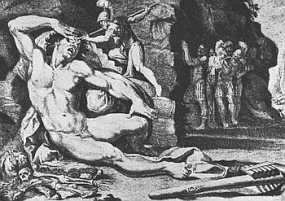
Odysseus blinding the cyclops PolyphemusOver the last week, we've been looking at commonly heard statements about Christianity that have taken on mythical proportions. It's hard  to be a Christian in the West and not encounter these myths: 

  1. Christians are more judgmental than non-Christians.
  2. Christians are stingier than non-Christians.
  3. Christians are more intolerant of other people than non-Christians.
  4. Christians are more short-sighted than non-Christians. 
  5. Christians don't know how to have fun. 
  6. Christians despise intellectuals more than non-Christians do.
  7. Christians prefer kitsch over important art.
  8. Christian subculture mimics the world rather than creating anything lasting.
  9. Companies run by Christians are as unethical as secular companies, and perhaps more so.
  10. Christianity causes more problems in the world than any other religion.

Today, we'll look at myths #7 & #8:

7. Christians prefer kitsch over important art

As the Church of Jesus Christ grew and expanded, it touched nearly every art form. The Gospel's revelation of the divinity of Christ and His human nature resulted in a synthesis that ultimately broke the back of gnostic religions. This, in turn, created an environment in which art flourished, as God's coming to Earth as Man hallowed imagery.

But while the important artists that forged the backbone of Western art identified as Christians, the 19th century saw an increasing backlash against the realism that undergirded Christian art up until that time. With the coming of German higher criticism in the late 19th century, questions about the veracity of Scripture led to questions about absolute truth. The resulting cultural decline reflected in art that deconstructed itself.

Christian artists, unable to fend off the trend, either stayed true to their art and faded into profitless obscurity, or they pandered to low culture in an attempt keep bread on the table. When modern marketing techniques raised advertising to the level of popular art, the culture rewarded ad icons. Those icons, when mass marketed, led to an even lower form of art now known as kitsch.

I suspect that the rise of fundamentalism on one side and higher criticism on the other, dealt a death blow to Christian art during the Great Depression. Fundamentalists, in an entrenchment move, lumped all contemporary art into the category of "potentially evil," and this spilled over into the Evangelical consciousness. As a reaction against the supposed judgment that fell upon this country for the Roaring Twenties, Fundamentalists pushed hard against all forms of profligacy, and art, as a whole, suffered in that wake. Art, in general, lay damned.

But God built a creative spirit into man, so that desire to create needed a channel. What it got was a version of art that combined advertising imagery with a new sanitized Christian "ideal." And popular art, especially by Christians, has not recovered.

In her seminal book, A Profound Weakness: Christians & Kitsch, Betty Spackman argues from two sides of this issue, at once decrying kitsch as poor art, while acknowledging that it can still carry meaning for Christians. More to the point, she makes a bulletproof case that much of what passes for Christian art today is more kitsch than art, and that recovering a true appreciation by Christians for more masterful art may be difficult given the current state of Christian subculture around the world.

When all of Evangelicalism in the West is considered, it's hard to escape the truth that kitsch dominates our expression. From our "His Pain, Your Gain" t-Shirts to "WWJD" jewelry to modern megachurches, Christian culture perpetuates kitsch over substantive works, the typical Christian bookstore replacing the secular museum. Worse yet, the average Christian today can rack his brain and not come up with the name of a contemporary Christian artist—with the possible exception of Thomas Kinkade.

The problem of Christians and kitsch extends to all parts of the creative life within the Church. As kitsch itself is a derivative form, so too many creative endeavors within the Christian community lack a true defining Christianity, instead adding a Christianized coating to secular forms. What a true Christian expression of the arts might look like in the 21st century is yet to be seen, but we all should hope to live long enough to witness its full blossoming.

Assessment: Confirmed

*** 

8. Christian subculture mimics the world rather than creating anything lasting

Our affinity for kitsch means Christian expression cannot avoid including it at the core of our subculture. As mentioned above, the derivative nature of kitsch means the art itself has come from some other source, itself often derivative. Christians attempting to create out of that limited pool come off as pseudo-sanctified mynah birds, rather than images of the Spirit as dove.

For this reason, contemporary Christian culture in the West lives more off a perverted form of its past than a vital present. When the Reformation is reduced to a derivative t-shirt, it's hard to argue that modern Christians care one iota about leading culture, preferring instead to be culture's dog on a leash.

Appealing to cultural relevance only worsens the problem, pulling the Church down into the world's cultural cesspool. Though not all of modern culture should be viewed at arm's length, sadly, the aspects deemed most usable by the Western Church are the ones most needful of discarding. Sure, it may be possible to erect something intriguing out of rusty tin cans, but is that redeeming the time we've been given by the Lord?

Until the Church in the West abandons its love affair with redeeming the sleaziest parts of our culture, most of what we redeem from it will be garbage. And derivative garbage, at that. Encouraging folks guided by the Lord to create new directions in culture—leading, not following—and backing their gifts wholeheartedly is our only hope.

Assessment: Confirmed 

***

Stay tuned, the final two myth assessments still to come… 

Entries in this series:

{Image: Odysseus blinding the Cyclops Polyphemus