
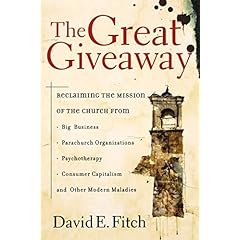
 David E. Fitch’s The Great Giveaway: Reclaiming the Mission of the Church from Big Business, Parachurch Organizations, Psychotherapy, and Consumer Capitalism is the best Christian book I’ve read since Nancy Pearcey’s Total Truth. A fantastic primer discussing how the Church must live in a postmodern age, The Great Giveaway examines the ways the Church bowed the knee to modernism and gave away her soul. By allowing alternative scientific approaches to spirituality to trump the Gospel of Christ, the modern Church distanced itself from historic faithfulness. In keeping to this premise, The Great Giveaway does not attempt to critique postmodernism, but finds the everlasting truths of Christ and asks how they reveal themselves in this age.
If that sounds like emerging church rhetoric, trust me, it’s not. Fitch manages to step out of the emerging church versus traditional church battle and show where each is lacking. What makes The Great Giveaway better than all the books critiquing the American Church today is that Fitch not only sees the problems, he offers the best solutions I’ve encountered. (Much of what you’ve read on Cerulean Sanctum since the inception of this blog is mirrored in the pages of The Great Giveaway, so if it sounds like I’m tooting my own horn here, I’m trying to be as objective as I can under the circumstances.)
Is this a perfect book? By no means. Serious flaws spring up here and there. A couple months ago a commenter asked how I could recommend flawed books. (I had issues with some of the concepts in Randy Frazee’s two books, though I recommend them highly). I’d like to turn that around and ask what books besides the Scriptures are without flaws? Discernment, so utterly lacking in the Church today, necessitates that we read every book by every author—our favorites or not—with an eye toward error and truth. Real discernment is not blanket condemnation, but rather wrestling with ideas with the aid of the Holy Spirit and the Scriptures.
The Great Giveway features the following chapters, and I’ll deal with each in turn this week:
- Our Definition of Success
- Evangelism
- Leadership
- The Production of Experience
- The Preaching of the Word
- Our Understanding of Justice
- Spiritual Formation
- Moral Education
Our Definition of Success
Overview
Fitch begins his book with an easy target: “Megachurchianity,” as I call it. Numbers, he writes, do not translate into faithfulness. Church Growth Movement thinking owes more to business principles than Scripture. The result of working toward bigness is a consumeristic outgrowth of church that places rugged individualism and business efficiency at the core of church health rather than faithfulness to Christ. Faithful churches instead center their life in Christ and genuine community. That community is measured by real relationship with fellow believers that speaks hard truths into people’s lives, sees the need for confessing sin in a grace-filled local body, and calls on church members to partake in discerning prayer needs for each person’s life and the church as a whole.
Comments
Since most of the people who read Cerulean Sanctum agree that an obsession with numbers tends to curtail real discipleship, I have little comment. The Great Giveaway starts with an easy target and doesn’t add much to the discussion. We agree that consumerist Christianity fails. We know how megachurch religion missed the boat on every living and active part of the Church. Fitch doesn’t add much to the conversation. Think of this chapter as a touchstone for everything else that follows.
Evangelism
Overview
Fitch points out that postmodernism is the death-knell to evangelism that relies solely on apologetics. Postmoderns are not impressed by talk that does not follow walk. In fact, walk is proof of talk. Postmoderns are much more willing to listen to Bible truth when that truth is preceded with Bible walk.
Evangelical obsession with evangelistic methodology comes at the expense of real relationships with people. We’re more interested in getting someone saved than being their friend. The days of that thinking are numbered, though. What people today need to see in Christians is the actual living out of the evidence of Christ in us. This puts the evangelistic onus back on the community of believers rather than the individual. Individuals can still attest to Christ by their own life changes and Christ working through them, but the real power is in a transformed community. The early Church’s influence came about because people saw Christ in that community.
To that ends, hospitality, praying for others in need, showing mercy to those who desperately need it, and bringing justice to those without it are stronger evidences of the veracity of Christ than merely running through The Four Spiritual Laws or The Romans Road. Fitch by no means subjugates the Scriptures to experience, but instead shows that love overcomes roadblocks that enable the truth of Scripture to permeate the hardened hearts of people today. It’s the sun that melts the snow in Isaiah 55:10-11.
In an age when we in America have virtually no sense of real community, developing a worshipful community that embodies genuine relationships that alter how we live every day should fuel our evangelism. Fitch also seeks to recover the importance of our baptism into a worshipping community, stating that too much attention has been put on one singular act of conversion and not enough on the kind of long-term discipleship that Christ calls for in the Great Commission. He also sees Church planting as the healthy expression of a growing church rather than the tendency to grow into a megachurch.
Comments
We need to always be careful when someone states that God’s Word needs outside proof to be reconciled as true. Postmodernism’s obsession with avoiding absolute truth is infamous, but I don’t believe that Fitch is saying that walk makes talk true. God’s Word is true by itself. However, to a generation raised on hearing the Bible constantly—who can truly escape it in America?—but without seeing it practiced much by the Church, we need to consider how we walk out what we believe in front of others because our walk is supposed to be a reflection of the truth of the Gospel.
The failure of church bodies and individuals to live out what they believe is largely responsible for the mess we see both inside and outside our churches. Call it sin, unbelief, or laziness, but whatever the label, we blew it.
I agree with Fitch on most every comment and solution he offers in this chapter. We Christians do need to start living as an alternative community within the larger society rather than finding the church co-opting that society’s patterns of living and broken solutions to problems.
If I have one problem, I don’t believe that planting more churches is the answer. We have enough churches. Now if an existing church is growing so large that it naturally must subdivide, that’s a different response than simply planting churches. I think Fitch favors subdivision, but he doesn’t make that entirely clear when he discusses church planting.
The review of The Great Giveaway continues with Part 2 and Part 3 .
 Psychologists of the 1950s had discussed the need for small encounter groups, but that idea didn’t express itself until the 1960s and the experimental groups of Big Sur. (The less said about them the better.)