When I was small, I found comfort in something beautiful: the sound of laughter in my house. Mom and Dad liked to entertain, and I remember cold winter nights when the chill outside was dissipated by the sounds of adults talking and laughing into the wee hours of the morning. I’d fall asleep to those sounds knowing all was right with the world.
I fear my son won’t know that same pleasure, not because we don’t want to entertain like my parents once did, but by the sheer fact that it’s increasingly rare in our society that others come over for anything. According to Robert Putnam’s seminal work, Bowling Alone: The Collapse and Revival of American Community, nearly every social group that existed in American culture in the 1960s has seen precipitous drops in members or involvement.
Putnam warns that our stock of social capital – the very fabric of our connections with each other, has plummeted, impoverishing our lives and communities. Putnam draws on evidence including nearly 500,000 interviews over the last quarter century to show that we sign fewer petitions, belong to fewer organizations that meet, know our neighbors less, meet with friends less frequently, and even socialize with our families less often. We’re even bowling alone. More Americans are bowling than ever before, but they are not bowling in leagues. Putnam shows how changes in work, family structure, age, suburban life, television, computers, women’s roles and other factors have contributed to this decline.
—From the webpage description of the book.
The title stems from the loss of bowling league membership in small towns, and in a frightening bit of correlation, I once spent an afternoon bowling alone in Silicon Valley for no other reason than no one else wanted to come. Worse yet, for the hour I was there, I was the only bowler in the alley.
Indeed, like its currency-based counterpart, social capital has value critical to the social economy of this country. Conserving social capital should be the hallmark of any belief system that calls itself conservative, but in an odd bit of data, Putnam’s own studies showed one of the most social capital impoverished portions of the country is the conservative South.
Alarmed by the data from Putnam’s book, a committee of top sociologists, intellectuals, historians and politicos convened at the University of Pennsylvania to discuss the findings and possible recourse. Their conclusion:
Incivility and coarseness are a continuation of behaviors that have always been with us. However, these behaviors are greatly amplified by the new economic dynamics of mass markets, by the new technologies of mass communication and by laissez-faire governmental policies.
The tender web of society depends on people, but we’ve instead chosen compartmentalizing technologies and cheapness.
 I grew up in what was a brand new subdivision in 1972. We were one of the first residents of that new neighborhood, watching houses go up and people move in. A mostly Catholic neighborhood developed with us Lutherans and the AoG pastor at the end of the street.
I loved that neighborhood. Most of the people were seasoned marrieds with kids in elementary and junior high school. Plenty of other kids to play with. I was ten, the perfect age for navigating both the slightly older kids and slightly younger.
One of the things that neighborhood did that impressed me is that very early on they started having block parties once a year. Amazingly fun, these were the single most anticipated events of the neighborhood year. We ate, drank, played, danced, celebrated and enjoyed an entire day of fun.
Time passed and the neighborhood got a little older. A few couples divorced. Those two or three “life-of-the-party” couples moved away. The kids got older and a second generation of people moved in. That life-affirming decade of block parties came to a crashing halt.
When I returned to that old neighborhood after my first stint in college, a few houses had some new toys: Beta and VHS videotape players, plus video game players. More houses now had personal computers, too, the 128k Macs, PC XTs, and PC Juniors of lore.
I stuck around that neighborhood for a few years, but didn’t notice the change initially. One fine spring day I glanced outside to find a curious sight: an empty street lined with empty yards.
As a kid, we’d played in the dead-end street every day. The yards were big enough to host a football game if you played across three of them, or a softball variant we played constantly called Zoneball.
Yet despite knowing that a few dozen children still lived here, I saw none Even the ones who were toddlers when I moved in and would have been outside weren’t.
A couple months later, a strange thing happened. Gorgeous June day, blue skies and sun, and the power went out at 6:45 PM. From a lawn chair on my parents’ porch I witnessed a curious exodus, as the neighborhood residents gradually stumbled out into the bright sunshine and started talking to each other.
By 7:00, the streets and yards were filled with kids playing an impromptu game of kick-the-can, just like I had done for so many summers. The old neighbors reminisced, then pulled the new neighbors into the conversation. The energy level? Block-party-sized. You could feel the life.
But around 7:30, the unmistakable hum of air conditioners starting up broke the electrical silence. By 7:45, emptiness reigned once again.
Till the day I die, I will never forget watching people break up and head for their front doors.
The TV, VCR, Computer, Video Game—pick a device—called like sirens and we obeyed. I took a stroll up the street, watching people through windows, each one parked in front of this tech gadget and that. The tech gods are indeed unappeasable.
Flash-forward twenty years and we loyal consumers opened a vein and told Sony, Panasonic, Apple, Microsoft and others to jack us in. Best Buy is the new worship center, its blue-shirted acolytes preaching to our itching ears that a 40″ TV is passé—60″ is the new hotness.
In his book Why We Don’t Talk to Each Other Anymore: The De-Voicing of Society, John Locke discusses studies that show that our dependence on technology for communication is damaging our ability to read instinctive social cues. Young people accustomed to interacting through computers and cellphones find that they can’t gauge other people’s feelings when confronted with face-to-face interactions. The result is an increasing disconnection between what one person communicates and another understands.
When a society can no longer interpret agreed-upon social cues, it won’t take Visigoths storming the gates for societal collapse to occur.
But what of the ultimate social capital bank, the Church of Jesus Christ?
A couple months ago, I petitioned readers to answer a few questions about their financial and living situations. One of those questions asked, “Do you live within thirty miles of extended family?” To my utter shock, out of the dozens of responses I got via comments and private e-mails, only about 10% answered positively.
Christians answered those questions, not unbelievers. But if we Christians–who so nearly make an idol of family with our rhetoric about it–aren’t near our extended families, then what of all our talk?
Joseph Myers wrote in his popular book, The Search to Belong: Rethinking Intimacy, Community, and Small Groups, that we Christians can no longer expect people to come to our homes since many are fearful of stepping across the threshold into another’s residence. If this is true, then we might as well pack up and turn out the lights.
Is it any wonder then that consumerism bedevils American Christians? If what God gave us to conserve is gone, why not find fulfillment in the latest tech gadget?
We used to be producers. Pre-Industrial-Revolution America saw capitalism flourish in home-based economies. Both parents worked at home. Both parents taught the kids. Both parents and children produced out of their home.
But after the Industrial Revolution, as our economy was wrongfully forced into big business models and city-living, the home’s essence as the base of family operations withered. The Church abetted that little death by failing to question this so-called march of progress. Instead, American Christians marshalled the parade of efficiency and championed late-19th and early-20th century triumphalism .
Consumerism rushed in to fill the void. Consumption replaced community. Advertising pitted the Joneses against the rest of humanity, handing us a new national pastime. Social Darwinism stirred that pot and told us that it was us or our neighbor, but it couldn’t be both. Someone had to win. Might as well be us.
If we wish to know why the “Church of Me” predominates today, why churches are filled with folks who want to know what’s in it for them, then we need only ask what happened to the home. We need to ask if modernism, postmodernism, industrialization, and globalization are bad for families, churches, and communities.
Destroy the home and you ultimately destroy community. Oddly, I hear no Christian leaders today arguing for a return to home-based economies that fuel local communities. A few might be trumpeting the single-wage-earner households that homeschool, but that’s a band-aid on a bigger problem. Until we can find a way to resurrect real home-based economies, well never see an end to the relentless onslaught of consumers trickling out of polished McMansions demanding that churches tickle their ears till the thrill departs and so do they.
No matter how much we talk about community, we simply don’t have real community in our churches. The Church in Acts broke bread in each others’ houses every day! And that was possible because of how they worked and lived out of home-based economies.
I think one of the reasons that revival has been so elusive in America since Azusa Street a hundred years ago centers around the fact that home-based economies afforded people the chance to linger at church to see revival. Can you imagine anyone today calling his boss and saying, “I can’t come into the office because revival broke out at our church?” That guy’d be pinkslipped the next day.
I think we can resurrect true community, the kind where you watch my back and I watch yours, but it’s going to take paradigm-shattering effort to do so.
A few ways to begin:
1. Stop with the materialism! Start getting rid of what we own. Stop letting what we buy rule us.
2. Start asking our pastors why they’re preaching that it’s okay for mom to stay at home, but not mom AND dad? Start asking how we can restore home-based economies that support the family, which supports the local community, and ultimately enhances the church community.
3. Start talking with other people we know about their always-going, non-stop-consuming lives. Create some dissonance in the standard thinking that we have to be robots who serve the State by perpetually buying things.
4. On the Web sites of prominent American Church leaders and their churches, bring up these questions and ask how real community can be restored.
5. Put people first, not things. Contact friends we haven’t spoken with in years. The alarming statistic for married men over forty shows that those guys have only one other man (or two) they consider to be a close friend. Time to better those numbers.
6. In church meetings, start brainstorming ways to keep people entrenched in the local body. Start questioning the need to chase work all over the country, too (one of the main reasons so few of us live near extended family). Americans are moving every seven years—and that number is getting smaller. We can’t experience real community in our churches if we’re turning ourselves over like that.
7. Make your home an open home. Find ways to make your home a nexus of community. Let your kids know that your home is for others; encourage them to bring friends over. Practice hospitality at all times. Start a block party.
8. Pray through your church directory. Then start inviting two or three families at a time to your house.
9. Develop relationships with local merchants. Consider the extra money you might spend at their place of business (versus a Category Killer or Big Box store) a tithe to the development of godly community.
10. Reject pat answers. We’re too busy, too tired, too disconnected, and too socially bankrupt. Time to divorce the status quo.
Despite the fact that our churches preach a form of Gospel today that is completely individual-centered, Jesus founded a Church, not disconnected individuals. It’s time we start thinking about Christ in Community and not always Christ in the Individual. But to get there, we have to be bold and question everything our society and our churches hold up wrongly as sacred, questioning assumptions in our churches that are based on non-Christian ideals and not on the Gospel of Jesus Christ.
We can have true community folks, but it’s going to cost us to get it back.
What are you prepared to give up to make it happen?
***
Other posts in the “Unshackling the American Church” series:

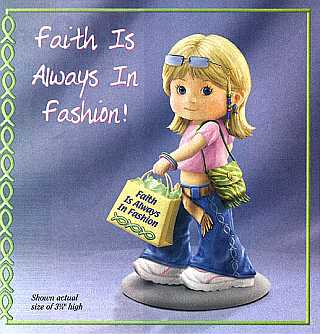 Strong’s Concordance lists that troubling word mammon as “avarice (deified).” A better definition one cannot possibly hope to unearth. Unearthing a Church buried under layer after layer of avarice deified, on the other hand, poses a challenge to us American Christians, so inured are we to the materialism that masquerades as legitimate culture in this country.
 What I cropped out of the picture is the sickening description for this figurine. You can find it at left. As a freelance commercial writer who’s a Christian, I’d rather be dragged over a pile of broken glass with an alcohol bath chaser than write what you see reproduced here.
 I promise my series on "Unshackling the Church" WILL continue, but I cannot write the next installment, which deals with community and fraternity, unless I go back to what is basic. Milk.