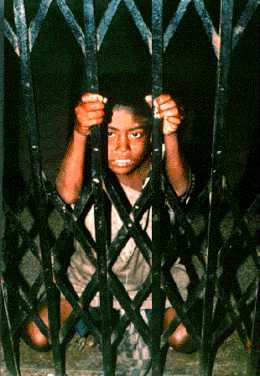
We’re thinking about putting our son in public school this August.
We homeschooled him via a public e-school this year and personally experienced the Achilles heel of homeschooling: lack of socialization. As an only child in an area where almost all the children go to public school, our son suffered from piecemeal contact with other kids and it showed. Yes, we have him in activities with other kids. It simply hasn’t been enough.
In addition, because he’s an only child, he needs to be in an environment where he’s not the center of attention all the time. Homeschooling works totally against that idea. Nearly every growth area he needs to improve in can best be met by hanging out with a large group of kids for long periods of time.
But when I mentioned this reality to a friend the other day, I received a rather pointed response:
“You’re handing him over to the Canaanites.”
Hmm.
What followed was the usual explanation of how anything but education in an exclusive private Christian school will permanently warp our son. We’ll be totally unable to counteract the brainwashing he’ll receive in public school. 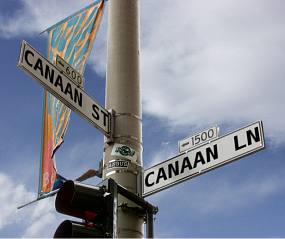 For our decision, we’ll end up with a child who grows up to be one part Bertrand Russell, one part Aleister Crowley, and one part Ted Bundy.
Thank you, NEA.
Or actually, thank you Baptists.
You see, two Baptist megachurches in our rural town control much of the public school district. Folks from their congregations make up a big chunk of the superintendents, principals, and teachers. Considering that these two churches try to outdo each in moral rectitude, I highly doubt first graders will be forced to read Heather Has Two Mommies.
But all this is beside the point.
No, some think the private Christian school education must be superior because it has better people in it. Along the road I live on, many families live in trailers, sectionals, and double-wides. They tend not to send their kids to private Christian schools for no other reason than they can’t pay the tuition.
Truth is, most people making a household income less than $100,000 a year can’t pay to send their children to private Christian schools.
Which leads to the heart of this post:
And the LORD spoke to Moses, saying, “Speak to the people of Israel and say to them, I am the LORD your God. You shall not do as they do in the land of Egypt, where you lived, and you shall not do as they do in the land of Canaan, to which I am bringing you. You shall not walk in their statutes. You shall follow my rules and keep my statutes and walk in them. I am the LORD your God.
—Leviticus 18:1-4
No matter what we do in the United States of America, we’re forced to choose our Canaan because we aren’t a theocracy like Israel was. As much as the Lord wants us to follow Him exclusively, we Christians aren’t called to bunker ourselves against the rest of the world. We’re called to shine our light amid the darkness. And where is the darkness? Everywhere we look.
And sometimes, it’s oh so disarmingly subtle.
Whatever my child may face in public school, I can assure you that none of it is subtle. On the other hand, the pernicious nature of the subconscious message of the exclusive private Christian school is the the message of upper-middle-class suburban Evangelicalism: materialism.
Fourth-graders putting condoms on bananas OR materialism. Which one damages the soul more? Which is harder to root out? When the Lexus SUVs pull up to drop the kids off at the private Christian school, are the kids aware of their privilege? When they’re all equipped with the latest iPod, the swankest TI graphing calculator, and the non-stop message that it’s all about them, how can they NOT be?
Worse still, how can they possibly see through that gray fog when their own parents can’t?
I’m no master of discernment, but I think I’m fairly capable of dealing with whatever the public school Canaanites can throw at me. The kids I truly worry about are those in the private Christian school who may very well be materialists at the core, yet surrounded by a highly polished veneer of Christianity or—in keeping with an age when truth is now truthiness— what I like to call Christ-iness.
We can’t drop out of Canaan because it’s all around us. We have to choose which Canaan we’ll dwell in. Some do so consciously, while other get sucked in by osmosis.
One of the reasons we moved to the country was to get away from the overt materialism we saw pummeling the suburbs. We want our son to see that not everyone garners merit by what they own. We want him to escape the dependence on others to provide for his every need. We don’t want him in the Canaan that’s so intractable that hardly anyone sees it.
The private Christian school parents forced to send their kid to public school may sit down with him or her and say, “Now be on your guard if they try to tell you that homosexuality and abortion are okay.” Meanwhile, the public school parents sending their child to the private Christian school may say, “Now be on your guard because many people there will define themselves by what they own or what they can buy.”
Choose your Canaan. We all must. No one gets a free pass. Every day each of us must fight evil.
But evil itself is not uniform. It bends the rules. Sometimes it comes as an angel of light and sometimes as a blackened beast from the pit of hell.
It’s the angel of light that troubles me.

 Those good works include such things as evangelizing the lost, training the young, feeding the hungry, fighting injustice, stewarding the Earth, and befriending the friendless.