
Community,Politics, and Pastoral Shenanigans

Standard

Election Day is only days away and news breaks of the Ted Haggard scandal, conveniently timed (as the whistleblower himself notes) to cause the most political fallout. 

Ugh.

We've been talking about community here lately, and while this post isn't part of the "Being the Body" series we're in, it's close. It's a tale about what happens when folks are removed from real community.

For the less media inclined, Ted Haggard, now the ex-leader of the National Association of Evangelicals and the ex-pastor of a huge Colorado megachurch, has fallen in some sort of scandal, causing him to resign both those roles. The allegations that brought Haggard down are unseemly, and I don't want to go into them here. But Haggard claims that some parts of them are true and, for the purposes of this post, that's enough.

The Godblogosphere is loaded with commentary on the Haggard situation. Everyone is weighing in with the reasons why this happened, but the analysis is the same tired lament focused on the usual suspects.

Recently, I reviewed a book by David Fitch called The Great Giveaway. One of the chapters dealt with pastoral sin, pointing the finger not so much at the pastors, but at the system we've created in our churches that sets the pastor apart as some kind of CEO, celebrity, or otherwordly figure with no ties to the rest of the church body. I believe that Fitch's analysis is far more accurate than what we're seeing discussed on the Godblogs.

A few points:

1. We've created a cult of celebrity around our most noted pastors. That kind of proto-idolatry only sets them up for failure because we no longer allow them grace to fail in the small things before they become larger.

2. Failure and sin are natural parts of the human condition. All have sinned and fall short of the glory of God, as we know. This includes our pastors, but we act as if it doesn't. Our mental disconnect sets up pastors for further failure.

3. Because of these factors, pastors find themselves separated from healing community. They cease to be fellow brothers within our church communities.

4. God institutes community for correction, even of leaders, yet our cult of pastoral celebrity destroys the natural workings of the correction. This places pastors outside the community and outside of the community's ministry TO them.

So once again, we see what happens when we do not allow the natural workings of godly community to police, protect, and encourage—even the pastorate.

While I do not condone what Haggard appears to have done, I'm not outraged. If anything, I feel sorry for what our kingmaker attitude has done to the pastorate. Unless we reform our communities, stop treating pastors as superhuman, get off our judgmental attitudes, and get back to recognizing that ALL the sheep have gone astray (not just some), we'll continue to see more high-profile pastors fall. We've got to be grace-filled communities that recognize the sin in our own leaders and allow them to receive grace from us, rather than blackballing them, stripping them of their ordination, and so on. With the constant threat of the "laity" turning on them like a pack of vicious dogs, pastors are all too likely to go into "coverup mode." No wonder the small sins wind up turning into monstrosities.

And don't believe that it can't be your favorite big-name pastor. I'm seeing a lot of people claiming their man is immune, all the while dancing on the ashes of Haggard's ministry. That's sickening, frankly. And unless we get wise to the fact our crippled views on community are what make stories like Haggard's possible, we'll continue to treat these pastors like they're a ruling class, rather than as sinful brothers in need of grace, just like we are.

We don't talk politics on this blog, but I wanted to drop that for one second to talk about this Tuesday's election.

I live in a state racked with pain. Ohio is in serious trouble. Our current Republican administration in this state is rife with malfeasance and failed agendas. The Republican governor has been an unmitigated disaster. His failures have resulted in Ohio being anathema to businesses of all sizes, driving many out of the state and attracting nothing to take their place. Now Ohio, the birthplace of more presidents than any other state, is in dire condition economically. We're the number one state for job losses, one of the worst of the worst signs of trouble.

I've noted in recent months through one of the series I did that I'm what they term a Crunchy Conservative. While much of what I believe politically sounds Republican, I oppose the Republican Party on many environmental, employment, and social issues.

This political season has underscored for me that we're drastically in need of some kind of reform in government. The Republicans don't represent the average family when they put big business ahead of the environment and small businesses. They don't represent the average family when they make all sorts of claims about supporting the family, but their final interest only comes down to supporting the richest one percent of families out there.

The Democrats, on the other hand, mouth some sort of allegiance to the little guy, but their party is responsible for supporting nearly every social evil imaginable.

And in the end, it seems like they're all liars anyway.

I believe that the same problem of making kings out of our pastors has soiled our politics. While politicians say they're part of the community, the community they're a part must only be millionaires and hedonists. I'm divulging no new truth here when I say that most people aren't like that. But the demographic on Capitol Hill doesn't reflect the common man out struggling to live in America 2006. It represents CEOs and loud-mouthed deviants.

My current rep is gung-ho about putting a nuclear waste site in a poorer area of the state not far from my home. Remember, I live in OHIO, not the Sonora Desert. She claims to be a part of my community, but I've got to wonder how any sane person would consider putting nuclear waste in a populated area with a high water table upstream from a major American city. I've got to wonder what PAC got to her and for how much. Isn't that sad?

She's a Republican. I don't know how I can vote for her, though. Her Democratic opponent supports a number of grievous moral sins. I can't vote for the opponent, either.

In short, no one represents most of the people I know in this district. Though they would vehemently protest my assessment, the candidates in this election aren't really part of our community. They're a part of some other class of people entirely who don't get us as much as we don't get them.

Sounds like some of the pastors in our churches, doesn't it?

I'm not sure what we can do about the problems in politics, but we can start doing a better job in our churches of allowing our pastors to fail in our community just as we ourselves are (or should be) allowed to. We need pastors who are like us, too, not outsider glamour boys who seem more attuned to politics than pulpits. 
Thoughts on Halloween and Reformation Day

Standard

We interrupt this Cerulean Sanctum “Being the Body” series to bring you the ubiquitous Godblogger posturing on Halloween and Reformation Day. I’ve seen scads of previous analyses of the former over the last few years, but now there’s a push to bring the latter out from under the covers. Better discuss both.

***

As to Halloween, last year I wrote a piece detailing why I now opt out even though I was raised in a Christian household that had no problems with the “holiday.”

The Obligatory “Halloween Is Bad” Post

Rob Wilkerson over at Miscellanies on the Gospel is one of my favorite bloggers. His recent post on Halloween is outstanding:

A Gospel Perspective on Halloween Horror

I don’t know what it is about folks from charismatic and Pentecostal backgrounds, but they seem most leery of Halloween, almost without exception. Meanwhile, Christian folks on the far, far side away from that perspective seem to be more tolerant of trick or treating.

***

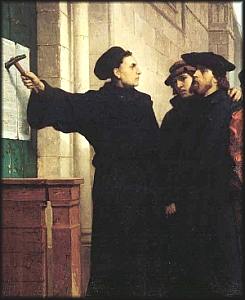
Celebrating Reformation Day, for me, is a little like remembering someone you loved dearly who has passed away. As a dyed-in-the-wool, anti-RCC Protestant, I would love to rousingly celebrate the anniversary of Luther’s pounding his 95 Theses into the cathedral door at Wittenberg. But I think we’ve squandered a lot of what the Reformation bought us.

I don’t think we practice most of the backbone concepts of the Reformation, even in the most ardent Reformed churches. I grew up Lutheran, and even so I ran into disconnects all over the place.

Take the idea of the priesthood of all believers. Nothing in our practice of our church life proves that we believe this foundational truth of the Reformation one iota. Too many of our churches have pastors who lord it over their congregations, disempowered congregants who are routinely told that only the specially trained (read “seminarians”) are equipped to minister, Martin Luther sticks it to the RCCand vicious church factions debating the same “who is greater?” nonsense that got the disciples in hot water with Jesus. Truthfully, our practice of the priesthood of all believers better resembles that classic line from George Orwell’s Animal Farm.
I know in my own life I’ve encountered that hypocrisy more times than I can count, none more glaring than my experience in the church Martin Luther founded. I worked at a Lutheran camp a couple summers and got in serious trouble with the leadership of the camp for baptizing kids who converted to Christ. Seems like a perfectly ordinary action to take with new believers, baptizing them and all. From the reaction of the leadership, though, you would’ve thought I’d killed those kids à la Jason of Friday the 13th movie fame.

At sole issue was the fact that I wasn’t a pastor. When I countered that the Philip who baptized the Ethiopian eunuch wasn’t an apostle but a guy who waited on the tables, I was lucky not to be stuffed into a canvas sack and thrown into the lake right then and there. So much for the priesthood of all believers. I guess some priests are more equal than others.

I could walk through the Reformation’s five solas and ask how we practice them in reality. Just the other day, I experimented by Googling the phrase “What must I do to be saved?” and perused the answers provided by leading Protestant Web sites. If that cursory survey is any indication, we’ve got to do a whole lot more to be saved than have faith in Christ, trust His Scriptures, and receive His grace. (Though I think soli Deo gloria still holds up in all cases.) Sadly, at the site of one prominent Reformed blogger, the list of requirements for salvation (according to the sermon by Cotton Mather posted there) included a whole lot more than what we got out of the entirety of the Reformation. Somehow, we Protestants have found a way to obscure the simple answer to that most necessary question. In many ways, we’re back where we were just prior to the Reformation.

But I guess the main reason that I’m not quite as pumped about Reformation Day as some others is my speculation about Martin Luther. I fear that some of the loudest celebrants of Reformation Day might be the very same people who would call for a good old burning at the stake for Martin Luther if he showed up today and pounded a new set of 95 Theses on the doors of our modern Evangelical churches. Love to see them Catholics squirm, but don’t tell us to give up our modern indulgences.

Too many of us Protestants have capped Christianity at the Reformation. We believe that nothing more can come out of Christ’s Church than what we got out of the Reformation nearly five hundred years ago. In some ways, we’re like the fifty-year-old shoe salesman at K-Mart who once quarterbacked his high-school team to a state championship. Our entire lives revolve around that day when we threw the winning touchdown. We relive it, revel in it, and on and on. But we let that one event in time become the be all and end all of our existence. It can never get better than that time, nor can we ever let it possibly come close.

But oh what we may be missing because we can’t see the opportunities that lie before us today!

Don’t get me wrong. I supremely value the Reformation. I also supremely value practicing what we preach and asking if we need a new reformation even better than the old one.

Now what church will let me nail that to their door today?

One Moment in Time—and Beyond

Standard

I believe it was an International Bible Society study that showed that nearly all people who become Christians do so by age nineteen. That figure stunned me at the time. We've got to get people young, folks. That's why bringing young people to Christ is so astonishingly important.

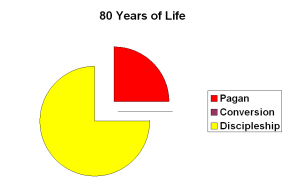
But another figure hidden in that survey speaks just as loudly. If the average American today lives to at least eighty, the IBS survey also tells us that the person who comes to Christ at age nineteen will spend sixty years or more in discipleship.

Think about that figure—sixty years of following Christ after conversion.Real life sliced and diced

The image at right puts this in perspective. The slice of pie that comprises a person's pagan life before Christ consumes about a quarter of life. Following after Christ takes up three-quarters. The moment of conversion, though crucial, is but a mere slice.

Yet you would think that conversion, that one moment in time, is all there is to the Christian life. Given how we Evangelicals devote so much time, energy, and angst to conversion, you'd think that the sixty years afterward are a drop in the bucket. In the Godblogosphere, the handwringing over conversion (and the theology behind it) weights it even more. Discipleship may seem an afterthought.

I'm saddened when I get e-mails from folks saying all their church ever talks about is getting people saved. Don't get me wrong; it's excellent that churches preach the salvation message. But most of the people in the church are already saved, so what help do they get in actually living out their conversion if they hear the same salvation message over and over again?

The Bible says this:

And this is eternal life, that they know you the only true God, and Jesus Christ whom you have sent.
—John 17:3 ESV

And we all, with unveiled face, beholding the glory of the Lord, are being transformed into the same image from one degree of glory to another. For this comes from the Lord who is the Spirit.
—2 Corinthians 3:18 ESV

I didn't know my wife the first time I met her. In many ways, I still didn't know her even on our honeymoon. Learning who she is will take me the rest of my life because the depth of her personhood will only be revealed in time.

The same goes for Jesus Christ. Most of us have barely scratched the surface of what it means to know Him. Yet the Bible says that knowing Him IS eternal life! It's not escaping hell, it's knowing the person of Jesus Christ. Deep calls to deep. If Jesus Christ and a hundred Jesus impersonators were put into a lineup, would we be able to pick the real Jesus out of the crowd of imposters? Think hard about that question.

Likewise, our conversion to Christ does not end our growth as Christians. Too often, though, our churches act like they have no more to tell us once we say yes to the Lord. "Just don't do bad things now" is the extent of the post-conversion advice.

But the Bible says that we're supposed to be changing from one degree of glory into another, a process that will take our entire lives. That is if we surrender to that process of Christ making Himself in us. For it's His glory that shapes us over those sixty years.

Too often, our discipleship is self-centered. Life becomes nothing more than the avoidance of pain and the accumulation of comfort. But we can't walk the narrow path staring into our navels; we'll wind up in a ditch.

For we are his workmanship, created in Christ Jesus for good works, which God prepared beforehand, that we should walk in them.
—Ephesians 2:10 ESV

And as you go, proclaim, saying, "The kingdom of Heaven is at hand." Heal the sick, cleanse the lepers, raise the dead, cast out demons. You have received freely, freely give.
—Matthew 10:7-8 MKJV

For the Son of Man shall come in the glory of His Father with His angels, and then He shall reward each one according to his works.
—Matthew 16:27 MKJV 

If you're a Christian, you're a new creation. And what were you created for? Good works in Christ. The real disciple of Jesus Christ spends his or her sixty years after conversion walking out a discipleship that is other-centric. It's centered on the Lord and on the ones who are dying around us. Yes, we can read great treatises on theology, accumulate vast libraries of Christian thought, attend Christian conferences one after the other, but if we're not freely giving away what we freely received, then we'll spend sixty years wasting God's mercy. Instead, we must be focused on others to ensure that the reward we have in heaven is great.

We all know "Away in the Manger." There's not a three-year-old out there that doesn't learn this Christmas carol first. As a result, few think of it in terms of theological depth. The final stanza says it all:

Be near me, Lord Jesus, I ask Thee to stay
Close by me forever, and love me, I pray;
Bless all the dear children in Thy tender care,
And fit us for Heaven to live with Thee there.

Our sixty years of discipleship is meant for one thing: to fit us for Heaven to live with Christ eternally. What you and I are doing right now in this moment of time is shaping our eternity. Don't be deceived. Following Christ was never intended as fire insurance. Instead, it's meant to remake citizens of Earth into citizens of Heaven.

Are we giving away our life here so we can take on new life? Can we with all certainty pick Jesus out of the lineup? He may not look like an itinerant rabbi, but the homeless man drunk outside our office building. How then will we know Him unless we do the good works that encounter Him? Are we spending all our time looking at our conversion when we should be focused on our inheritance?

Sixty years is at once quite long, yet so very short in the eyes of eternity. In truth, our lives are not so much like a pie chart, but a never-ending timeline that began a breath ago. In a flash comes conversion, but then we live out the eternal consequences of our discipleship.

It's about learning to be a disciple, giving away freely what we were freely given: love, mercy, and grace. Let's not waste our sixty years.