
 The annual Christian Booksellers Association convention (now with the utterly ghastly new name “International Christian Retail Show”—boy, that’s a blog entry in itself!) is running this week and it’s started off with a bang due to a speech given by Andy Crouch (who?) that called Christian fiction writers to abandon writing escapist novels and start addressing “reality.” His assertion comes from watching airline travelers; he observes that they have traded their books for playing solitaire on a notebook computer or cell phone. From this he posits that too many of us have traded gritty life for virtual reality:
It’s worth pausing and asking ourselves whether what we are looking for when we read, what our readers are looking for, is not escape and seclusion. This is a constant Christian temptation. We are prone to create our Christian virtual reality. I’m sure that right here at the International Christian Retail Show you’ll be able to meet good-hearted folks creating Christian video games. Isn’t that appealing? A world, suitably tweaked and put at your disposal for your entertainment, where Christianity actually works! Just obey the Christian rules and you win the game. A world where prayers are always answered! A world where sin doesn’t weave itself so tightly around even our best efforts! It is so tempting to strategically simplify, to create a fictional reality in which things just seem to work better than they do in this world.
But to do that is to deny the Incarnation, to deny that God became real in this world, in this very world where God does not seem real to many people much of the time. To create Christian virtual reality is to choose escape and seclusion and thus become entirely irrelevant to the heart of the gospel, which is God entering into this very world in order to liberate it from its captivity to itself.
So I plead with you, as a reader, as a fellow follower of the Incarnate One, as someone who daily wonders how this gospel to which I am giving my life can possibly be true, I plead with you not to tell me stories which improve on the world. Instead, tell me stories about the world as it is, strange and real and full of grace.
Like so many Christian commentators today, Crouch understands a problem exists. However, I believe his analysis and solution are profoundly wrong. It is not that people have abandoned books and movies (box office numbers continue their free-fall, too) because they are escapist, but because they aren’t escapist enough!
I’ve given up on most mainstream fiction because I can no longer stomach anti-heroes. Every character in every novel I have read lately is an amalgam of relativistic “ideals” that amounts to nothing more than a shell inhabited by moralistic flotsam and jetsam. You can’t tell the good guys from the bad guys because the bad guy has his subversively “noble” cause, while the “good guy” has more moral failings than the denizens of Sodom.
Now we might live in a postmodern age that attempts to call black “white” or even “chartreuse,” but I can tell you straight up that people are bored stiff with fictional characters that have few admirable traits, no transcendence over the rest of skulking humanity, no divine fire in their bellies that compels them to rise up and let the world know that they are different.
I’m shifting to film here because it provides a more concentrated and widely-known pool of examples to choose from, but why do people love the Star Wars movies and flock to them even when Episodes 1-3 were acknowledged by everyone as having awful dialog, wooden acting, and ham-handed direction? After watching a great musical like Singing in the Rain or The Sound of Music, why do so many people let their first comment be, “Why don’t they make movies like that anymore?” Why did the first Matrix movie inspire devotion, the second ambivalence, and the last one contempt?
It’s all about heroes. People are dying for heroes. People long for happy endings in which the clearly drawn hero with a heart of gold vanquishes the bad guy—a bad guy so bad he’d even eat his own mother for breakfast. The average guy in the average house in the average suburban tract has had his fill of anti-heroes. He doesn’t want someone who looks like him, struggles like him, and in the end is no better for any of his trials. He wants to see someone grow and learn and kick the bad guy’s ass in the last scene. If Yoda had a penchant for picking up little green call girls and knocking back the Tatooine hooch whenever he had the chance, no one would be cheering, and no one would be standing in line to see another Star Wars film. The Wachowski brothers forgot that the reason people liked The Matrix was more than just the cunning special effects, it was the fact that the good guys were good and believed in something greater than themselves. When in The Matrix Reloaded Morpheus’ altruism was demeaned as being little more than religious fanaticism, you could feel the collective audience sigh of “Well, there goes the series!”
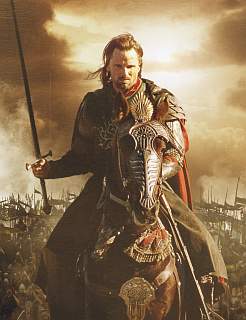
What some label as mere escapism, the majority of people consider to be their one chance to see the good triumph over evil. When our TV news programs depict one hopeless scene of brutality, disease, and loathsomeness after another, why would we want to subject ourselves to reading the same in our fiction or watching it on our screens? People don’t want to see any conflict in a character like Aragorn from The Lord of the Rings other than Do I kill that orc with my broadsword or with my dagger? We don’t want all his moral failings paraded before us; we want him to grow into his kingship. Because if he can, maybe we can, too.
Has anyone asked the solitaire player on Crouch’s flight why he plays solitaire instead of reading the latest novel? Could it be that the solitaire player prefers an electronic card game because it contains the promise that the game could be won? Virtual reality at least allows the one immersed in it to possibly come out on top, to vanquish some imagined foe, to live out the heroism that is so lacking in our daily lives.
This is no endorsement for John Eldredge’s fatally flawed Wild at Heart, but the reason that book resonated with so many disaffected men is that it put out a call to heroism, a call lacking in much of our culture because we have for too long ceded our imaginations to anti-heroes and protagonists of questionable morality. Our culture screams, “There are no heroes!” We are told by the media elite that happy endings are for simpletons. Yet, who reading this today would want to come to the end of his/her life and NOT want it to end happily?
I find Crouch’s appeal to Christian writers to write more fiction that is rooted in the funk of this world and to avoid obvious happy endings to be a capitulation to the spirit of the age. It is to take our injunction to think on what is noble, pure, and right and turn it into just another dark day in the gutter. You can claim that it’s all about mystery and grace, but if that amazing grace doesn’t lead us to a heavenly home where we’ll be for a lot longer than ten thousand years, then Christian writers will be offering their readers the same bankrupt worldview that the world is offering. Our identity as Christians will be lost amid the many secular and religious voices that take a look at the vagaries of our existence and can only shrug and say, “Man, life is tough, isn’t it?”
The incarnation that Crouch uses as his proof text does not end with the dead Christ hanging on His cross. Paul himself said that if that is the whole of it, we are people to be most pitied. No! That dead Christ—our very archetypal hero—overcame Death itself! The stone is rolled away from the tomb! Jesus was the victor then and will be the victor to come when He and His righteous legions destroy all the powers of Darkness!
If our creative writing doesn’t regularly reflect this final triumph of good over evil, then all we have handed our readers is another maudlin dose of despair. I for one am not willing to write books that fail to offer this triumph; I know that you are not wanting to read them, either.
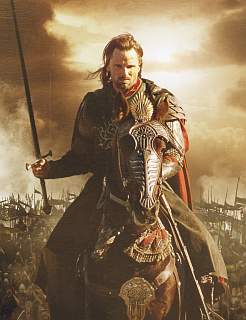
{Image: Aragorn of The Lord of the Rings trilogy from New Line Cinema}
 This is in response to a couple comments in my
 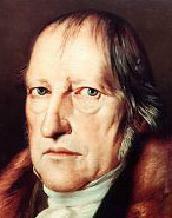 Hegel basically created his philosophy to explain the process of history. First there is one view or event called the thesis. Then there is the opposing view or event called antithesis. Out of these two (many times a compromise of the two; other times simply the end process of the two clashing) is the synthesis.