
In the Trenches of the Worship Wars

Standard

Michael Spencer delivers a crushing blow to the solar plexus of twenty-something worship leaders everywhere in a piece that had me alternating between howls of derisive laughter and outright head-nodding anger. Check out “That Flushing Sound: Evangelicals Worship Till There’s Nothing Left” if for no other reason than to bond with another “came to Jesus during the ’70s” blogger. Any guy who references Yohann Anderson’s quirky “Songs & Creations” songbook knows that of which he speaks.

A sampling:

This was in the early 1970s. There was something just beginning out there in evangelicalism. It was an awareness of the youth culture that had defined the sixties. For some time, our church fought that youth culture, with its long hair and rock music, but now, something had changed. There was the beginnings of seeing the wisdom of allowing that same youth culture to have an influence in the youth ministry of the church.

Now there were youth musicals that used contemporary music, played by bands with drums and guitars. It was OK to have long hair and dress like the rest of your school as long as you were still part of the youth group. You could be “cool” and be a “Jesus person.” On those Sunday nights, you could see the beginnings of that youth culture, that “Jesus Movement” as we called it, beginning to come into the church.

How did it get in the door? How did those drums and guitars get into the sanctuary? How did those songs that WE liked but our parents didn’t like get into the service? The leadership of the church said it was OK as long as it kept the young people interested in church.

Sound familiar? It should. It was the beginning of a way of thinking that has the adults in your church being told to do the hand motions to the latest Third Day songs.

Owie. Michael, I’ll be looking for you in the pew again on Sunday. From what I can tell, you’re out doing field research and must’ve dropped in unexpectedly last weekend.

I play a drum kit (not a staple of the Robert Shaw Chorale last time I checked) in the worship band at my church and I can vouch for everything that Michael says. I may very well be part of the problem.

Toward the end, he tosses out this grenade:

The results at the majority of smaller churches are chilling when compared to the competent, decently organized worship of a few decades ago. Unprofessional behavior. Ridiculous casual approaches to God. A performance mentality that puts some of the worst people in the church up front solely because they have the ego to want to sing. Stupid yammering between songs. Endless repetition. Too much music. Music that is too loud. Music simply being TOO IMPORTANT. Taking up too much time and too much energy. Too much depending on musicians. The endless addition of new songs off the radio and from CDs hardly anyone has heard and many will never be able to use in worship. Technical glitches galore. (What I have sat through with the projection of words on a screen has long passed comic. It’s torturous. It’s insane. And yet we put up with it.) What has happened to the worship of the average small church in the last 5-10 years is nothing less than a plague and I know I can’t be the only one who feels it.

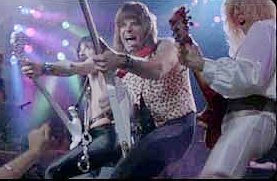
I feel your pain, Michael. I’m the drummer and I’m telling people we need to rein it in a little, but the response is basically the same as MC5’s oft-quoted (and unrepeatable) admonition that includes mothers, jams, and kicking. This is Spinal TapNor do I ever advise anyone to base their worship “stylings” off anything that would appeal to Eddie Vedder or Lars Ulrich.
Yeah, I’ve been there—and in many ways am still there. I was once a part of a Vineyard church that had glorious worship times that mixed Christ-centered modern worship music with the great hymns of the Faith. When a new worship leader took over, it was off to the races on arrangements. It was all too fast, too loud, and too in your face. I was 38 years old and thinking, These kids today and their rock worship music…

In other words, I feel like I could have written the InternetMonk’s cautionary tale myself.

I do have a little addition to his insights, though. He goes on to say the following:

Can someone do something?

Yes, church leaders need to do something. They need to understand what is happening, and they need to stop it from happening. Allowing the cause of “keeping the young people/young families interested” to run a church is a dereliction of leadership. Someone get a grip.

Pastors and elders: Get some spine! Have a session or a meeting and speak clearly to this. Don’t hand your worship leadership over to anyone who isn’t willing to accept a vision that includes everyone and to work closely with you to have a competent, intergenerational, Christ-centered worship service within boundaries that you choose. If it looks like a bad excuse for a concert, and if the older members can’t join in, there’s something wrong. Stop it now.

Here’s where I pull out the old “you can’t go home again” problem with this advice.

Part of Michael’s contention is that once you had real worship leaders schooled in actually reading music and directing choirs. I knew people who had degrees in such a thing as Church Music. A quick look around, though, shows those people to have vanished into the ether. Where did they go? Answer: Church’s killed their careers, but not necessarily in the way the Monk contends. Guitar slinging teens raised on Larry Norman and Randy Stonehill didn’t put the choir director out of business, the paradigm shift in paying church staff did.

I got my degree in Christian Education right at the time that churches decided to stop paying folks like Christian Education Directors and Music Directors. That fifty-year old guy who could read an E. Power Biggs organ chart and knew the difference between a soprano (not Tony) and an alto (not a saxophone) was told he could keep his job so long as he didn’t expect to get paid for it anymore. The new spirit was that of volunteerism. (In my case, my alma mater read the handwriting on the wall and rechristened my old department “Spiritual Formation.” As far as I can recall, Director of Spiritual Formation was what those bearded Haight-Ashbury types who lived in Big Sur and spent most of their day in a hot tub called themselves. And we all know how they got paid.)

Anyway…this is about music and how it went from paid professionals to guys ten rungs below youth pastor—and salaryless, too.

Let’s face facts. The great composer of high church music, Johann Sebastian Bach, was able to add “To the Glory of God” to the end of every one of his great compositions because someone was paying him to write them. He didn’t have to take another job to feed his twenty children. But as today’s churches decided that it wasn’t worth paying a professional, educated music director, so went the quality of music. They wanted free and they got exactly what free pays for.

Today a few megachurches do pay young guys fresh out of college (or not) who grew up listening to their dads’ Ramones records. But the Church on the Corner doesn’t and therein lies the problem. Guitars didn’t kill old fashioned worship music, cheapness did. I would venture to guess that the majority of small churches don’t even pay for the rights to sing the Top 40 worship songs they dredge up off the radio, much less consider paying for the quality and professionalism a real music director can bring.

And one last thing…

Rock music put guitars, bass, and drums into the churches, but as the limited pool of musically-inclined people began to flock to those instruments, there was left a dearth of professionally-trained pianists, organists, vocalists, and orchestral performers—the very folks we formerly saw every Sunday morning. Today, most non-megachurches have maybe one or at most two folks who are trained on a classical instrument—and that number’s not getting larger. I hate to think it’s Pandora’s box once more, but it certainly seems that they may never pass this way again as long as garage bands playing rock on Saturdays are on stage in our churches on Sunday.

Now there’s a real downgrade issue for you.

The Purposefully Wayward Servant Syndrome

Standard

An anonymous commenter on the post Love Sin / Hate Sin noted that some Christians, especially when dealing with life’s disappointments, use sin as a way of getting back at God. Call it “The Purposefully Wayward Servant Syndrome.” From what I’ve seen, it’s prevalent among all kinds of normally righteous-living Christians.

You and everyone you know at your church has been praying for three months about the transfer you put in at your company, a move that will take you to the branch location closest to where your elderly parents now live in sunny Miami. Not only will you now be in a position to assist your folks as they near the end of their lives, but you’ll be able to work from the beach, plus get a more powerful title and more pay. You pack the family up, move into the fabulous new home that you found in just three days, and spend an entire two weeks in Miami before the news comes down that corporate is closing the Miami branch and moving it to Duluth, just south of the Arctic Circle. And since there’s already a branch in place at Duluth, you’ll lose your title and your new pay increase. And you’ll be answering to the moron who is so well known in your company that every branch office not only knows the guy, but has their own set of regional jokes decrying his ineptitude. Welcome to hell.

Why, God? Why?

In keeping with Purposefully Wayward Servant Syndrome, now seems like the perfect opportunity to show God how you feel about all this by doing something really stupid. You fully admit that you’re not in control of issues like this, He is, but you can at least express what little control you have by raising a fist to the sky.

That upraised fist takes on many forms. Anger, obviously, but also frustration, depression, and a whole host on unpleasant emotions. But rarely is it just an emotion—some kind of action accompanies those feelings and that action nine times out of ten is rooted in whatever sin we judge appropriate enough to trot out before God to show Him just how we feel about His sovereignty in situations like this.

Shoplifting? Drunken rampage? Cheating on our spouse? Punching one of our kids? Binging and purging? Buying one of every porn mag on the rack at the local convenience store we would ordinarily avoid because it sells entire racks of porn? What’s the worst thing we can do to show God just how displeased we are at the way He runs the universe?

We know it’s wrong, but for one brief second it satisfies us to think that we still have some modicum of control over our lives. We’re also smart enough to know that God hates when we sin even more than we hate feeling like we moved out in faith and only later fell off the end of the world.

We have a cautionary model in all this:

Jonah went out of the city and sat to the east of the city and made a booth for himself there. He sat under it in the shade, till he should see what would become of the city. Now the LORD God appointed a plant and made it come up over Jonah, that it might be a shade over his head, to save him from his discomfort. So Jonah was exceedingly glad because of the plant. But when dawn came up the next day, God appointed a worm that attacked the plant, so that it withered. When the sun rose, God appointed a scorching east wind, and the sun beat down on the head of Jonah so that he was faint. And he asked that he might die and said, “It is better for me to die than to live.” But God said to Jonah, “Do you do well to be angry for the plant?” And he said, “Yes, I do well to be angry, angry enough to die.”
—Jonah 4:5-9 ESV

Jonah under the vineNot a righteous anger. Definitely an upraised fist. And while I don’t want to add to the narrative, I have no problem envisioning Jonah raising a ruckus out there in the desert, probably hurling some sand, and making enough of a spectacle of himself that a few passersby asked, “What’s up with the prophet?” He may have not gone to the depths that some of us do, but he complained enough to let God know that he wasn’t a humble servant who believed “Thy will be done.”

The Book of Jonah ends with a cliffhanger:

And the LORD said, “You pity the plant, for which you did not labor, nor did you make it grow, which came into being in a night and perished in a night. And should not I pity Nineveh, that great city, in which there are more than 120,000 persons who do not know their right hand from their left, and also much cattle?”
—Jonah 4:10-11 ESV

Unfortunately for those of us who live for closure, Jonah’s response is lost to history. You’d think the correction he’d received earlier in the belly of the fish would have been enough to tame the “I’m not getting my way!” tantrums, but Jonah was a tough nut to crack.

I’d be deceiving you all if I didn’t say that I’m well acquainted with Purposefully Wayward Servant Syndrome. There have been far too many times in recent years where we stepped off the cliff in faith after much agonizing prayer only to be dashed on the rocks of despair below. I’ve done my share of finding ways that I can make myself more miserable and in the process profess my little statement of displeasure to a holy God who’s not impressed by my unrighteous escapades.

Honestly, I think this is where the Church has dropped the ball as God’s agents of hope and reconciliation. Like Job’s advice-giving friends, too often we go to the our church congregations and tell them we’ve been broken on the rocks and the first thing we get is a heaping helping of Romans 8:28, a pat on the back, and an “Everyone’s got problems, don’t they?” talk that only goes to enhance the desire to try out that Purposefully Wayward Servant Syndrome experience—at least once.

Wouldn’t those times be so much better if we knew that at least one person in our church would go a second mile with us?

More years ago than I wish to admit, I sat on the front porch of a sweaty, smells-of-unwashed-boys cabin during summer camp. As a counselor, I hadn’t done much real counseling, but now I had a boy crying his eyes out who wasn’t even in my cabin, who had just been told that his parents were divorcing. Not having come from a household wrecked by divorce, what could I say? All I could tell that weeping boy was one day God might have him sitting where I was sitting now, and unlike me, he’d know exactly what to say to some weeping boy who’d been handed the same awful news.

I don’t know what happened to that boy in the long run, but there on the porch he dried his eyes, looked me square in the face, and said, “I’ll know what to say because I’ve been there.” Then we prayed together.

If you’ve been plagued by Purposefully Wayward Servant Syndrome in your life, perhaps the Lord is asking you to sit down beside the very people who are now going through the same misery you once suffered. Your experience can show them they don’t have to eat the bitter herbs that you greedily gulped down in response to feeling abandoned at your point of greatest need, when the world was caving in and God seemed shut up behind six foot thick celestial doors of brass.

I don’t want to add to Jonah, but I’ve got to believe that we would not have seen so much frustration in the life of that Wayward Servant if others stood with him. Sometimes the mere presence of another is the tempering factor that limits the depths of stupidity that some of us so easily fall into.

Be the Church. Be Christ to the grieving. No platitudes or generic memorized spiels that are easily dispensed to the hurting before you flit off to your next scheduled appointment, but real, bloody, messy care in the midst of someone else’s ruin.

You know how desperately it’s needed because you’ve been there, too.

What Hath Marla Wrought?

Standard

Marla's Flickr PicOkay, so Marla Swoffer over at Always Thirsty posts her Retro vs. Metro analysis of the factions that comprise the Christian blogosphere. Controversial? Well, she may have topped even my myths of homeschooling and blogging might be a waste of time posts. Then she reopens a past swipe I took at some of the Retro folks, trying to drain further blood out of the blogging leviathan that is Tim Challies.

I think she's nuts in attempting this comparison, but I'm listed as a co-conspirator; to save my blogging life I must comment below. My preferences are backgrounded in cerulean blue. Where there is no highlighting at all on either side, there is no preference or I simply want to stay out of a minefield. If both sides are highlighted, then I think a dichotomy is impossible.

RETROMETRO
Rural or Small TownUrban or Suburban
ChalliesiMonk
ESTJINFP
Left-BrainedRight-Brained
ConservativeLiberal
CalvinistArminian
Quiver FullFamily Planning
ProsePoetry
C.S. Lewis: Mere ChristianityC.S. Lewis: Chronicles of Narnia
HomeschoolPublic School
PyromaniacTall Skinny Kiwi
ThinkFeel
Sola ScripturaGod Revealed in Many Ways
ApologeticsTestimony
PuritansMystics
God the FatherJesus
IsolateIntegrate
PastFuture
Gifts of the Spirit: NOGifts of the Spirit: YES
WordsPictures
Criminal JusticeSocial Justice
ProverbsPsalms
Amy's Humble Musings(vacancy)
Historic ReformationNew Reformation
OlderYounger
PatrioticGlobal
Women: TraditionalWomen: Egalitarian
RantBrood
DoDream
ReformedEmergent
Theologically CorrectRelationally Relevant
Psychology: NOPsychology: YES
The ThinklingsThe Boar's Head Tavern
ESVThe Message
CertainOpen
Catholics: NOCatholics: YES
SermonConversation
TruthLove
HymnsModern Music
CraftsmanshipTechnology
LiteralMetaphorical
Harry Potter – NOHarry Potter – YES
PCMac

I don't want to get dragged into the battles on birth control, don't ascribe entirely to either the Calvinist or Arminian points of view, and have been over the schooling issues recently. My pick out of the Trinity? C'mon! Plus Marla forgot the Holy Spirit in that mix, so that makes the whole enterprise suspect. Justice has to cut all ways, but I'm burned out on justice issues, so I'm not commenting. Both the Reformed side and Emergent side have some blinders on, and the whole idea of pitting theology versus relationship is a moot one

Concerning my non-committal ways on a few blogs, both Tim Challies and Michael Spencer have linked to Cerulean Sanctum a couple times in the last ten days, so I don't bite the hands that expose this blog to more readers. Between the two, I probably come down somewhere in the middle. Phil versus Andrew? I've never gotten much from the Kiwi, and I read the Pyro more for the good writing and snark appeal than the apologetics, so those two are a wash for me.

There were a lot of false distinctions; on many of those I highlighted both sides. I think the distinction between Sola Scriptura versus God Revealed in Many Ways is a truly poor one, since I believe that they aren't in opposition. That may leave some readers scratching their heads, but I have no problem with my position even when those on both sides would contend it's impossible to believe both are equally true.

Anyway, that's where I stand. I can do no more.

Now what blog empire wants to strike back?