How the Church Can Improve Christian Education, Part 1

Standard

Many readers know that my degree is from Wheaton College in Christian Education. Today, Wheaton labels that same degree Spiritual Transformation. While that’s a spiffy title, it muddies what we’re doing. We ARE educating the next generation. While the goal may be spiritual transformation, unless we comprehend that this is an educational issue, we’ll drift aimlessly and fail to reach that lofty goal.

I like the RSAnimate videos online and have watched them all over the course of this last year. One featuring Sir Ken Robinson surfaced recently, and it addressed the increasingly flawed way we educate the next generation. Robinson also spoke at a TED symposium a few years back, and that presentation is equally fine (and funny). I HIGHLY encourage you to watch both videos (or at least the RSAnimate one), as this limited series of posts will riff on Robinson’s ideas:

Good stuff, eh?

I believe that the Christian Church in America suffers from the same failed outcomes in education, and I think the failure of our general educational systems contributes to the failure of Christian education. In addition, Christian education suffers from its own, peculiar failures.
Here is my take on what is not working:

1. We’re not transmitting basic Christian doctrine to our people.
2. We’ve undervalued and stymied the talents of the more artistic members of our churches.
3. As a result, we don’t connect creative vision with the Gospel, nor do we allow that vision to inform the practice of our doctrine.
4. As a result, we’ve fallen into patterns of operation that no longer work within a changing culture.
5. Because our patterns of operation are less effective and are met with increasing hostility (because they are deficient), we’ve adopted a bunker mentality.
6. Our bunker mentality further alienates the culture at large.
7. That alienation results in a continued loss of existing churchgoers and potential converts, and the people we do manage to keep are less deep in the faith because no greater vision exists.

Let’s start with the most pressing problem: The people in the seats don’t know the basics of the Christian faith.

If you disagree with that statement, I would ask you to ask the average Christian two questions (one simple and one more complex):

1. Why is Jesus the only way to God?
2. Why is the Christian doctrine of the Trinity essential?

I believe that many Christians would flail at the first question and punt the second entirely. Sadly, I think a lot of Christians aren’t entirely convinced that Jesus is the only way to God, which is why that question becomes so damning when asked. And consider that we tend to take for granted that Christians should “just get” the Trinity by some kind of happenstance spiritual osmosis, and it becomes all the more obvious why that question leads to blank stares.

I believe that the greatest educational failure in the American Church is the lack of a comprehensive cradle-to-grave educational plan. This occurs because too many churches have made happenstance spiritual osmosis the primary basis of their educational philosophy.

One verse may be the culprit here:

And I am sure of this, that he who began a good work in you will bring it to completion at the day of Jesus Christ.
—Philippians 1:6

A misguided understanding of that verse is probably the greatest reason that so many churches have an educational philosophy of “throw it all at the wall and see what sticks.” And folks, that chancy philosophy is making us stupid, barely there Christians.

The other day, the Holy Spirit walloped me with a passage in Acts that opened up the reason why we can’t rely on happenstance spiritual osmosis as an educational philosophy:

But it was not long before a violent wind (called a northeaster) swept down from the island. The ship was caught so that it couldn’t face the wind, and we gave up and were swept along. As we drifted to the sheltered side of a small island called Cauda, we barely managed to secure the ship’s lifeboat. They pulled it up on deck and used ropes to brace the ship. Fearing that they would hit the large sandbank near Lybia, they lowered the sail and drifted along. The next day, because we were being tossed so violently by the storm, they began to throw the cargo overboard. On the third day they threw the ship’s equipment overboard with their own hands. For a number of days neither the sun nor the stars were to be seen, and the storm continued to rage until at last all hope of our being saved vanished. After they had gone a long time without food, Paul stood among them and said, “Men, you should have listened to me and not have sailed from Crete. You would have avoided this hardship and damage. But now I urge you to have courage because there will be no loss of life among you, but only of the ship. For just last night an angel of God, to whom I belong and whom I serve, stood by me and said, ‘Stop being afraid, Paul! You must stand before the emperor. Indeed, God has given you all who are sailing with you.’ So have courage, men, for I trust God that it will turn out just as he told me. However, we will have to run aground on some island.”
—Acts 27:14-26

The Apostle Paul stands up and gives an encouraging prophetic word: The storm is awful, but not a one of us passengers will die. God will take care of us.

What struck me about that passage is the massive caveat in that final sentence.

Paul’s prophetic word wasn’t going to come true if the ship remained hundreds of miles from shore. They had to get nearer to land. Your ship breaks up in the middle of the sea in a violent storm and people will die. Get closer to land and your chances increase. You have to take some practical steps to see that vision come true. God asks something of the sailors: Get yourself to a place where I can make this happen.

Right now in the American Church, the educational ship is in a storm in open water. We have got to take practical steps to get that ship closer to land. God WILL make Philippians 1:6 happen, but we can’t be stupid about getting the Church to a place where He can.

In the next posts in this series (2, 3), I’ll talk more about what we can do to improve Christian Education in our churches and what “getting to a place where God can make it happen” looks like. Stay tuned.

The complete series:
What You Won’t Hear Christian Leaders Say—And Why That Makes All the Difference

Standard

NOT overheard at a local church board meeting, parachurch ministry press conference, year-end megachurch round table, or big Christian conference:

“We’re not going to make plans, set goals, commit to any programming, buy any teaching materials, start any further ministries, hire or fire any staff, or even talk about the future until we see what the Father is doing.”

No, that’s not something you’re going to hear any time soon—despite the words of Jesus:

So Jesus said to them, “Truly, truly, I say to you, the Son can do nothing of his own accord, but only what he sees the Father doing. For whatever the Father does, that the Son does likewise….”
—John 5:19

How is it possible then that we consider ourselves better than our Lord by acting without first checking to see what the Father is doing?

It seems to me that we Christians in America would be far more effective in nearly everything we do if we stopped with the Type-A personalities, stopped all the works that aren’t working,Seeking God and instead did whatever it took to see what the Father is doing—and then did it.

If that means prayer for months on end, calling an all-church/ministry/organization fast, and actually practicing the revelatory gifts of the Holy Spirit, then that’s what we do. Then maybe we American Christians would see some success and see a changed nation.

Because if we’re truly doing what we see the Father doing, that thing He is doing WILL be effective, and all the more so when the Body of Christ gets on board.

It seems so simple. Why then do we not do this? Why do we charge ahead and waste time on works that God is not in?

The answer: We’re spiritually lazy and unwilling to let our laziness be found out.

Jesus didn’t see what the Father is doing by any means other than a deep prayer life and listening to the Holy Spirit. You can’t fake that, though, and expect to see what the Father is doing. Sadly, many churches, parachurch ministries, and national-stage Christian leaders make the attempt.

Which is how we’ve gotten to this place of disparity where our nation is brimming with Christians yet they have little or no effect on the culture and society at large.

What if a church was bold enough to drop all the worthless running around and instead prayed, fasted, and learned to hear the voice of the Spirit for the purposes of understanding what the Lord is doing? What if a parachurch ministry said, “Honestly, we’ve been wasting your donations because we didn’t first check to see what God was doing before we barged ahead with our plans”? What if a nationally known Christian leader said that he was going to take a year off to seek God so as to know what He is doing so that leader could present that to his followers?

I keep hoping to see this happen, but I’m not getting any younger.

When Being “Discerning” Isn’t, Part 2

Standard

In the first part of this limited series, I talked about how we Christians often make pronouncements that eliminate all genuine discernment. Today, I want to expand that post and note how easily we fall into ghettos of thinking that harm our ability to engage a dying world for the better.

As if perfectly anticipating this post, the following showed up online:

A recent article on the CNN website entitled, “More teens becoming ‘fake’ Christians,” drew my attention to a book written by Kenda Creasy Dean, a United Methodist minister and Princeton seminary professor. The author’s credentials, I have to admit, initially set off my alarm bells, signaling “liberalism alert.”  Yet I am very, very glad I kept reading.

The author of that statement is the chancellor of the strongly evangelical Patrick Henry College, Michael Farris. His “Are We Becoming a Nation of ‘Fake’ Christians?” is worth reading.

Fact is, for the educated believer, plenty of articles are worth reading.

But you wouldn’t always know that from the way some Christians talk and act. The statement above that grieves me is this: “The author’s credentials, I have to admit, initially set off my alarm bells, signaling ‘liberalism alert.'”

Fortunately, Farris decided to keep reading.

But many Christians never get that far. Too many of us naturally assume that nothing “the other guys” have to say is worthwhile. We can’t learn anything from “them,” so let’s stick to “our” stuff and disengage the rest of the world.

If we want to know why our country is in trouble, this is one of the major reasons. We stick with a party line and never once ask if the other party has anything worthwhile to say. Simply granting that they may will get us labeled “traitor.”

Or “heretic” in Christian circles, which is about as low a label as a supposed believer can receive.

In those Christian circles, we just substitute different labels than the political ones. Let’s try a few and see how they read:

“The author’s credentials, I have to admit, initially set off my alarm bells, signaling ‘charismatic alert.'”

“The author’s credentials, I have to admit, initially set off my alarm bells, signaling ‘Calvinist alert.'”

“The author’s credentials, I have to admit, initially set off my alarm bells, signaling ‘Emergent alert.'”

Now some may consider the above overkill, yet every day I read blogs written by Christians of one sect/denomination/belief or another, and this kind of thing goes on all the time. Instead of adding “Yet I am very, very glad I kept reading,” the conversation stops right there.

The reasoning? Discernment.

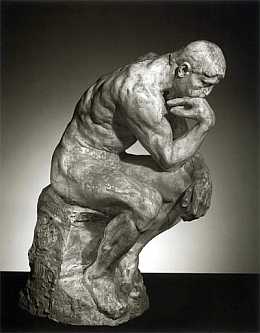
But stopping right there and blaming an inability to engage the ideas of someone who thinks differently from us is not discernment. The Thinker by RodinIt’s small-mindedness. In truth, it’s a form of willful ignorance.

Worse, the tendency is to fall into a perpetual state of ridicule. Some people DO keep reading, if only to add more grist for their predisposed mill.

The problem is that people who think differently from us, even Christians who think differently from us, may still have valid points we need to consider. No one is wrong on everything. Ignoring those who think differently or lampooning their most obvious errors without considering areas in which they may be correct (because that would get us labeled “soft” or something worse) is the height of spiritual pride and sloth. It is in no way being discerning.

Somehow, Paul was able to wade into the very midst of the philosophers and speak to them about Christ, even using some of their own illustrations to do so. Somehow.

Wouldn’t it be great if…

…the charismatic open-mindedly read Dietrich Bonhoeffer?

…the Calvinist open-mindely read Watchman Nee?

…the Emergent open-mindedly read John MacArthur?

Wouldn’t it?

Instead, we increasingly see people retreating to their own little ghettos of thought and practice, and the conversation either gets more shrill or it ceases altogether. When that occurs, problems go unsolved, community dies, and everyone retreats to his or her own bunker.

People who think differently than I do have helped shaped my Christian walk for the better. If it were not for them challenging the established way I thought, I wouldn’t be the Christian I am now. And the only way I got that bettering was by engaging hard and radical ideas that put my existing belief system under a microscope.

Yes, that’s scary. Yes, that raises the potential that my carefully crafted persona of perfection will come crashing down. Fact is, for most of us, that persona does need to come crashing down. We all need to admit that we could stand to learn a few things. We all need much more humility.

The worst thing we Christians can do to our perceived foes  in the public square is to call for their silence, to stick our fingers in our ears, or to resort to shouting them down. None of that shows any discernment. It’s just childish.

Francis Schaeffer wrote extensively that we Christians cannot be afraid of ideas. We must also not be afraid of genuine truth that may show holes in our own beliefs, even if those truths come from “the other guys.” Our holes don’t necessarily mean that we are wrong, only that greater truths and understandings exist, and we must understand them for what they are and how they may help us bolster our own understanding of what is true, honorable, just, pure, lovely,  commendable, excellent, and worthy of praise.