
Being the Body: How to Forge Real Community, Part 5 (Conclusion)

Standard

In this last post in the series “Being the Body,” we’ll look at a few more ways that our churches can better grow the community of believers within them.

#8 – Our communities should regularly enjoy a real communion feast together.

Folks who have studied the communion meals of the early Church come away with one truth: they were true feasts. Not the thimble of grape juice and a portion of a cracker, Still from the movie Babette's Feastbut entire meals in which the sharing of the bread and wine was the high mark.
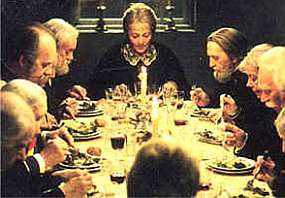
We need to encourage our churches to prepare this kind of feast at least once a month. In fact, the more meals we eat together as a church, the more we’ll grow to know each other.

I would also encourage these real communions services to be a time when people share what Christ has done for them (since the last time a communion meal was held). We need those stories of faith to build our own faith,  but we seldom get to hear them enough for them to do any good. This would also be a time for the entire church to pray for individuals in need. We could hear the need, pray for the need, and use that time to meet the need right then, if possible.

#9 – Those of us in community should always keep an open home.

A community is not closed. It’s always open to others. It’s 24/7/365, too. Because our homes are the Lord’s and not ours, we need to always make them open to others, be they part of the community or not.

We can’t let the fortress mentality so prevalent in our country today keep others out of our homes. Our homes are not bunkers, but stations of ministry. Our mission field starts within the walls of your house and mine. If we’re not making our homes open, then we’re despising God’s gift to us.

We’ve got to get over having each room perfect, too. If you’re house is a little messy, who cares? Real homes are messy to some extent. We’re not supposed to live in museums. Obsessing over a home’s cleanliness speaks more about our fixation on the material rather than loving people. Better that a house be filled with love for everyone who enters it than it be spotlessly clean.

(See sidebar category listing “Hospitality” for more on this.)

#10 – As a community, we must find a holistic Christian perspective on our employment.

We have no excuses: we spend too much of our day devoted to our means of employment. If you’re a regular reader, you’ve heard this before, but unless we Christians rethink the way we work, we will forever have the Lord third or fourth in our lives. We need a revival of Christians seeking God for ways to drop out of the rat race and still provide for our families. Since we’re making community a priority, these issues should be discussed by the community.

We must also rethink unemployment. As a community, we are responsible to ensure that no brother or sister in the community goes without work if they need it. Despite the fact that today’s jobs are much more specialized than in ages past, we must ALWAYS draw alongside anyone seeking work and actively help them find a job. Our community is diminished by letting the unemployed search for work alone. If we are not dropping at least two dozen leads for each unemployed person a week, then we’re shirking our responsibility. The Bible commands that we work, therefore we are compelled to provide or seek work for those in the church community who need it. And we don’t stop helping until they get it.

(See sidebar category listing “Work” for more on this.)

#11 – True community makes ministering to the “weaker parts of the Body” a priority.

And who are these? The single parents, the elderly, the mentally ill, the sick, the developmentally disabled, and the families of those people.

An exceedingly powerful way to tell how vital a church truly is would be to examine how they deal with these folks. Are people ashamed of the mentally retarded teen, or do they go out of their way to incorporate him in the life of the church? Do people volunteer to take care of him so his parents can have a couple nights out to themselves each month?

Same goes for the single mom or dad. Some churches treat them as if they’re an embarassment rather than ministering to them as Christ would. If their singleness bothers us, then we should be routinely watching their kids so they can get out and meet a potential mate.

Real community always considers the weak and asks what can be done to bless them or their families. It’s one of the perpetual thoughts of people who esteem others better than themselves.

#12 –  True community is never afraid to be countercultural.

Being a community flies in the face of everything we hear daily as Americans. Thinking of others first does not come naturally to the natural man, but to the spiritual man it is the core of his ministry. If we fear Man, we should not be servants of Christ.

For this reason, we must pursue real community in the Body of Christ even if the world fights viciously against our desire to do so—and it will, because the world is passing away. But the communion of saints is eternal! What we begin here in our church communities is the groundwork for something that will never perish. We must always remember that our fitness as a community will reflect in the afterlife. God gives us our time here to fit us to heaven, and if we’re not living in a godly community that stands apart from the world’s individualism, then we are not being good stewards of the time the Lord has given us.

The bottom line of community is this: we can continue to live as randomly scattered body parts that accomplish little for God’s glory, or we can be the vital Body of Christ living in countercultural community. God demands the latter of us when we come to Christ. Yet our American cultural mandate is anything but community-focused.

We Christians in America must rethink everything we’ve assumed about community, putting it under the authority of the Scriptures as illumined by the Holy Spirit. That we’ve failed to do so even the slightest bit speaks against the American Church’s obedience to the very principles God lovingly gave His people.

I believe that nearly every vice in our churches today can be traced back to a flawed understanding of what it means to live in true community. We are the Body of Christ. To live as a Body, we must make life-changing decisions. Time is short, so we must start being real community or God will judge us for it.

So do more than consider the twelve ideas presented in this series, start living them out. And go before the Lord and find even better ways to live out community. What I’ve laid out here is a mere sketch of what can be done

Have great week and bless others.

Posts in this series:

(Image: Still from the movie Babette’s Feast, 1987)
Being the Body: How to Forge Real Community, Part 4

Standard

It’s discouraging how disconnected we are as people. Even Christians live like there’s no one else outside the walls of their church. Sadly, in many cases, we erect walls inside the church, too.

I continue to receive private e-mails from folks who are resonating with this series because they’ve been victims of our lack of community. Their churches gave them the “God helps those who help themselves” line and let them twist in the wind.

It tears me up to read those stories. Yet they keep coming in increasing number.

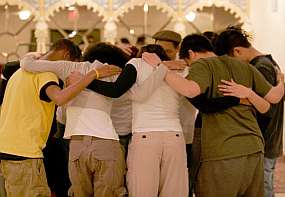
In some ways, I can’t blame people for choosing self-sufficient isolation and a hands-off attitude toward others. Prayer circleWe’re inundated by those two messages. As much as we believe that no one can tell us Americans what to do, we live in a culture that bombards us with a million takes on how we should live. Every day, no matter how much we believe we’re our own guides, media saturates us with messages we heed without much thought. Don’t believe me? Did you tailor your wardrobe or plan your activities today based on what the weatherman said? That’s just one simple example.

While Joe Meterologist at KRPP TV isn’t certified to teach, his message is educational nonetheless. Our teachers outnumber us, and few of them teach a message that upholds basic Christian thought. We tell ourselves we ignore the pedagogical aspects of the messages we hear, yet they still impart a worldview. We Christians need to understand that just because we spend ten minutes a day in Bible reading doesn’t mean we’re inoculated against the diseased mantras the world chants around us.

One of the worst messages we Americans receive focuses on the idea that each of us is our own man (or woman). But as pointed out in the first installment of this series, that message conflicts with God’s message of community. We Christians must mercilessly counter the propaganda of self-centeredness by understanding that

#7 – Godly education builds godly community.

Just as people don’t start out seeking good, they don’t start out seeking godly community. Nor do they even know what it is, considering so few truly see it practiced.

Seeing it practiced lies at the core of how our churches need to begin educating Christians to be a community. Several educational practices, if correctly instituted in our churches and homes, can help us develop true community:

a. We must teach community.

Community is at odds with the selfish way we live. Living selfishly takes no conscious training at all. Simply allow a child to absorb our culture as it stands today and that kid will grow up thinking of one person and one person only.

Our churches need to start teaching the “We”  and the “Us” instead of the “I’ and the “Me.” Our worship songs need to be about our community worshiping God, not just individuals. Our Sunday School curricula must stress that none of us lives or dies to himself. We must train our children to get their focus off themselves and onto the Lord and His people. We need to make it clear that Christians do not go the way of the world, making us a countercultural community that must increasingly swim against a cultural and societal current that works against everything community is. For that reason, we must hang together or the stragglers will get picked off.

Children who are taught to value the community will stay in that community. Our kids must know that they are part of a much bigger picture, the entire story of God’s redemptive plan.

b. We must teach a holistic Christian worldview.

It’s time we got serious about starting in Genesis and teaching through Revelation, underscoring God’s relationship with His called-apart people. Each Christian must fully grasp they are part of a community of faith. They must know what makes that community special. They must also know the worldviews that war against Christianity, understanding them for what they are, while also understanding how those other viewpoints fight to suppress community within the Body of Christ.

c. We must teach a unified curriculum.

One of the reasons that so many churches have problems with cohesiveness starts with their teaching. Very rarely does a church teach a unified, age-specific curriculum. By failing to teach this way, we send people home with no basis for further conversation. A family of five might have had the parents, teen, tween, and kindergartner receive totally different teachings, giving the parents no clear way to use what the kids were taught throughout the rest of the week.

But if the entire family received the same teaching geared for their level of understanding, everyone benefits from the community of learning fostered. In this way, the community teaches and learns together, unifying the Body.

d. We must teach the way of Christ to mastery.

Years of lousy achievement test scores have provoked public, private, and parochial schools into teaching to mastery. Students must master a topic before they advance.

Yet our churches seem to have no clue about mastery. The Bible hints there are levels of mastery in knowing Christ, but our church-based education systems (and in many cases, our teaching at home) reflects a cavalier osmosis approach to education.

But what if we discipled people to mastery?

Take serving. We should teach serving in our churches until people actually serve or else we don’t move on. We teach honesty until people are honest. We teach selflessness until people are selfless.

Radical idea, I know. But if our current system of making disciples is any indication, we have no clue how to make disciples. Mastery education will make the difference. Our churches will be profoundly altered if each person in them were to learn one truth of the Gospel a year and fully put it into practice—just one!

(I’ll be expanding this idea in a future post.)

e. The truths and values that we teach our church communities should always be visible.

I’m a strong advocate of churches putting up a huge plaque at every gathering spot within a church building stating what the core truths and values of the church community are. Obviously, affirming the kind of theological truths found in historic Christian creeds (like the Apostles or Nicene) would be included. Yet each church community is unique, therefore the Holy Spirit will be doing unique things in that body. A church located in a wealthy suburb will probably have fewer opportunities to work with the poor in their neighborhoods than an urban church would. Their truths and values would differ. Their plaque should reveal their community’s uniqueness.

If we’re to develop true community, we cannot avoid reinforcing the truth of the community’s shared creed. Making it readily visible to all in the community through plaques and remembrances is critical.

More importantly, the values a community believes and the truths it upholds must be seen in its practice of them. Actions do speak louder than words—or in the case of Christianity, godly actions permit the message to be received and believed. A community at odds with the practice of the Gospel will have zero influence in the lives of those in the church community and the lives of anyone they seek to reach for Christ. For this reason, the greatest means for upholding the Gospel within a community is truly living it.

f. Theological disputes must be handled as a community.

This may not seem unrelated to education, but the manner in which a church handles theological disputes proves to the community that everyone in it can learn from the collected godly wisdom of the group.

Sadly, one of the great gains of the Reformation has also turned into the great tragedy of Protestantism, in that we do not seek truth as a community, but as individuals. Though I fully support breaking from the hellish Roman church, we Protestants have not done well in upholding a unified interpretation of community truth. The freedom given for individuals to come to the Scriptures as unique persons results in a few too many unique views completely lacking in God’s imprimatur. A return to a community-based interpretation of Scripture would strengthen our churches’ educational programs by allowing the community to approach interpretation rather than just the individual alone.  (David Fitch discusses this marvelously in The Great Giveaway.) It also acknowledges the truth that the Holy Spirit not only dwells in the individual, but also in the midst of the church assembly. That understanding reduces opportunity for heresy and creeping error.

Having seen so many churches undercut by a winner-take-all approach to theological disputes, I think it’s high time we find a better alternative. A community approach may just well be the best way of all to educate our people even in the midst of controversy.

I fully believe that rethinking our education models within our churches to better align with community goals would greatly amplify our teaching and, ultimately, our success—a success for both making disciples and building godly community.

Look for the last set of suggested ways to build vital church community tomorrow.

Posts in this series:


Being the Body: How to Forge Real Community, Part 3

Standard

In this fourth installment of the series “Being the Body,” we’ll look at the major conceit of most of us in the Western Church. I believe this fallacy prevents us from becoming the real community of Jesus Christ on Earth. If we can get over this lie we’ve believed, great things will happen in our midst.

The Scriptures say this:

The earth is the LORD’s and the fullness thereof, the world and those who dwell therein….
—Psalms 24:1 ESV

[King David praising God before the assembly of Israel:] “But who am I, and what is my people, that we should be able thus to offer willingly? For all things come from you, and of your own have we given you….”
—1 Chronicles 29:14 ESV

“The silver is mine, and the gold is mine,” declares the LORD of hosts.
—Haggai 2:8 ESV

“Behold, all souls are mine; the soul of the father as well as the soul of the son is mine….”
—Ezekiel 18:4a ESV

“For none of us lives to himself, and none of us dies to himself. If we live, we live to the Lord, and if we die, we die to the Lord. So then, whether we live or whether we die, we are the Lord’s.
—Romans 14:7-8 ESV

“You are not your own, for you were bought with a price…..”
—1 Corinthians 6:19b-20a ESV

Here’s the short summation: you and I own nothing. We don’t even own ourselves. It’s all the Lord’s.

But do we Evangelicals, so enamored of our supposed political and economic power, truly believe that? The way we live would suggest otherwise. Yet for us to embody the fullness of Christ as His Body, we need to realize an important truth:

#6 – Real community can only come about when we understand that everything God has given us must be in play for others at all times, especially for those within the community of faith.

If we truly believe the Scriptures above are true, then we have no right to ever withhold needful things from others. Sort of explodes our fallacious notion of “mine,” doesn’t it?

If our current church culture is any indication, no lie from hell can outdo our allegiance to “mine.” We may talk about original sin and point to the lies children tell as proof, but a sixteen-month-old child whose first words consist of “mine” is just as convincing a proof of original sin as lying. Unfortunately, though we discourage the lying, we smirk at the grab for what’s mine. “Isn’t that cute, hon? He’s destined to be a corporate raider some day!”

As we know, “mine” knows no boundaries. It doesn’t stop at the expensive items like cars or houses. Our love for what we convince ourselves is ours extends down to the most insignificant things.

The Bible says this:

He who loves money will not be satisfied with money, nor he who loves wealth with his income; this also is vanity. When goods increase, they increase who eat them, and what advantage has their owner but to see them with his eyes? Sweet is the sleep of a laborer, whether he eats little or much, but the full stomach of the rich will not let him sleep.
—Ecclesiastes 5:10-12 ESV

We can’t stop accumulating wealth can we? Fifteen years ago, everything I owned in the world could fit into the back of a Honda Civic Hatchback. If it all got stolen, I wouldn’t miss it.

A self-examination: If you’re reading this and are married, isn’t it amazing how much more stuff you’ve picked up since saying, “I do”? It costs money to insure all that accumulation, too, because we all worry what might happen to it. Not so much that we would lose it, but that once it was all gone, people would treat us differently. We wouldn’t be as affluent. People might actually think we were—God forbid—poor!

How many of us reading this sleep a little less comfortably at night than we did when we owned nothing? That sleep largely suffers for one enormous reason. Few of us, deep down inside, can rest assured that our church communities would draw alongside us should we suffer financial ruin. We fear that our churches are not convinced of the following:

“If your brother becomes poor and cannot maintain himself with you, you shall support him as though he were a stranger and a sojourner, and he shall live with you. Take no interest from him or profit, but fear your God, that your brother may live beside you. You shall not lend him your money at interest, nor give him your food for profit.”
—Leviticus 25:35-37 ESV

God did NOT say that He Himself would rain down food, shelter, or clothing, but that this help should come from the community of faith! The act of true fear of God within a believing community is that we cover the needs of our brothers and sisters.

Just this weekend I heard from yet another brother in dire financial straits. (We’ve never met face-to-face, but I know him from his online writings.) Helping handThe broken-record response from his church? “Sorry, we won’t help you.” They have the financial resources, so they could help; they just won’t. They love money more than they love this brother or their own community.

I have one word for that: sickening. Are there any churches left that fear the Lord?

We watch faithful brothers and sisters in Christ go through bankruptcies and other financial disasters without lifting a finger to help, then we excoriate them for it. There’s not a person reading this right now who doesn’t have a decent, hard-working family in his or her church enduring financial hell. What are we doing for them? Anything? Or are we blaming them instead, trying to find a reason for their ruin much the same way the Pharisees sought to find a reason for the original blindness of the man Jesus healed?

Do we know that it’s for the glory of God that we help our brothers and sisters in their time of need?

Folks, if the rest of the world around us still wants to cling to “mine,” it means that those of us who understand that it’s all the Lord’s are even harder pressed to pick up their slack. We have to decide that we value Christ more—and subsequently the ones He died to save—than we value material wealth. We must desire to live like this:

And they devoted themselves to the apostles’ teaching and fellowship, to the breaking of bread and the prayers. And awe came upon every soul, and many wonders and signs were being done through the apostles. And all who believed were together and had all things in common. And they were selling their possessions and belongings and distributing the proceeds to all, as any had need. And day by day, attending the temple together and breaking bread in their homes, they received their food with glad and generous hearts, praising God and having favor with all the people. And the Lord added to their number day by day those who were being saved.
—Acts 2:42-47 ESV

If it means we do without a 60″ plasma TV so we have funds to help a family who can’t pay their electric bill, then we do without.

If it means we don’t go out of town on a vacation this year so we can pay the rent of a family hit by unemployment, then we don’t go. (And our children learn a valuable lesson about what is important in God’s eyes.)

If it means that we eat canned soup the rest of the week so we can make a weekly feast for all those in our church who can’t even afford canned soup, then we eat canned soup the rest of the week.

If it means that we have to sell something of “ours” so that a family in our church can keep a roof over their heads, then we sell it.

Because we believe that Jesus Christ is Lord.

Because we believe that He died and rose again to forge a community of saints who will live forever in Paradise.

Because our reward is in Heaven, not in this life.

Because we know that unless we start living that way, we will never see revival in our churches or the kind of Christian community that brings healing, peace, unity, love, and the presence of the Holy Spirit. The kind of community that has the lost taking notice.

Putting what God has given us into play means more than handouts, too. It means we open our homes to others because those houses are God’s. It means we give our time and effort to help others, because we don’t own time and effort, either. It means we don’t hold exclusive rights to our family members, making other families our family, too. When we finally realize that we own nothing, what we can give to others is magnified a thousandfold. And community is built.

We’ve believed the lie of “mine.” But there is no “mine.” It’s all God’s. And His command to us is that we give what He’s given us to those in need, especially those in the community of faith. Because that’s what the Body does, it looks after itself. If the heart is sick, the whole body is sick. All suffer together.

And when we look after each other, all rejoice together, too.

Posts in this series: