
When Cleanliness Thwarts Godliness

Standard

In my previous post, “Burying The Proverbs 31 Woman™,” I mentioned that I’d been talking lately with women about issues that affect them. Oddly, one issue came up repeatedly.

We’ve all heard the old aphorism: Cleanliness is next to godliness. Anymore, though, I’m not sure that’s true. In fact, the opposite may be the case.

Most women in a church are painfully aware of The Proverbs 31 Woman™ whose house is so perfectly kept that even Howard Hughes could bunk there in peace. The white glove treatmentForget eating off the kitchen floor, as the bathroom floor would do just as well. If that woman has kids, it’s a wonder how her home retains that museum-like quality—unless, of course, she chains the little tykes to a wall in the furnace room for hours on end. No matter what time of day or what’s going on in the household, one can hear a faint moaning, as dust mites starve to death by the millions. And that pleasant but faintly artificial smell that permeates the house? Scotchguard.

Sadly, a handful of those women in a church is enough to drive other women to despair. I know this because my own wife despairs of ever having our house look like the shrine to Martha (either the biblical person or Stewart) that we have encountered in some women’s homes.

This is not to say that we live in a pigsty. By no means! It’s just that it’s darned near impossible to keep up with that “sanctified” level of cleanliness and order.

Which leads to an intriguing problem.

Lately, I’ve heard women say that the main reason their families stay cooped up in their homes and do not have other people over is the fear of being judged for having a home that is not clean. And by clean I mean worthy of a visit by Queen Elizabeth. (At least that’s how I see it.)

It’s a two-fold problem: Women are afraid of being judged, and there exists a phalanx of people who will, indeed, judge them and their home’s perceived level of cleanliness.

All this manages to do, though, is place burdens on women while hurting Christian community.

Imagine, under the circumstances, how impossible these verses become:

And day by day, attending the temple together and breaking bread in their homes, they received their food with glad and generous hearts, praising God and having favor with all the people. And the Lord added to their number day by day those who were being saved.
—Acts 2:46-47

Husband: “Hey, hon, let’s have our small group over for dinner Friday.”
Wife: “But the place is a wreck and there’s no way to get it cleaned up by then.”
Husband: “I’m willing to do what I can to help.”
Wife: {Sighing} “We all know how that worked last time. You can’t swap Windex for Pledge, remember?”
Husband: “Oh well, maybe some other time.”

But next time never comes, does it?

Wouldn’t it be great if we Christians could stop with the judgmentalism, stop with the self-esteem issues, and stop with the need to have our homes look like the interior of the Guggenheim? Wouldn’t it be great if we could stop worrying about what other people think and instead do what is deemed best by God?

Seriously, isn’t fellowship closer to godliness than cleanliness?
When Being “Discerning” Isn’t, Part 2

Standard

In the first part of this limited series, I talked about how we Christians often make pronouncements that eliminate all genuine discernment. Today, I want to expand that post and note how easily we fall into ghettos of thinking that harm our ability to engage a dying world for the better.

As if perfectly anticipating this post, the following showed up online:

A recent article on the CNN website entitled, “More teens becoming ‘fake’ Christians,” drew my attention to a book written by Kenda Creasy Dean, a United Methodist minister and Princeton seminary professor. The author’s credentials, I have to admit, initially set off my alarm bells, signaling “liberalism alert.”  Yet I am very, very glad I kept reading.

The author of that statement is the chancellor of the strongly evangelical Patrick Henry College, Michael Farris. His “Are We Becoming a Nation of ‘Fake’ Christians?” is worth reading.

Fact is, for the educated believer, plenty of articles are worth reading.

But you wouldn’t always know that from the way some Christians talk and act. The statement above that grieves me is this: “The author’s credentials, I have to admit, initially set off my alarm bells, signaling ‘liberalism alert.'”

Fortunately, Farris decided to keep reading.

But many Christians never get that far. Too many of us naturally assume that nothing “the other guys” have to say is worthwhile. We can’t learn anything from “them,” so let’s stick to “our” stuff and disengage the rest of the world.

If we want to know why our country is in trouble, this is one of the major reasons. We stick with a party line and never once ask if the other party has anything worthwhile to say. Simply granting that they may will get us labeled “traitor.”

Or “heretic” in Christian circles, which is about as low a label as a supposed believer can receive.

In those Christian circles, we just substitute different labels than the political ones. Let’s try a few and see how they read:

“The author’s credentials, I have to admit, initially set off my alarm bells, signaling ‘charismatic alert.'”

“The author’s credentials, I have to admit, initially set off my alarm bells, signaling ‘Calvinist alert.'”

“The author’s credentials, I have to admit, initially set off my alarm bells, signaling ‘Emergent alert.'”

Now some may consider the above overkill, yet every day I read blogs written by Christians of one sect/denomination/belief or another, and this kind of thing goes on all the time. Instead of adding “Yet I am very, very glad I kept reading,” the conversation stops right there.

The reasoning? Discernment.

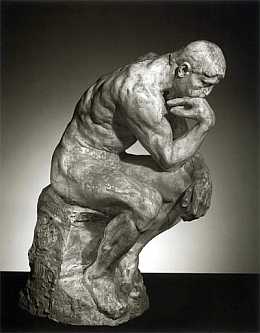
But stopping right there and blaming an inability to engage the ideas of someone who thinks differently from us is not discernment. The Thinker by RodinIt’s small-mindedness. In truth, it’s a form of willful ignorance.

Worse, the tendency is to fall into a perpetual state of ridicule. Some people DO keep reading, if only to add more grist for their predisposed mill.

The problem is that people who think differently from us, even Christians who think differently from us, may still have valid points we need to consider. No one is wrong on everything. Ignoring those who think differently or lampooning their most obvious errors without considering areas in which they may be correct (because that would get us labeled “soft” or something worse) is the height of spiritual pride and sloth. It is in no way being discerning.

Somehow, Paul was able to wade into the very midst of the philosophers and speak to them about Christ, even using some of their own illustrations to do so. Somehow.

Wouldn’t it be great if…

…the charismatic open-mindedly read Dietrich Bonhoeffer?

…the Calvinist open-mindely read Watchman Nee?

…the Emergent open-mindedly read John MacArthur?

Wouldn’t it?

Instead, we increasingly see people retreating to their own little ghettos of thought and practice, and the conversation either gets more shrill or it ceases altogether. When that occurs, problems go unsolved, community dies, and everyone retreats to his or her own bunker.

People who think differently than I do have helped shaped my Christian walk for the better. If it were not for them challenging the established way I thought, I wouldn’t be the Christian I am now. And the only way I got that bettering was by engaging hard and radical ideas that put my existing belief system under a microscope.

Yes, that’s scary. Yes, that raises the potential that my carefully crafted persona of perfection will come crashing down. Fact is, for most of us, that persona does need to come crashing down. We all need to admit that we could stand to learn a few things. We all need much more humility.

The worst thing we Christians can do to our perceived foes  in the public square is to call for their silence, to stick our fingers in our ears, or to resort to shouting them down. None of that shows any discernment. It’s just childish.

Francis Schaeffer wrote extensively that we Christians cannot be afraid of ideas. We must also not be afraid of genuine truth that may show holes in our own beliefs, even if those truths come from “the other guys.” Our holes don’t necessarily mean that we are wrong, only that greater truths and understandings exist, and we must understand them for what they are and how they may help us bolster our own understanding of what is true, honorable, just, pure, lovely,  commendable, excellent, and worthy of praise.

No Longer Ignoring the Economy, But…

Standard

This Christianity Today article holds out some hope for those of us who have been railing for years about the American Church’s stunning silence on economic issues: “How the Economy Became a Family Issue.

Someone with a national voice is finally speaking out. Finally!

But wait…darn!…the speakers frame the conversation entirely within a political context (based on the snippets reported in CT), despite the “family issue” rhetoric. If that’s the case, then we will continue to lose this battle, as the means of correction go far beyond politics.

We Christians have forgotten that community and economy go hand in hand. If we do not rethink our practice of community and move beyond a “every nuclear family for itself” mentality, then we will NEVER fix our economic problems, no matter which chad we punch in the election booth.

OK, so let’s pray this is a baby step in the right direction and not a tangential slide into voting into office a herd of status quo, talk-talk-talk Republicans. The track record is not good (think The Contract with America).

We can only hope that the conversation turns into a self-examination by Christians concerning our own complicity in creating the mess we now find ourselves in. Perhaps then something glorious will rise from the ashes of our broken communities and shattered economy.