
A Look Back at “Judgmental Christians…”

Standard

My final post of 2004 was “‘Judgmental Christians’ and The Way of Christ for 2005,” wherein I wondered if we Christians were more defined by our judging the lost than by our service of others in the name of the Lord. While I believe it is one thing to cling to Truth, it is quite another to cling to Truth AND serve others in love. A helping handWhen we only do the first part well, being labeled “judgmental” is rightly applied; we function as the holder of the lifebuoy, but refuse to throw it to the unworthy.

As they say at other blogs, read the whole thing.

I believe that 2005 saw no improvement to what I blogged about in the post above. We are still highly judgmental. We continue to judge the lost, people who lack the moral compass Christ provides. Frankly, that’s a waste. It’s like working at an orange grove in Florida and wondering why the trees there don’t yield cherries.

Because of this, I believe that the Godblogosphere recognized that judging the lost was a waste of online time. I don’t know if we bloggers took our judging the lost completely offline or not, but I noticed that online the rants diminished. I still see plenty of non-blogged Christian handwringing over what the heathens are doing. Lots of press releases from Christian organizations talking about the next new perversity to rise in the ranks of the perverted, but still no real service in love to those same people—at least none of the kind that Jesus exhibited in His earthly ministry to prostitutes, cheats, liars, crooks, and sinners of all flavors. We talk about Jesus Our Model, but we still don’t really serve or love like He did.

What happened in the Godblogosphere this year, however, was a reconcentrating of our judgmental ire on each other, not only on other Christians in general, but other Christian bloggers specifically. While I’m amused at the timing of many of the wars that broke out after I stepped out of my blogging shoes for a few days (only to return to chaos in the Godblogosphere), I was consistently disheartened by the level of attacks and the sheer unwillingness of opponents to listen and seriously ponder what each side was saying. Sometimes, we don’t even hear the acid in our own words even as we’re running a litmus test on what the other side just uttered.

More than anything else, it seems that 2005 was characterized by witch hunts and finger pointing. I can’t believe how many times I blogged on this issue, but a few posts come to mind:

I hate to sound like a Christian version of Rodney King, but “can’t we all just get along?” And if the rift is so wide that getting along isn’t possible, can’t we at least treat each other humanely? Let the secular bloggers resort to vitriol. Our default mode is supposed to be love, not acid-throwing. It is possible to disagree without beating each other over the heads with a baseball bat. The teams in an NHL battle may check someone into the boards with enough fury to crack Plexiglases, but the two teams still shake hands at the end.

For 2006, it is my wish that all of us Godbloggers consent to the following when dealing with those whose views differ from ours: Love, lisitle=

Jabez, Swaziland, and Christmas

Standard

The Wall Street Journal earlier this week broke the story of Bruce Wilkinson's African folly. The Prayer of Jabez author prayed his patented prayer and yet still managed to bomb out in his attempt to transform Swaziland's orphans into productive citizens populating a Disney-esque dude ranch and tourist trap. The intentions were good: The Prayer of Jabez Coverthe money for this lofty idea—called Dream for Africa—would be plowed back into fighting AIDS and poverty in a country where the heads of AIDS-ravaged households are the eldest children left behind in the wake of death and sorrow. Dream for Africa was the quintessential utilitarian Christian response to devastation.
But unable to crack the vagaries of African culture, Mr. Wilkinson resigned from heading his visionary venture, pulling up his personal stakes in Swaziland and taking his figurative ball back home. This has left his supporters in the country in a lurch. The end result is bitterness. (Like they say, read the whole thing.)

Wilkinson has taken quite a bit of flak from some Christians who are hooting over his failure. Their point is that the Rick Warren model of Christian dominionism that Wilkinson epitomizes is anti-Christ. I contend that there is a greater reality here.

First, although I'm a firm opponent of the Evangelicalized version of the Pentecostal "Name It and Claim It" theology that The Prayer of Jabez espouses, I must ask this of Mr. Wilkinson's critics: What have you done for orphans in Swaziland? How simple it is to point fingers in the aftermath of Dream for Africa's failure and say, "I told you so." How hypocritical to judge someone else's failure when we ourselves have done little or nothing. Frankly, I find this piling on by supposed Christian people who want to get their licks in on Bruce Wilkinson to be despicable and anti-Christ. There—I said it.

However, Wilkinson is not without blame here. His is a cautionary tale that all Christians should heed:

Unless the LORD builds the house, those who build it labor in vain. Unless the LORD watches over the city, the watchman stays awake in vain.
—Psalms 127:1 ESV

It is one thing to believe we are doing the Lord's work, but quite another to be doing it as He alone leads. Dream for Africa's greatest mistake was to try to do things on Man's timetable with Man's strength using Man's cleverness. Wilkinson had a decent vision to help the poor, orphaned, and ill in Swaziland. But the hubris at work here is the way it was planned and executed. In short, the Lord was not allowed to build the house.

Part of the blame here goes to Western presumptions about whether God works in mysterious ways or easily explainable, manufactured ones. In far too many churches today there is a mentality that we go ahead with our plans and ask for God's blessing. When this is coupled with the raging anti-supernaturalism inherent in so much of Western Christianity, God becomes little more than a rubber stamp on what we desire for an outcome. As Bruce Wilkinson learned, we can pray the Prayer of Jabez till we're blue in the face, but unless the Lord makes all the pieces fall into place, we're building a house that will not stand.

Wait for the LORD and keep his way, and he will exalt you to inherit the land….
—Psalms 37:34a ESV

Waiting is, indeed, the hardest part. Somehow, today's expression of Evangelicalism has developed an inability to wait on God for anything. The history of world missions consists of laborers who went years and sometimes decades without seeing a single convert, but then the floodgates of heaven were opened and the harvest made plentiful. Wilkinson's African involvement was cut off after three years. So much for waiting.

Again, what we see in Wilkinson's Swaziland disaster is a greater problem with Evangelicalism in America in the 21st century. We want things done now and we want them done according to our plans. Sadly, this kind of brute force manipulation of God's will amounts to little more than wind. And while the most vociferous of Bruce Wilkinson's critics are hooting over his failure (and their hope that Rick Warren will fail miserably in Rwanda), they, too, often embody this problem—only in a blind way that is uniquely theirs.

Even though I don't approve of the manner in which Dream for Africa charged in and did things under Man's power, it saddens me even more that there are people gloating over its failure, while offering nothing else in return. Surely there are people out there who God has blessed with a heart for Africa that are willing to take the decades it may take to bring about the end of AIDS, orphans, and poverty in Africa by God's way alone and only under His timetable.

Two thousand years ago, the religious intelligentsia thought they knew it all, but God built a house His way. He brought His Son into the world in poverty, made His Son's Kingdom not of this world, and confounded every person who thought they knew just how the Messiah would come and what He would look like. Man's confusion as to God's way made it all the more easy to take that supposed Messiah and crucify Him. Those upholders of all that was right knew what they were doing, or so they thought.

One of these days, we'll see just how many of our enterprises failed because we second-guessed God. It's all too easy for any of us to do. Bruce Wilkinson and Dream for Africa failed. And yet, so many of our own whims have gone up in flames for the very same reason.

Phariseeism is not far from any of us.

Christmas…Resurrection

Standard

We may all have heard the statistics:

  • More heart attacks occur in December than any other month
  • More people are treated for depression in December than any other month

What is it about this time of year that people are so stressed, so sad?

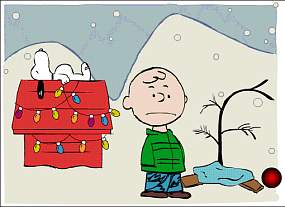
I’ll admit that Christmastime has not been the same for me since my parents died. My father died at Christmastime five years ago, and Mom was clearly terminal, living with us, but in many ways already gone. Charlie Brown's ChristmasThe following Christmas in 2001 drove home the fact , now that they were both gone, that they had borne a far greater role in the joy of the season for me than I had understood. You are always a child at Christmastime as long as you’ve got a surviving parent, but take that away and now it’s up to you to be the one who maintains the Christmas spirit. Now it’s for your children more than for you. It’s a role we never think about accepting until it is thrust upon us and there is no one else to turn to.

Big families make up for some of that loss, but Christmas is a bit sad for me now because I see that my own little family is probably going to stay little. The dynamic of having brothers and sisters at Christmastime will be lost on my son, something I never thought would be the case when my wife and I got married, but that is how things are, quite apart from our best intentions. Just the three of us creates a certain vulnerability at Christmastime that is hard to explain. I had my brothers around growing up, but my son will probably just have us.

Today, I was going to bake cookies, but my son may have chickenpox and my wife is very sick. Illness at Christmastime is the worst time for being under the weather. I remembered a couple Christmases growing up when one of my family was sick, but that was rare. However, in the last few years someone has always been sick at Christmas, usually me. When we were excited about hosting my wife’s family for Christmas a couple years ago, the real flu hit just about everyone and the whole enterprise shriveled up because no one was in the mood to do anything. The whole house should have been quarantined. Lots of planning and effort, but not much realization.

Whatever planning I had this year didn’t materialize. We can’t go see my brother across town for Christmas because he and his wife are expecting a child any day now and chickenpox and ready-to-birth moms are an absolute no-no. I had great plans for my wife and I to wrap presents together this year and relax, but she is in bed sick, and with my meager present-wrapping skills, I labored for six hours over what amounted to a little more than a dozen presents. Doing things alone at Christmas is not how it should be.

That meager stack of presents isn’t how it should be, either. I grew up with a Christmas tradition that said that Dec. 25th was the day that you got everything you were going to get for the year. All the toys came then. Most of the clothes came then. As a result, Christmases were huge at our house. Despite having a large family room, between the genuine tree and the tsunami of gifts pouring out from under it, there was hardly room to walk. I loved to shop for people, too, being one of those people who got more excited by what he gave then by what he received. I always tried to think of marvelous gifts to give, and more often than not, those gifts were spectacular and exactly the right thing to for each person.

Today, though, financial considerations have cut back our Christmases to the point that whatever boost I got from giving has been dampened by the realization that few of the things I’d like to give are within our reach anymore. If there’s a tree, it swallows whatever may be under it. And every year we are asked to cut back even more. Two out of the last five Christmases found us without an income, vulnerable at the one time of the year when plenty is assumed. Those were hard. I’m not sure I ever really got over them, either. You wonder what the next Christmas holds, a bit more fearful than the Christmas before.

None of this is how it should be. It’s not how I remember Christmas.

For four hundred years, the world lay waiting. There was no word from the Lord. The pagans swept in, and with them came darkness. Medes, Persians, Babylonians, Romans—one horde after another asserted control over the people of God.

Then came the light, the promise, the hope.

Christmas is a sad time for many who remember that it was good once, but doesn’t seem that way anymore. They are the ones who cry out, “Maranatha!” Christmas reminds us of all that should be right with the world, but the world isn’t always right. And as time goes on, it seems a little less right every year. It is our groaning, awaiting something better, the second Advent.

Nostalgia can bring paralysis. When I see people paralyzed by Christmastime, I know how they got that way. If you had a great childhood and things aren’t so great now, Christmas is missing that spark of life. An emptiness resides where the expectation once lived, nagging and frustrating.

But it’s not about Christmas, is it? It’s about an empty tomb. Christians were never the Christmas people, those concentrated on the First Advent. No, we are the resurrection people, born to die, then to live again. And at this point in time, as we move farther away from our own birth and closer to the time of our own death, we live in that stasis between the two, caught between opposing worlds, to die to the one and be raised into the other.

No one said it would be easy walking out that dying. When I look at Christmas 2005, I see a lot of little deaths. In the midst of that sadness, though, is the hope of the world to come.

If you’re sad this Christmas, let someone else know. It’s not something you struggle with alone—millions of others have a heavy heart as the shortest days of the year roll around. Don’t bear that by yourself.

…but we ourselves, who have the firstfruits of the Spirit, groan inwardly as we wait eagerly for adoption as sons, the redemption of our bodies. For in this hope we were saved. Now hope that is seen is not hope. For who hopes for what he sees? But if we hope for what we do not see, we wait for it with patience.
—Romans 8:23b-25 ESV