

Hidden Messages of American Christianity Wrap-up

Standard

MegaphoneThis series has proven to be popular and some have suggested it’s too early to be concluding it. No doubt there are dozens of hidden messages we Christians send along with the Gospel, confusing its purity, especially in the ears of the lost. Stepping back and analyzing what we say and how we say it should be an essential part of all we do. We live in an age when truth is lacking or is filled with so much noise as to be obscured altogether, so diligence in keeping the Gospel free from extraneous garbage has never been more needed.

A commenter wondered why I did not talk about the mixing of the Gospel with political messages. That’s a good one that I should have discussed, so I’ll give it a few words. Personally, I believe that neither of the two major parties in the United States is pursuing righteousness in governance. Aside from one or two important hot-button issues, both the Democrat and Republican parties are so highly compromised on truth that Christians should avoid the rah-rah tendencies we might have to wholeheartedly advocate either. This is not a call to drop out of the proper role each citizen has to utilize the freedoms this country affords, but to always vote soberly and with the understanding that political entities will, by nature, always be compromised. Blending the pulpit with politics will always degrade the Gospel message. Ultimately, the Christian’s allegiance is not to kingdoms of this world. When we forget that, we go off-message.

It was suggested that something be said about denominationalism, while another commenter noted that most denominations operate by emphasizing one aspect of the Gospel over another. I believe that is largely true from my own experience. Balance is needed at all times lest the Church of Jesus Christ operate more like the seven blind men examining the elephant. Each man thought his description of the mysterious beast most apt, but each fell short of understanding. It is a sad truth that the Church in America lurches from emphasis to emphasis, but I don’t have any answer for this other than to speak to individual Christians and exhort them to consider what all the major Christian voices are saying and try to find the middle ground without compromising on truth. Christianity, while it does make exclusive truth claims, walks a narrow road between extremes of practice and belief. We Christians today need to stay doctrinally pure, but also understand the competing ideals within different denominations that might exist to make us more fully rounded in the Lord.

I think I need to move on to other things, though, so in ending this series I have only one further comment.

Of all the hidden messages of American Christianity, none is more hidden than you and me. While it is a cliché to say that you and I might be the only Jesus that some will ever see, it’s a good cliché to remember. What we are, no matter how young or old in the Lord we might be, reflects out to the dying world. Of all the hidden messages then, none is more important than how each of us personally reflects Christ and His Gospel. Understanding where we need to improve in our own transmission of the pure message is critical. What noise does each of us transmit that shouts out over the Gospel message, obscuring it? Does our self-righteous cause others to turn away from the Lord? Does our lack of knowledge of the Scriptures make it seem that we’re not all that interested in knowing what we supposedly believe, even as we try to tell others that they should believe as we do? Does our forgetting our neighbor in his time of need speak more words to him than our attempts to share the Lord? What are our own lacks that blur truth with lies?

In the end, the hidden messages of American Christianity start and end with the way we live out the Gospel before the dying world. That calls for us to soberly consider where each of us has compromised the message by the ways in which we live. That will look different for each of us, but no matter the case, God is greater if we only let Him be:

The word that came to Jeremiah from the LORD: “Arise, and go down to the potter’s house, and there I will let you hear my words.” So I went down to the potter’s house, and there he was working at his wheel. And the vessel he was making of clay was spoiled in the potter’s hand, and he reworked it into another vessel, as it seemed good to the potter to do.
—Jeremiah 18:1-4 ESV

The series posts:

1. Hidden Messages of American Christianity: Classism

2. Hidden Messages of American Christianity: Kneeling at the Altar of Excellence

3. Hidden Messages of American Christianity: Correctness Before Love

4. Hidden Messages of American Christianity: Pastor O’Gill and the Little People

5. Hidden Messages of American Christianity: “We’re Cool, Too!”

6. Hidden Messages of American Christianity: “Family Cocooning Session: No Trespassing Allowed!”

7. Hidden Messages of American Christianity: The Outstretched Hand
Hidden Messages of American Christianity: The Outstretched Hand

Standard

This is the seventh (and last) in a series of posts covering the hidden messages that sneak into American churches' proclamation of the Gospel. For more background, please refer to this post.

Though today's post addresses what is a hidden message, I don't have any answers for it. I'm throwing it out there because I hear it all the time. I'm hoping that you readers have more insights than I do. (I'm also going to ask readers to bear with me because I sense this post is going to ramble excessively.)

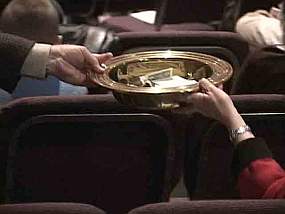
It's one of the most prevalent excuses I encounter in my area of the country for people not attending church. Men who avoid church like the plague cite it more than any other issue for their lack of attendance, Offering platefrom what I've personally heard. The older the commenter gets, the more likely this issue sticks in his craw.

It's money.

No, I'm not talking about folks who are ticked off that the church is preaching budgeting instead of preaching Christ, it's their complaining about the church asking for money. It's as if no other message can get through once the offering plate is passed. The "There they go again shilling for money!" lament is raised and the sermon message is now permitted to go in one ear and out the other.

"Always with the money thing! Why do they need so much money, Martha? The pastor makes twice what I do and I caught a whiff of Chanel No. 5 on his wife when I walked past. How much does that stuff cost? A thousand dollars an ounce? And he's asking for money? How low can you get?"

Now I'm not naive enough to think that the majority of these grumblers aren't using money as an excuse to sleep in on Sunday or to justify their rejection of Christ. But why do I hear this complaint so often if it didn't carry some actual weight?

At one point in my life I attended a well-known Presbyterian church in the toniest suburb in Pittsburgh. The corporate elite of Pittsburgh occupied the pews every Sunday. It had a chauffeur's entrance. The choir (paid) consisted of the leads of the city opera. When industrial meltdowns and financial strife rocked the area in the mid-Eighties, this church was targeted by activists and their Sunday services disrupted for no other reason than wealth. The church I left last year was suburban, middle to upper-class, and rarely asked for money. The pastor had a hard time bringing up the issue. As a result, this huge church was always encountering one cash flow problem after another. My present church is more rural ("penturbian," if you want the exact, trendy word), is lower to middle-class, has a mini-sermon about tithing shared by one of the elders every Sunday, and seems to do a reputable job staying in the black. Not only that, but every time there is a need over and above the regular giving, people always come through with an amount that surprises me.

I'd love to draw some kind of conclusion about these three churches, but there are too many variables. One never asked for money because it was loaded. One rarely asked for money, should have had it in abundance anyway, but didn't. One talks about money every Sunday, doesn't seem to want for it, plus it always has reserves. No matter the case, money plays into every aspect of how each of those three churches operate. That's true with every church, every ministry. But is there a way to downplay the whole issue of money so that those who complain that churches are only out for money have no more ammo for their assault?

It's Christmastime, so we're now under bombardment by Project Angeltree, Chuck Colson's organization. We donated money to them a few years ago to send the kids of prisoners to summer camp. Christian camping being near and dear to my heart, I couldn't say no when my wife suggested it, even though it violated our decision to only give to charities run by people we personally knew. Starting in September, I swear we get letters from Angeltree every week, plus scores of e-mails.

I'm not the type to complain that Christians are always asking for money, but the sheer volume of mail we get from Angeltree makes me uncomfortable. Whatever we gave a few years ago has been more than eaten up from the cost of their mailings to us.

So I can understand how some people have a problem with Christians asking for money. This isn't to say that money is not needed, but the sheer amount of money that some churches and ministries burn through is incredible. To sustain whatever they're doing, more and more money is solicited. But is this hidden message that churches and parachurch organizations are always on the lookout for cash really a message we want to send, even if it is not entirely true in every situation?

Now I can't speak for parachurch organizations, but I wonder if the way we do church today relies too much on money. I think our buildings are too expensive, not only to build, but to maintain. I don't see in Acts that the early Church spent their money on buildings. Nor was there much in the way of expensive programs and church initiatives. Benevolences were turned around and filtered back to the neediest in the community of believers in the early Church, yet the way we collect church monies today often leaves the givers in the dark as to where their money went. And too often, overhead consumes the majority of money rather than benevolences. Shouldn't we be asking if we're handling money for the Kingdom in the best way possible?

Shouldn't that advise the way our churches are structured and operated? What if a church met in homes rather than an expensive church building? What if the pastoral staff went unpaid (or partially compensated), but was large enough so that one person didn't carry the whole ministry load, each staff member living the life of a genuine "tentmaker"? What if we went beyond tithing and set everything we caretake for the Lord on the table so that anything needed was available to anyone at any time for his or her need? What if the Church functioned to unite giver and receiver personally, rather than having our monies go into an ethereal pool of funds? What if our newfound financial reliance on each other allowed us to step out of the rat race? What if churches didn't ask for money at all?

Most of all, what if the Church handled money so uniquely that it took away any objections by those who believe that Christianity is all about the Benjamins?

I know that Americans are funny about money, but I still hold out hope that one day our churches will look different because we've found a better way to handle it. The house churches in China are destitute compared with the Communist-approved state churches, but somehow they keep growing, effectively making disciples in a way we in America long ago forgot. While there are many mitigating factors in that growth in Chinese house churches, I've got to believe that our attitudes toward money in the American Church are partly to blame for our lack of effectiveness. We've built some fancy churches and installed some expensive programming, but what do we have to show for it?

Is it possible that something better could arise in the American Church if all our money disappeared some day? Maybe if it did, the lost might be able to look beyond the our hidden message of money and to the true heart of the Gospel.

Insights into This Blog

Standard

There have been a few bloggers who have noticed that the tenor of the Godblogosphere has turned more cannibalistic in recent months. Christian bloggers increasingly savage other Christian bloggers, the tone of posts is more critical, and everyone's trying to play "King of the Mountain" on doctrinal issues.

Yes, I see it too.

While I may blog about doctrine from time to time, Cerulean Sanctum exists to call the Church back to its roots in Acts, so my focus here is praxis. The practical living out of what we believe is what this blog is about—the Church in action. Sure, I talk about writing, personal issues, homeschooling, and a few other topics, but primarily I look at how the American Church walks its talk.

So yes, this site can be critical of the Western Church. My writing style is also very much no holds barred for those who can cope with it. What I hope distinguishes this site from others is that I almost always try to talk about solutions. It does nothing to build the Church if we talk about what's wrong with it without also discussing how we can fix what's broken. If I served as nothing more than a critic, with no solutions or help, then the Church is not bettered, nor are the people in it challenged to improve the practice of the Faith.

Many of the posts here are "Physician Heal Thyself" in that I'm just as guilty of blowing it as anyone. I'm learning, too. I can be as good as the next guy in the pew in talking about the Faith while not living it out in a practical way. I hope that people notice that I tend to use the collective "we" when I blog; this is intended to reveal that I'm probably stumbling in my own practice, too, and that I identify with all of us who fall short of the glory of God. This blog serves to challenge my own practice as much as it does anyone else's. If that means that some of the posts here seem a bit too "blanket" in their critiques, it's for this reason.

This has been a year of skyrocketing growth for Cerulean Sanctum. Plenty more people read this blog than they did in January 2005. I hope that 2006 reveals no slackening in the quality of writing, nor in the calling of the Church for the betterment of her practice of the Gospel.

I appreciate every person who reads Cerulean Sanctum. My prayer is that no one leaves here unchallenged. We all have room to grow. Thanks for growing with me.