
Today’s city newspaper featured a front page story about a school bus rear-ended by a dump truck. A teenager was killed. Someone’s 18-year-old son, all ready for graduation, all geared up for college in the fall (“Mom, Dad, I got accepted!”), wolfs down his breakfast, maybe says goodbye, maybe even offers a kiss on a good day, gets on that bus and winds up a few minutes later in eternity.
A couple days ago, I read an obituary in my town newspaper about a 27-year-old man who died in a freak accident while on vacation. The part that got me was that he was very active in the Big Brothers organization. They ran his picture in the obit, a smiling face bright with possibilities. Now some boys who don’t have fathers don’t have the surrogate dad who took time out of his schedule to help them.
Personally, I find it very hard to read these kinds of stories. I’m thinking that perhaps I shouldn’t.
David Kuo at Beliefnet recently wrote the following in his post Thoughts on Suffering after seeing for himself the misery in Uganda:
Is that [poor decision-making] God’s fault?
I think not. Because at every moment those decisions were made God was whispering for people to do the right thing, the just thing, the merciful thing. But we chose not to listen.
God has done his job. We haven’t done ours.
I used to think the suffering question was a serious head scratcher, a truly troubling thing—the best evidence against God. No more. I think it is largely an excuse to make ourselves comfortable in our complacency by blaming God for the suffering we aren’t spending our lives addressing.
We live in unusual times, times that didn’t exist until a handful of years ago. It is said that the average person today is inundated with more data in a few weeks than most people in the 18th century and previous got in their entire lives.
We can thank our instantaneous global news networks for this. All the world’s misery can be pumped into my home in a matter of seconds. Every day of the year. For as long as I live.
I’ve thought for many years that this constant stream of anguish and pain coming at us from every corner of the globe is an aberration of our age. God never intended Man to process so much misery at once. 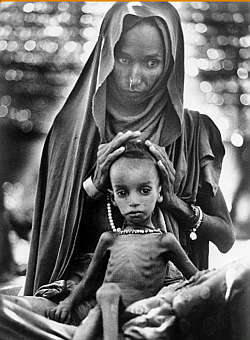 If we’re increasingly a nation of people on psychoactive medication, should we be surprised? Isn’t there enough pain within ten miles of our homes to last us a lifetime? What then do we do when we hear an orphanage was buried under a mudslide in Ecuador or a bus full of nuns holding babies in their arms went off a cliff in Singapore?
If you and I were serious about praying for others, we’d have enough prayer requests from hurting people in just our church alone to last most of us from week to week. Isn’t that the case with you? I know it is for me.
I could probably spend two or three hours a day just praying for the crushing needs of people I know. So how can I shoulder the rest of the world’s problems?
I believe that many of us are suffering from compassion fatigue. The flood of misery washes over us and we’re just numb to it anymore. That’s a problem, because God never intended that we live our lives as if anesthetized to pain.
Somewhere, though, we have to draw the line.
With all due respect to David Kuo, I can’t blame myself for the problems of Africa. If he wants to blame himself, that’s his prerogative. This is not to say that I don’t care about the pain in Africa, only that if I want to be sensitive to the needs of others, I can’t let myself grow numb in the waterfall of misery that is the entire world in 2008. And that means I have to find a means to turn off at least part of that waterfall. For my own effectiveness as a Christian.
That may seem callous, but I have to ask myself what my responsibility would have been a couple hundred years ago. Before the instant news update on the earthquake in Japan. Before the daily notification of genocide in Sudan. Before the suffering of the entire world landed on my doorstep and asked me in one united voice to solve the problems of 6.5 billion people.
It’s not that I don’t care, only that God never intended for me to be the savior of the world.
 I can’t remember more than hazy concepts from the blogs I’ve visited. Viral videos? Web 2.0? Dancing 3-D holograms? Heck, I can’t even tell you the movies I’ve seen in the theater in the last five years.