In Part 1 of this limited series on how the Church in America can improve Christian education, I showcased two videos by Sir Ken Robinson, a British education expert who seems to be all the rage among the intelligentsia. Included in that post were two videos, which are important for understanding what follows, so I encourage everyone to watch them, especially the first from RSAnimate.
Okay, now that you’ve watched the video(s)…
Robinson states truths that are quite obvious to anyone who has worked in education. One truth is that all learners are different. Another truth is that nearly all children start out with a capacity for creative problem solving, often exceedingly creative. Combining these ideas, Robinson leans toward the kind of educational theory that asks educators to work harder to differentiate learning in learners. It all comes down to accommodating the learner with as many opportunities for self-direction and self-discovery of knowledge as possible.
But there’s a problem with that philosophy.
Certain kinds of rationalistic knowledge can be arrived at rationally. A great deal of how our world works can be deduced through experience, with a little mentoring added in. This kind of learning style has been advocated for years, going back all the way to Jean-Jacques Rousseau’s Émile and continuing to the modern day in theorists like John Holt. In short, Robinson advocates nothing new. In fact, that path is well worn in some educational circles.
Christian education, however, can’t be addressed solely through this method. While Romans 1 states that from creation we can deduce some truths about God, we can’t deduce all by observation. General revelation (creation) and special revelation (the Bible, the voice of the Holy Spirit) exist together because of this.
So while it may be possible to observe the world and make deductions about mathematics from it, coming to truths about Christian doctrine requires book learning. At some point, teaching the Christian faith must have some rote element.
That element has been problematic for years, though. Go back a couple centuries and rote knowledge of the Faith was about the only kind one could find. The way we taught our children the Faith felt mostly like a lecture, wherein we drilled the same core truths into everyone. 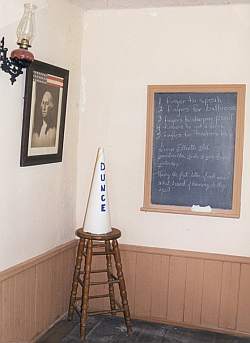 For a long time that method worked, mostly, no matter what Sir Ken Robinson thinks. We did a good job of schooling everyone in basic theology and doctrine.
Somewhere along the line, though, the Church got away from a disciplined methodology for making disciples. Post-19th century, the way we disciple people has become a haphazard mess because we rebelled against any notion of standardizing the way we teach people the Faith. Instead, we’ve left most people to attain depth in the Faith on their own, treating most Christian education as a supplement to what people, even children, are getting elsewhere. The problem is that they are either not getting that instruction elsewhere or the instruction they are receiving is wholly undermining what they should be receiving.
The result? Christians today are staggeringly ill-informed about what they are supposedly to believe about the Christian Faith. When a “mature” Christian can’t lay out a solid presentation of why Jesus is the only way to God, when he or she can’t explain why the doctrine of the Trinity is important, we’ve got a serious problem on our hands. And much of that goes back to a total lack of solid rote teaching.
But poor rote-style teaching is not the only problem. While we may admire Christians of the past for their head knowledge, heart knowledge matters too. And more than that, today’s Christian faces challenges unknown to his ancestors in the Faith, challenges that require bold, creative thinking to resolve.
Learning by rote doesn’t fully work because Christianity is not merely a rationalistic or philosophical exercise. While critical doctrines underlie it, our Faith is not entirely cerebral. Unlike its secular counterpart, Christian education doesn’t come down to knowing what a cosine is or how best to tune a car engine. It’s foundationally relational and spiritual. Adding to that complexity is God’s wisdom in making each of us unique in our spiritual giftings.
That each of us is uniquely gifted to serve the Lord, that each of us has a personal experience of God that must also fit into a corporate understanding of Him rooted in unwavering truths, presents an enormous educational challenge that dwarfs the challenge Robinson discusses. The problem of education within the Church is so multifaceted that—as I believe—we’ve punted any attempt to make it work at all.
The upshot of the problem in the American Church:
Our people don’t know or understand the basics of the Christian Faith.
Our people don’t know what their personal giftings are.
Our people don’t know how to use their giftings.
Our local church leaders have abandoned their role of helping others to identify their gifts and use them for the building up of the Body of Christ.
Our local church teachers have seen so little advancement in their pupils that teaching becomes a purposeless, dispiriting chore.
Parents in our local churches have no idea how to address the Christian educational needs of their children (and feel even less capable when even the “experts” in the churches achieve such modest results).
Our church leaders address these problems with a “business as usual” approach, even when that approach achieves few results.
Our churches lack a cradle-to-grave plan for education.
A further major hurdle exists, and it’s the backbone of Robinson’s ideas—and a major headache for Christian leaders.
One of the greatest failings of the modern Christian Church, particularly its Evangelical branch, is a wholesale distrust of creative people. We love our doers, our teachers, and our pastors, but someone who creates artworks we may not immediately grasp or who has creative, nontraditional ideas about how to solve pressing church issues gets the evil eye from us. As a result, we’ve driven too many of these folks out of our churches at a time when we desperately need them to help us address needs within the Body in a more proactive way.
Watching Ken Robinson’s explanation of how to right the ship of public education can give us hope. But there’s a gotcha. Robinson’s call for a massively individualized approach to education makes the work of the teacher even more difficult. A 1:1 type of teaching style asks teachers for a huge investment of time to give each student unique direction that best matches that student’s unique gifts.
In light of this, the following questions loom for the Christian Church in America:
Are we prepared to teach a systematic doctrine tailored to a cradle-to-grave plan?
Are we prepared to address the unique needs of each student as God deals with that student individually?
Are we prepared to identify the unique giftings of each student and tailor his or her spiritual direction toward the best use of those gifts within the Body of Christ?
Are we willing to reach out to the creative people we’ve often pushed away?
If we say yes, then we have to be prepared to question every aspect of how we live. If we don’t make the changes to our lifestyles that free us to dedicate the time and energy needed to fix these problems, they will continue to fester, undermining the growth and the effectiveness of the Church.
The secular world WILL address those problems in time. The question is whether the American Church values educating its own as much as the secular world does.
Stay tuned to the next post in this series for solutions.
The complete series: