
It’s discouraging how disconnected we are as people. Even Christians live like there’s no one else outside the walls of their church. Sadly, in many cases, we erect walls inside the church, too.
I continue to receive private e-mails from folks who are resonating with this series because they’ve been victims of our lack of community. Their churches gave them the “God helps those who help themselves” line and let them twist in the wind.
It tears me up to read those stories. Yet they keep coming in increasing number.
In some ways, I can’t blame people for choosing self-sufficient isolation and a hands-off attitude toward others. 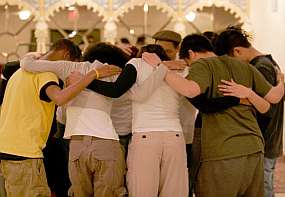 We’re inundated by those two messages. As much as we believe that no one can tell us Americans what to do, we live in a culture that bombards us with a million takes on how we should live. Every day, no matter how much we believe we’re our own guides, media saturates us with messages we heed without much thought. Don’t believe me? Did you tailor your wardrobe or plan your activities today based on what the weatherman said? That’s just one simple example.
While Joe Meterologist at KRPP TV isn’t certified to teach, his message is educational nonetheless. Our teachers outnumber us, and few of them teach a message that upholds basic Christian thought. We tell ourselves we ignore the pedagogical aspects of the messages we hear, yet they still impart a worldview. We Christians need to understand that just because we spend ten minutes a day in Bible reading doesn’t mean we’re inoculated against the diseased mantras the world chants around us.
One of the worst messages we Americans receive focuses on the idea that each of us is our own man (or woman). But as pointed out in the first installment of this series, that message conflicts with God’s message of community. We Christians must mercilessly counter the propaganda of self-centeredness by understanding that
#7 – Godly education builds godly community.
Just as people don’t start out seeking good, they don’t start out seeking godly community. Nor do they even know what it is, considering so few truly see it practiced.
Seeing it practiced lies at the core of how our churches need to begin educating Christians to be a community. Several educational practices, if correctly instituted in our churches and homes, can help us develop true community:
a. We must teach community.
Community is at odds with the selfish way we live. Living selfishly takes no conscious training at all. Simply allow a child to absorb our culture as it stands today and that kid will grow up thinking of one person and one person only.
Our churches need to start teaching the “We” and the “Us” instead of the “I’ and the “Me.” Our worship songs need to be about our community worshiping God, not just individuals. Our Sunday School curricula must stress that none of us lives or dies to himself. We must train our children to get their focus off themselves and onto the Lord and His people. We need to make it clear that Christians do not go the way of the world, making us a countercultural community that must increasingly swim against a cultural and societal current that works against everything community is. For that reason, we must hang together or the stragglers will get picked off.
Children who are taught to value the community will stay in that community. Our kids must know that they are part of a much bigger picture, the entire story of God’s redemptive plan.
b. We must teach a holistic Christian worldview.
It’s time we got serious about starting in Genesis and teaching through Revelation, underscoring God’s relationship with His called-apart people. Each Christian must fully grasp they are part of a community of faith. They must know what makes that community special. They must also know the worldviews that war against Christianity, understanding them for what they are, while also understanding how those other viewpoints fight to suppress community within the Body of Christ.
c. We must teach a unified curriculum.
One of the reasons that so many churches have problems with cohesiveness starts with their teaching. Very rarely does a church teach a unified, age-specific curriculum. By failing to teach this way, we send people home with no basis for further conversation. A family of five might have had the parents, teen, tween, and kindergartner receive totally different teachings, giving the parents no clear way to use what the kids were taught throughout the rest of the week.
But if the entire family received the same teaching geared for their level of understanding, everyone benefits from the community of learning fostered. In this way, the community teaches and learns together, unifying the Body.
d. We must teach the way of Christ to mastery.
Years of lousy achievement test scores have provoked public, private, and parochial schools into teaching to mastery. Students must master a topic before they advance.
Yet our churches seem to have no clue about mastery. The Bible hints there are levels of mastery in knowing Christ, but our church-based education systems (and in many cases, our teaching at home) reflects a cavalier osmosis approach to education.
But what if we discipled people to mastery?
Take serving. We should teach serving in our churches until people actually serve or else we don’t move on. We teach honesty until people are honest. We teach selflessness until people are selfless.
Radical idea, I know. But if our current system of making disciples is any indication, we have no clue how to make disciples. Mastery education will make the difference. Our churches will be profoundly altered if each person in them were to learn one truth of the Gospel a year and fully put it into practice—just one!
(I’ll be expanding this idea in a future post.)
e. The truths and values that we teach our church communities should always be visible.
I’m a strong advocate of churches putting up a huge plaque at every gathering spot within a church building stating what the core truths and values of the church community are. Obviously, affirming the kind of theological truths found in historic Christian creeds (like the Apostles or Nicene) would be included. Yet each church community is unique, therefore the Holy Spirit will be doing unique things in that body. A church located in a wealthy suburb will probably have fewer opportunities to work with the poor in their neighborhoods than an urban church would. Their truths and values would differ. Their plaque should reveal their community’s uniqueness.
If we’re to develop true community, we cannot avoid reinforcing the truth of the community’s shared creed. Making it readily visible to all in the community through plaques and remembrances is critical.
More importantly, the values a community believes and the truths it upholds must be seen in its practice of them. Actions do speak louder than words—or in the case of Christianity, godly actions permit the message to be received and believed. A community at odds with the practice of the Gospel will have zero influence in the lives of those in the church community and the lives of anyone they seek to reach for Christ. For this reason, the greatest means for upholding the Gospel within a community is truly living it.
f. Theological disputes must be handled as a community.
This may not seem unrelated to education, but the manner in which a church handles theological disputes proves to the community that everyone in it can learn from the collected godly wisdom of the group.
Sadly, one of the great gains of the Reformation has also turned into the great tragedy of Protestantism, in that we do not seek truth as a community, but as individuals. Though I fully support breaking from the hellish Roman church, we Protestants have not done well in upholding a unified interpretation of community truth. The freedom given for individuals to come to the Scriptures as unique persons results in a few too many unique views completely lacking in God’s imprimatur. A return to a community-based interpretation of Scripture would strengthen our churches’ educational programs by allowing the community to approach interpretation rather than just the individual alone. (David Fitch discusses this marvelously in The Great Giveaway.) It also acknowledges the truth that the Holy Spirit not only dwells in the individual, but also in the midst of the church assembly. That understanding reduces opportunity for heresy and creeping error.
Having seen so many churches undercut by a winner-take-all approach to theological disputes, I think it’s high time we find a better alternative. A community approach may just well be the best way of all to educate our people even in the midst of controversy.
I fully believe that rethinking our education models within our churches to better align with community goals would greatly amplify our teaching and, ultimately, our success—a success for both making disciples and building godly community.
Look for the last set of suggested ways to build vital church community tomorrow.
Posts in this series:
- Being the Body: The Necessity of Community in the American Church
- Being the Body: How to Forge Real Community, Part 1
- Being the Body: How to Forge Real Community, Part 2
- Being the Body: How to Forge Real Community, Part 3
- Being the Body: How to Forge Real Community, Part 4
- Being the Body: How to Forge Real Community, Part 5 (Conclusion)
 The broken-record response from his church? “Sorry, we won’t help you.” They have the financial resources, so they could help; they just won’t. They love money more than they love this brother or their own community.