
Branded for Christ

Standard

My father wore nice clothing. He bought from an old-fashioned men’s store owned by a respected Jewish family that sold top designers at JC Penney prices. The movers and shakers in that family were serious-looking men who walked around with slivers of marking soap in their pockets and tape measures draped around their necks at all times. And when they spoke with you, it was always from over the tops of their half-glasses.

As a teenager, I visited that store with fascination. The owners lived and died men’s clothing. The Steinbergs could take one look at a suit and know the designer. They recognized the cloth, understood a designer’s cut. Cassini, De la Renta, Botany 500, Perry Ellis—it didn’t matter. The brand spoke to them, whispering its secrets, secrets the Steinbergs guarded as they built a reputation for excellence.

In the recent past, I discussed branding with a fellow Christian blogger. He didn’t like the idea of thinking of himself as a brand, but despite the protests, there’s no escaping the marketing aspects of branding. Any public personna, even a blogger’s, has an aura it exudes. That glow attracts others because of the peculiar set of characteristics that define the blog. Cerulean Sanctum’s brand falls into the following set of characteristics:

  • I primarily discuss the American Church.
  • I examine issues within the Church that may be overlooked by others.
  • I offer practical (rather than theoretical) answers to those issues.
  • I try to keep a balanced perspective between warring philosophies, usually because I believe no side today fully sees the bigger picture.
  • The writing here may be controversial, not because it skewers individuals or denominations, but that it forces the Church as a whole to examine itself more thoroughly.
  • Readers consider the commentary here to be passionate, intriguing, unique, and thoughtful.

That’s the Cerulean Sanctum brand. (Notice how objectivity anchors some of those brand characteristics, while others are perceptions.)

You’ll notice I rarely depart from the brand. Diverging from the brand only harms the message. I shared with that other blogger the half-dozen or so things he does well and told him he should consider staying with—and reinforcing—those characteristics of his brand. In most cases, adding too much to the brand or stripping off what people appreciate in the brand spells doom. Imagine if Apple Computer abandoned its well-known industrial design. Or the company decided to forgo ease-of-use.

My son has a London Fog winter coat. Growing up, London Fog epitomized for me classically-tailored men’s outerwear. The Steinbergs sold London Fog; it was my dad’s coat of choice.

But my son’s coat is nothing more than the name London Fog stitched into a coat that could be any generic outerwear made anywhere in the world (Bangladesh, in this case). Nothing of London Fog’s brand can be found in the coat. With no sense of tailoring or style, it’s just a coat. I can’t even say that it will weather like a London Fog. Given its cost and origin, probably not. I’m not sure I even noticed the London Fog name when I bought it. One thing I do know: I’ll cast a wary eye at anything else branded London Fog that I might find on the racks today.

Diverging from the brand or simply tossing the brand name on any old item dilutes the power and prestige of a brand.

Whether we like it or not, Christianity has a “brand.” Certain characteristics of the Faith contribute to its objective practice and to the perceptions of others. Good or ill accompany those practices and perceptions. Holy Spirit stained glass by TiffanyI’m sure every person reading this is intimately acquainted with both the good and the ill. Still, I’m sure we can come to some agreement on what the Christian “brand” entails.

Or can we? Maybe even that’s the wrong way to go about understanding what people know about being followers of Christ. Perhaps there’s a better source for understanding our brand than asking ourselves how it’s viewed.

Many of the posts on Cerulean Sanctum begin with me wondering how other people—whether in the Church or outside it—comprehend Christians they encounter. Sort of the “walk a mile in another person’s moccasins” view. In the case of people who don’t know Christ, reasons exist for their reluctance to listen to the Gospel we bring them. Before anyone drops a “Christ said the world will hate us” bomb now, let me ask whether the perceptions of the Church by others are formed…

…because our light is exposing their darkness…

-OR-

…because the American Church’s own state is so dim, the unbeliever’s darkness looks like high noon on a clear Antarctic day in comparison.

Much more difficult choice, isn’t it? That sneer on the face of a coworker whenever Christ is mentioned may have more to do with the lousy experiences he’s had with Christians and the Church than it does with any hatred he may have toward Christ Himself.

We’d do well to find out from non-believers what it is we’re doing wrong. I’m not talking about megachurch demographic sampling nonsense here, but asking the hard questions. For instance, the next time we sit down with someone who doesn’t know Christ, ask the following in casual conversation:

What do you appreciate about Christianity?

What bothers you about it?

I can promise you this, you’ll learn a lot from those two questions. The question we should then ask ourselves is how we go about reversing negative perceptions while reinforcing the good. Since I can promise that most trait perceptions come down to the way we practice the faith, we’ll get a firm dose of reality, plus a roadmap for prayer and growth.

I’ve said many times here that we’re not in the initial stages of evangelization in the United States, we’re in mop-up mode. Nearly everyone living in this country has heard the name of Jesus. Now all they need to see is an American Church that practices what it believes.

Let’s face it: We’ve diluted the brand. We’ve added too much garbage to Christ’s message. We’ve tacked on enough Christianized cultural artifacts to derail millions. Or we abandoned the very heart of the Gospel to the point that people aren’t really sure what defines Christianity anymore. And it’s not just the unsaved who face that dilemma. I know solid Christians searching for Christ in the midst of a Church that has largely forgotten the truth of what it means to follow Him in simple discipleship.

I grew up singing “They’ll Know We Are Christians By Our Love.” The title of that song grabs me every time because it’s essential to our brand. Christians should always be characterized by their love for others and for the Lord. But are we known for our love or for the fact that ten times yesterday someone from a Christian organization phoned to remind us to vote against godless heathens? (If only just one person a day called you or me to remind us we are loved by Christ and by the brethren!)

What do non-believers say? Trust me, they’re getting our message—especially if that message doesn’t match our practice or the true call of Jesus. We need to ensure when we mention Christianity to others, the response is positive rather than negative. Otherwise, we need to fix how we live.

In more ways than one, we’ve been branded for Christ. Whether we believe in the value of that brand enough to protect it and communicate it effectively is quite another thing altogether.
Being the Body: How to Forge Real Community, Part 5 (Conclusion)

Standard

In this last post in the series “Being the Body,” we’ll look at a few more ways that our churches can better grow the community of believers within them.

#8 – Our communities should regularly enjoy a real communion feast together.

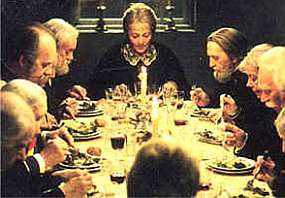
Folks who have studied the communion meals of the early Church come away with one truth: they were true feasts. Not the thimble of grape juice and a portion of a cracker, Still from the movie Babette's Feastbut entire meals in which the sharing of the bread and wine was the high mark.

We need to encourage our churches to prepare this kind of feast at least once a month. In fact, the more meals we eat together as a church, the more we’ll grow to know each other.

I would also encourage these real communions services to be a time when people share what Christ has done for them (since the last time a communion meal was held). We need those stories of faith to build our own faith,  but we seldom get to hear them enough for them to do any good. This would also be a time for the entire church to pray for individuals in need. We could hear the need, pray for the need, and use that time to meet the need right then, if possible.

#9 – Those of us in community should always keep an open home.

A community is not closed. It’s always open to others. It’s 24/7/365, too. Because our homes are the Lord’s and not ours, we need to always make them open to others, be they part of the community or not.

We can’t let the fortress mentality so prevalent in our country today keep others out of our homes. Our homes are not bunkers, but stations of ministry. Our mission field starts within the walls of your house and mine. If we’re not making our homes open, then we’re despising God’s gift to us.

We’ve got to get over having each room perfect, too. If you’re house is a little messy, who cares? Real homes are messy to some extent. We’re not supposed to live in museums. Obsessing over a home’s cleanliness speaks more about our fixation on the material rather than loving people. Better that a house be filled with love for everyone who enters it than it be spotlessly clean.

(See sidebar category listing “Hospitality” for more on this.)

#10 – As a community, we must find a holistic Christian perspective on our employment.

We have no excuses: we spend too much of our day devoted to our means of employment. If you’re a regular reader, you’ve heard this before, but unless we Christians rethink the way we work, we will forever have the Lord third or fourth in our lives. We need a revival of Christians seeking God for ways to drop out of the rat race and still provide for our families. Since we’re making community a priority, these issues should be discussed by the community.

We must also rethink unemployment. As a community, we are responsible to ensure that no brother or sister in the community goes without work if they need it. Despite the fact that today’s jobs are much more specialized than in ages past, we must ALWAYS draw alongside anyone seeking work and actively help them find a job. Our community is diminished by letting the unemployed search for work alone. If we are not dropping at least two dozen leads for each unemployed person a week, then we’re shirking our responsibility. The Bible commands that we work, therefore we are compelled to provide or seek work for those in the church community who need it. And we don’t stop helping until they get it.

(See sidebar category listing “Work” for more on this.)

#11 – True community makes ministering to the “weaker parts of the Body” a priority.

And who are these? The single parents, the elderly, the mentally ill, the sick, the developmentally disabled, and the families of those people.

An exceedingly powerful way to tell how vital a church truly is would be to examine how they deal with these folks. Are people ashamed of the mentally retarded teen, or do they go out of their way to incorporate him in the life of the church? Do people volunteer to take care of him so his parents can have a couple nights out to themselves each month?

Same goes for the single mom or dad. Some churches treat them as if they’re an embarassment rather than ministering to them as Christ would. If their singleness bothers us, then we should be routinely watching their kids so they can get out and meet a potential mate.

Real community always considers the weak and asks what can be done to bless them or their families. It’s one of the perpetual thoughts of people who esteem others better than themselves.

#12 –  True community is never afraid to be countercultural.

Being a community flies in the face of everything we hear daily as Americans. Thinking of others first does not come naturally to the natural man, but to the spiritual man it is the core of his ministry. If we fear Man, we should not be servants of Christ.

For this reason, we must pursue real community in the Body of Christ even if the world fights viciously against our desire to do so—and it will, because the world is passing away. But the communion of saints is eternal! What we begin here in our church communities is the groundwork for something that will never perish. We must always remember that our fitness as a community will reflect in the afterlife. God gives us our time here to fit us to heaven, and if we’re not living in a godly community that stands apart from the world’s individualism, then we are not being good stewards of the time the Lord has given us.

The bottom line of community is this: we can continue to live as randomly scattered body parts that accomplish little for God’s glory, or we can be the vital Body of Christ living in countercultural community. God demands the latter of us when we come to Christ. Yet our American cultural mandate is anything but community-focused.

We Christians in America must rethink everything we’ve assumed about community, putting it under the authority of the Scriptures as illumined by the Holy Spirit. That we’ve failed to do so even the slightest bit speaks against the American Church’s obedience to the very principles God lovingly gave His people.

I believe that nearly every vice in our churches today can be traced back to a flawed understanding of what it means to live in true community. We are the Body of Christ. To live as a Body, we must make life-changing decisions. Time is short, so we must start being real community or God will judge us for it.

So do more than consider the twelve ideas presented in this series, start living them out. And go before the Lord and find even better ways to live out community. What I’ve laid out here is a mere sketch of what can be done

Have great week and bless others.

Posts in this series:

(Image: Still from the movie Babette’s Feast, 1987)

Community,Politics, and Pastoral Shenanigans

Standard

Election Day is only days away and news breaks of the Ted Haggard scandal, conveniently timed (as the whistleblower himself notes) to cause the most political fallout. 

Ugh.

We've been talking about community here lately, and while this post isn't part of the "Being the Body" series we're in, it's close. It's a tale about what happens when folks are removed from real community.

For the less media inclined, Ted Haggard, now the ex-leader of the National Association of Evangelicals and the ex-pastor of a huge Colorado megachurch, has fallen in some sort of scandal, causing him to resign both those roles. The allegations that brought Haggard down are unseemly, and I don't want to go into them here. But Haggard claims that some parts of them are true and, for the purposes of this post, that's enough.

The Godblogosphere is loaded with commentary on the Haggard situation. Everyone is weighing in with the reasons why this happened, but the analysis is the same tired lament focused on the usual suspects.

Recently, I reviewed a book by David Fitch called The Great Giveaway. One of the chapters dealt with pastoral sin, pointing the finger not so much at the pastors, but at the system we've created in our churches that sets the pastor apart as some kind of CEO, celebrity, or otherwordly figure with no ties to the rest of the church body. I believe that Fitch's analysis is far more accurate than what we're seeing discussed on the Godblogs.

A few points:

1. We've created a cult of celebrity around our most noted pastors. That kind of proto-idolatry only sets them up for failure because we no longer allow them grace to fail in the small things before they become larger.

2. Failure and sin are natural parts of the human condition. All have sinned and fall short of the glory of God, as we know. This includes our pastors, but we act as if it doesn't. Our mental disconnect sets up pastors for further failure.

3. Because of these factors, pastors find themselves separated from healing community. They cease to be fellow brothers within our church communities.

4. God institutes community for correction, even of leaders, yet our cult of pastoral celebrity destroys the natural workings of the correction. This places pastors outside the community and outside of the community's ministry TO them.

So once again, we see what happens when we do not allow the natural workings of godly community to police, protect, and encourage—even the pastorate.

While I do not condone what Haggard appears to have done, I'm not outraged. If anything, I feel sorry for what our kingmaker attitude has done to the pastorate. Unless we reform our communities, stop treating pastors as superhuman, get off our judgmental attitudes, and get back to recognizing that ALL the sheep have gone astray (not just some), we'll continue to see more high-profile pastors fall. We've got to be grace-filled communities that recognize the sin in our own leaders and allow them to receive grace from us, rather than blackballing them, stripping them of their ordination, and so on. With the constant threat of the "laity" turning on them like a pack of vicious dogs, pastors are all too likely to go into "coverup mode." No wonder the small sins wind up turning into monstrosities.

And don't believe that it can't be your favorite big-name pastor. I'm seeing a lot of people claiming their man is immune, all the while dancing on the ashes of Haggard's ministry. That's sickening, frankly. And unless we get wise to the fact our crippled views on community are what make stories like Haggard's possible, we'll continue to treat these pastors like they're a ruling class, rather than as sinful brothers in need of grace, just like we are.

We don't talk politics on this blog, but I wanted to drop that for one second to talk about this Tuesday's election.

I live in a state racked with pain. Ohio is in serious trouble. Our current Republican administration in this state is rife with malfeasance and failed agendas. The Republican governor has been an unmitigated disaster. His failures have resulted in Ohio being anathema to businesses of all sizes, driving many out of the state and attracting nothing to take their place. Now Ohio, the birthplace of more presidents than any other state, is in dire condition economically. We're the number one state for job losses, one of the worst of the worst signs of trouble.

I've noted in recent months through one of the series I did that I'm what they term a Crunchy Conservative. While much of what I believe politically sounds Republican, I oppose the Republican Party on many environmental, employment, and social issues.

This political season has underscored for me that we're drastically in need of some kind of reform in government. The Republicans don't represent the average family when they put big business ahead of the environment and small businesses. They don't represent the average family when they make all sorts of claims about supporting the family, but their final interest only comes down to supporting the richest one percent of families out there.

The Democrats, on the other hand, mouth some sort of allegiance to the little guy, but their party is responsible for supporting nearly every social evil imaginable.

And in the end, it seems like they're all liars anyway.

I believe that the same problem of making kings out of our pastors has soiled our politics. While politicians say they're part of the community, the community they're a part must only be millionaires and hedonists. I'm divulging no new truth here when I say that most people aren't like that. But the demographic on Capitol Hill doesn't reflect the common man out struggling to live in America 2006. It represents CEOs and loud-mouthed deviants.

My current rep is gung-ho about putting a nuclear waste site in a poorer area of the state not far from my home. Remember, I live in OHIO, not the Sonora Desert. She claims to be a part of my community, but I've got to wonder how any sane person would consider putting nuclear waste in a populated area with a high water table upstream from a major American city. I've got to wonder what PAC got to her and for how much. Isn't that sad?

She's a Republican. I don't know how I can vote for her, though. Her Democratic opponent supports a number of grievous moral sins. I can't vote for the opponent, either.

In short, no one represents most of the people I know in this district. Though they would vehemently protest my assessment, the candidates in this election aren't really part of our community. They're a part of some other class of people entirely who don't get us as much as we don't get them.

Sounds like some of the pastors in our churches, doesn't it?

I'm not sure what we can do about the problems in politics, but we can start doing a better job in our churches of allowing our pastors to fail in our community just as we ourselves are (or should be) allowed to. We need pastors who are like us, too, not outsider glamour boys who seem more attuned to politics than pulpits.