Busting Myths About Christianity: Assessing Myths 4-6

Standard

The other day, we looked at three myths that dog Christianity, particularly the form found in America. Today we'll examine three more.

The ten myths:

  1. Christians are more judgmental than non-Christians.
  2. Christians are stingier than non-Christians.
  3. Christians are more intolerant of other people than non-Christians.
  4. Christians are more short-sighted than non-Christians. 
  5. Christians don't know how to have fun. 
  6. Christians despise intellectuals more than non-Christians do.
  7. Christians prefer kitsch over important art.
  8. Christian subculture mimics the world rather than creating anything lasting.
  9. Companies run by Christians are as unethical as secular companies, and perhaps more so.
  10. Christianity causes more problems in the world than any other religion.

Let's look at numbers four through six…

4. Christians are more short-sighted than non-Christians

You won't find a church with a Fifty Year Plan. Or a Twenty, for that matter. Long-range goals don't figure into much of what we do in American Christianity. In many way, we American Christians resemble a school full of amnesiacs, always learning, but never remembering the past well enough to build toward a future.

Somehow, we've allowed the first half of one passage to subsume the rest of Scripture: 

Come now, you who say, "Today or tomorrow we will go into such and such a town and spend a year there and trade and make a profit"– yet you do not know what tomorrow will bring. What is your life? For you are a mist that appears for a little time and then vanishes.
—James 4:13-14 ESV

While most of us would deem "Live for today for tomorrow you die," to be the ultimate self-centered expression of a culture hellbent on hedonism, we've somehow aligned it with the James passage. We get all dispensational and start talking how "it's all going to burn." Our lives take on "So what?" sheen.

That so many people who call themselves believers fall into this trap should bother us. But it doesn't.

Jesus said this:

"Do not lay up for yourselves treasures on earth, where moth and rust destroy and where thieves break in and steal, but lay up for yourselves treasures in heaven, where neither moth nor rust destroys and where thieves do not break in and steal. For where your treasure is, there your heart will be also."
—Matthew 6:19-21 ESV

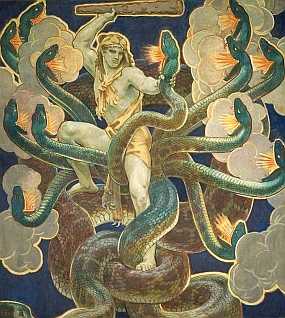
We need to look at James in light of Jesus. The Lord tells us that our mist-like life here and now has eternal purpose that will carry over into the afterlife. Singer-Sargent "Hercules and the Hydra"It is one thing to live for the day, but quite another to live for the day so eternity is richer.
You don't hear enough sermons about storing up treasure in heaven. I hear plenty about living the good life now, yet the only correct way to understand "it's all going to burn" is not as an excuse to cover profligacy this side of heaven, but as the means of testing every man's and woman's work after we die.

Who can blame a non-Christian for going for the gusto now? He or she's got nothing else to look forward to. Some will move beyond the "live for the moment" lifestyle that plagues America, opting for the concept of a "legacy." Even that may be wishful thiking, hoping our typical three-month collective memory will somehow stretch out to a century or more.

But when a Christian adopts "grab all the gusto' as a personal motto? That's the most pathetic short-sightedness of all. Yet how much of modern Christianity in the United States lives by that mantra? Better that we all be poor wretches considered the scum of the earth by non-Christians than we build a Camelot now that will only succumb to moths and rust.

Are all Christians that short-sighted? No. But increasingly, our churches fill with folks looking for the good life stamped by the Holy Spirit's seal of approval. When our preaching says nothing of building a true legacy that we will actually play out in eternity based upon what we do now, our short-sightedness damns us to a future as the shoe-shine boys of heaven, buffing the sandals of saints who laid it all down, even unto death.

We know we have an eternal future. What is more short-sighted than living as if that doesn't matter?

Assessment: Confirmed

***

5. Christians don't know how to have fun

When it comes to amusing ourselves to death, I think American Christians find as many ways to do it as non-Christians, albeit with fewer F-words and less full-frontal nudity.

We demanded, and seem to have received, more movies geared to Christians. And while the finished products haven't been all that spectacular, our craving for more will ensure they keep coming–with increasing regularity.

I plan on writing more about this topic in the near future, but in many ways, we Christians in the United States traded sanctification for entertainment. When God Himself no longer seems to excite us, we surround Him with our little cultural dog and pony shows, praying someone will pay attention. How else do we explain the entertainment complexes we used to call "churches." At one point in time, we went to see men on fire for God, but now preachers have to literally pour gasoline over themselves and light a match to get anyone to sit up and take notice.

Oddly enough, this fifth myth may be a remnant from the Seventies, before Christians got hip to their entertainment choices. I'm not sure non-Christians today hold the opinion that Christians don't have fun. That's been replaced with the concept that Christians don't really care about the life and death belief system they hold, practicing those beliefs more as a hobby than a way of life. If anything, it's the non-Christian who's grown more serious about life, while too many of us Christians worry that our new 60" TV still isn't big enough to show all the fine detail in the latest Left Behind video game we bought after reading the book and seeing the movie.

It's quite sad that in so many instances the one thing that separates us from non-Christians isn't the amount of entertainment we consume, but the randomly-sterilized nature of the entertainment we spend millions of dollars buying. Sure, their violent video game has swearing, but our violent video game doesn't.

If we think we're fooling God with that kind of subtlety, we're only fooling ourselves.

Assessment: Busted—perhaps too Busted

***

6. Christians despise intellectuals more than non-Christians do 

It would be safe to say that I don't personally know any Christian intellectuals. On the other hand, while I do not know any non-Christian intellectuals, either, I know a few who have convinced themselves they are. And as we all know, an audience that only consists of one's self is usually an easy audience to please.

First Things has a couple online articles covering Mark Noll's seminal book on this issue, The Scandal of the Evangelical Mind (found here and here). Dr. Noll researched that book during my tenure at Wheaton, and though I never took any classes from him, I had a few other profs I'd classify as intellectuals. Unfortunately, like most intellectuals, those profs congregated in very tight circles. The less intellectually rigid of us rarely encountered them "in the wild." And so it is today.

I knew an Old Testament scholar who attended the same church I once did. Sadly, that church never seriously appreciated the kind of study that scholar pursued. Though they trotted him out on occasion as a kind of "please take the witness stand, Doctor" expert, he eventually left the church. I suspect he tired of being a sort of intellectual freakshow amid people who'd rather be watching Fear Factor.

So whither the Christain intellectual? Do any still exist?

Say what we will about history, but it's loaded with Christians (and people who mentally assented to Christianity) who drove the arts, philosophy, literature, and science—and in large numbers.

But what happened to them all? Where did they go? Sure, you see a Plantinga here, and a…uh, hmm. I'm not coming up with any names for contemporary Christian lit authors. Artists? Nope—no one comes to mind. In fact, I suspect that most Christians, even if their lives depended on it, couldn't name one contemporary Christian intellectual or artist.

Are we so bereft today that all we can remember are those great Christian intellectual luminaries of the past? Christianity nurtured Western civilization into being, yet in the 21st century we Christians gave it all away.

Perhaps we missed the point of this verse:

Where is the one who is wise? Where is the scribe? Where is the debater of this age? Has not God made foolish the wisdom of the world?
—1 Corinthians 1:20 ESV

Rather than understanding that cleverly invented myths from the world's wisemen don't trump the eternal truth of God correctly handled God's wise men, we threw all the wisemen—and their wisdom, no matter the source–out.

That this ignores most of the rest of Scripture, and also makes a fine distorted case for tearing all the wisdom books out of the Bible, eludes far too many people. In the end, Christianity never calls anyone to turn off his mind. To insist it does only results in the kind of brain-dead emotionalism that leads to error. Hoisting godly wisdom by it own petard makes the Church look vacant in the cranium.

While the non-Christian may ignore the intellectuals, I suspect precious few of them are hauling out treatises to discredit the life of the mind. We Christians of the 21st century, unlike our predecessors of long ago, seem to be the ones intent on slaying the intellect.

If the few Christian intellects left decry the problem, perhaps there's some truth to the rumor. But then, we don't listen to anything they say anyway.

Assessment: Confirmed

***

More myth assessments in days ahead…

Entries in this series:


{Image: Hercules and the Hydra by John Singer-Sargent — Simply awesome.

_____ & VIOLENCE

Standard

I'm sitting in my office watching the icicles shiver on this second December in a row of brutal cold. My brain numbed along with the rest of me, I'm dying here attempting to come up with something to write about.

Oh, what the hay, let's talk about sex. Actually, let's talk about the Christian writer's plight of writing about sex. Or the inability to write about it. Or…whatever.

Contemporary Christian fiction, by all accounts, has plumbed every topic, sinful or otherwise, known to man. Adultery, miscarriage, thievery, dementia, fraud, pedophilia, murder, terminal illness, infertility, racism, pornography—you name it and someone's written about it. Gone are the days when most Christian novels dealt with virginal teen schoolteachers coming of age on the windswept Kansas prairies.

In an effort to figure out the inexplicable Christian fiction market, I've read through more Christian novels this year than all previous years combined. I suspect a good thirty novels or so. Bloody KnifeThrough my readings, I've found a curious trend that reveals much about the current mindset of Evangelicalism 2006.

More than anything else, the books I've read showcased violence. Not simple acts of heroism defending a lady's honor with a punch to some malefactor's snoot, but visceral, gory stuff. Bombings, knife fights, kidnapping and subsequent murder, degrading sexual assaults on women, lynchings, impalement—the list goes on and on.

We Christian writers seem to have no limit to how much violence we can pack into a page. Not much is left to the imagination, either. You can almost see, feel, hear, and smell the blood dripping. And the books keep selling.

So the violence portion of the old "sex & violence" mantra is alive and well in today's Christian fiction. We don't appear to have any qualms showing human beings hacking, slashing, crushing, and exploding other human beings.

But sex….

While many Christian novels deal with sexual topics, a quick read through the books themselves shows sex depicted almost as hearsay, as if a fourth-hand rumor that…well, people "do it", ahem…trickled down to the author from the cousin of a friend who knew a guy in college who once talked with someone who touched a naked body. Chastely. Because they were a doctor. 

This is not to say that authors aren't talking about sex, but they seem to be doing it in a way that sounds like what you hear in a fourth grade boys locker room. It's all a little dirty and we can't say too much without snickering or getting embarrassed.

I've noticed this to a great extent in novels written by men, though I can't tell you why. Men may lack the peculiar romantic verbiage so well cultivated by the fairer of the species. Perhaps editors, sensing a particular squirm factor in anything that even remotely smacks of Song of Solomon, ask for sanitizing rewrites that bind the author hand, foot, pen, and keyboard. Whatever the case, it comes off forced.

Curiously, when you look at major political talking points in Evangelicalism, sex appears at the core of almost every ballot initiative, signature collection, and protest. Major hot-buttons like abortion, homosexual marriage, sex education, and abstinence promotion all have sex at the center. Meanwhile, we seem mum on the environment, fighting injustice, advocating for the disadvantaged, and so on.

In the same way that writers can depict the goriest details of violence because it's not on our approved sanitation schedule, we blanch at any honest look at the intimate lives of our characters. We can write about dysfunctions, but we shy away from depicting normal sexual relationships. And even when we write about broken sexuality, we back off in a way that we never do when writing about a villain filling a victim full of lead. We end up capitalizing our violence and slathering whiteout over anything "naughty." 

I don't think I'm arguing to sex up our fiction. We have a tendency to go overboard in Christian circles when we see an imbalance. I simply don't understand our flinching at sex and our wholesale embrace of blood and guts. That dichotomy paints a disturbing picture of modern Evangelicalism.

Or maybe I am arguing to deal more bluntly with sex in our fiction. Porn use among Christians runs rampant. And while that topic's not a new one in Christian fiction, even when it's discussed, you can hear the tap-dancing shoes clicking away. We can't bring ourselves to discuss raw subjects in a way that uses the words of the disease. I recently wrote a short story dealing with the cancer of pornography and its insidious effects. An editor deemed it quite sellable—just not in a Christian market. Too much raw truth too quickly. A group faint by the faithful wouldn't be pretty.

We might well know the dirty details, we just can't bring ourselves to face them without the proper shielding. Recently, Mark Driscoll caught all sorts of flak for saying that perhaps some pastors stray because their wives don't take care of their appearances. Outrageous? Yes, a little. But I can promise you that even as some folks were harumphing over Driscoll's baldfaced commentary, inside they knew better. Outrage is only outrageous when it strikes close to home.

In the end, I don't understand the dichotomy. Why does violence come so easily, yet we tiptoe around honest sexuality? Dismemberment flows unimpeded from our pens, but not a gentle, knowing caress between a married couple. Does that honor the Lord?

The comments section is now open for flaming.  😉

Community,Politics, and Pastoral Shenanigans

Standard

Election Day is only days away and news breaks of the Ted Haggard scandal, conveniently timed (as the whistleblower himself notes) to cause the most political fallout. 

Ugh.

We've been talking about community here lately, and while this post isn't part of the "Being the Body" series we're in, it's close. It's a tale about what happens when folks are removed from real community.

For the less media inclined, Ted Haggard, now the ex-leader of the National Association of Evangelicals and the ex-pastor of a huge Colorado megachurch, has fallen in some sort of scandal, causing him to resign both those roles. The allegations that brought Haggard down are unseemly, and I don't want to go into them here. But Haggard claims that some parts of them are true and, for the purposes of this post, that's enough.

The Godblogosphere is loaded with commentary on the Haggard situation. Everyone is weighing in with the reasons why this happened, but the analysis is the same tired lament focused on the usual suspects.

Recently, I reviewed a book by David Fitch called The Great Giveaway. One of the chapters dealt with pastoral sin, pointing the finger not so much at the pastors, but at the system we've created in our churches that sets the pastor apart as some kind of CEO, celebrity, or otherwordly figure with no ties to the rest of the church body. I believe that Fitch's analysis is far more accurate than what we're seeing discussed on the Godblogs.

A few points:

1. We've created a cult of celebrity around our most noted pastors. That kind of proto-idolatry only sets them up for failure because we no longer allow them grace to fail in the small things before they become larger.

2. Failure and sin are natural parts of the human condition. All have sinned and fall short of the glory of God, as we know. This includes our pastors, but we act as if it doesn't. Our mental disconnect sets up pastors for further failure.

3. Because of these factors, pastors find themselves separated from healing community. They cease to be fellow brothers within our church communities.

4. God institutes community for correction, even of leaders, yet our cult of pastoral celebrity destroys the natural workings of the correction. This places pastors outside the community and outside of the community's ministry TO them.

So once again, we see what happens when we do not allow the natural workings of godly community to police, protect, and encourage—even the pastorate.

While I do not condone what Haggard appears to have done, I'm not outraged. If anything, I feel sorry for what our kingmaker attitude has done to the pastorate. Unless we reform our communities, stop treating pastors as superhuman, get off our judgmental attitudes, and get back to recognizing that ALL the sheep have gone astray (not just some), we'll continue to see more high-profile pastors fall. We've got to be grace-filled communities that recognize the sin in our own leaders and allow them to receive grace from us, rather than blackballing them, stripping them of their ordination, and so on. With the constant threat of the "laity" turning on them like a pack of vicious dogs, pastors are all too likely to go into "coverup mode." No wonder the small sins wind up turning into monstrosities.

And don't believe that it can't be your favorite big-name pastor. I'm seeing a lot of people claiming their man is immune, all the while dancing on the ashes of Haggard's ministry. That's sickening, frankly. And unless we get wise to the fact our crippled views on community are what make stories like Haggard's possible, we'll continue to treat these pastors like they're a ruling class, rather than as sinful brothers in need of grace, just like we are.

We don't talk politics on this blog, but I wanted to drop that for one second to talk about this Tuesday's election.

I live in a state racked with pain. Ohio is in serious trouble. Our current Republican administration in this state is rife with malfeasance and failed agendas. The Republican governor has been an unmitigated disaster. His failures have resulted in Ohio being anathema to businesses of all sizes, driving many out of the state and attracting nothing to take their place. Now Ohio, the birthplace of more presidents than any other state, is in dire condition economically. We're the number one state for job losses, one of the worst of the worst signs of trouble.

I've noted in recent months through one of the series I did that I'm what they term a Crunchy Conservative. While much of what I believe politically sounds Republican, I oppose the Republican Party on many environmental, employment, and social issues.

This political season has underscored for me that we're drastically in need of some kind of reform in government. The Republicans don't represent the average family when they put big business ahead of the environment and small businesses. They don't represent the average family when they make all sorts of claims about supporting the family, but their final interest only comes down to supporting the richest one percent of families out there.

The Democrats, on the other hand, mouth some sort of allegiance to the little guy, but their party is responsible for supporting nearly every social evil imaginable.

And in the end, it seems like they're all liars anyway.

I believe that the same problem of making kings out of our pastors has soiled our politics. While politicians say they're part of the community, the community they're a part must only be millionaires and hedonists. I'm divulging no new truth here when I say that most people aren't like that. But the demographic on Capitol Hill doesn't reflect the common man out struggling to live in America 2006. It represents CEOs and loud-mouthed deviants.

My current rep is gung-ho about putting a nuclear waste site in a poorer area of the state not far from my home. Remember, I live in OHIO, not the Sonora Desert. She claims to be a part of my community, but I've got to wonder how any sane person would consider putting nuclear waste in a populated area with a high water table upstream from a major American city. I've got to wonder what PAC got to her and for how much. Isn't that sad?

She's a Republican. I don't know how I can vote for her, though. Her Democratic opponent supports a number of grievous moral sins. I can't vote for the opponent, either.

In short, no one represents most of the people I know in this district. Though they would vehemently protest my assessment, the candidates in this election aren't really part of our community. They're a part of some other class of people entirely who don't get us as much as we don't get them.

Sounds like some of the pastors in our churches, doesn't it?

I'm not sure what we can do about the problems in politics, but we can start doing a better job in our churches of allowing our pastors to fail in our community just as we ourselves are (or should be) allowed to. We need pastors who are like us, too, not outsider glamour boys who seem more attuned to politics than pulpits.