Branded for Christ

Standard

My father wore nice clothing. He bought from an old-fashioned men’s store owned by a respected Jewish family that sold top designers at JC Penney prices. The movers and shakers in that family were serious-looking men who walked around with slivers of marking soap in their pockets and tape measures draped around their necks at all times. And when they spoke with you, it was always from over the tops of their half-glasses.

As a teenager, I visited that store with fascination. The owners lived and died men’s clothing. The Steinbergs could take one look at a suit and know the designer. They recognized the cloth, understood a designer’s cut. Cassini, De la Renta, Botany 500, Perry Ellis—it didn’t matter. The brand spoke to them, whispering its secrets, secrets the Steinbergs guarded as they built a reputation for excellence.

In the recent past, I discussed branding with a fellow Christian blogger. He didn’t like the idea of thinking of himself as a brand, but despite the protests, there’s no escaping the marketing aspects of branding. Any public personna, even a blogger’s, has an aura it exudes. That glow attracts others because of the peculiar set of characteristics that define the blog. Cerulean Sanctum’s brand falls into the following set of characteristics:

  • I primarily discuss the American Church.
  • I examine issues within the Church that may be overlooked by others.
  • I offer practical (rather than theoretical) answers to those issues.
  • I try to keep a balanced perspective between warring philosophies, usually because I believe no side today fully sees the bigger picture.
  • The writing here may be controversial, not because it skewers individuals or denominations, but that it forces the Church as a whole to examine itself more thoroughly.
  • Readers consider the commentary here to be passionate, intriguing, unique, and thoughtful.

That’s the Cerulean Sanctum brand. (Notice how objectivity anchors some of those brand characteristics, while others are perceptions.)

You’ll notice I rarely depart from the brand. Diverging from the brand only harms the message. I shared with that other blogger the half-dozen or so things he does well and told him he should consider staying with—and reinforcing—those characteristics of his brand. In most cases, adding too much to the brand or stripping off what people appreciate in the brand spells doom. Imagine if Apple Computer abandoned its well-known industrial design. Or the company decided to forgo ease-of-use.

My son has a London Fog winter coat. Growing up, London Fog epitomized for me classically-tailored men’s outerwear. The Steinbergs sold London Fog; it was my dad’s coat of choice.

But my son’s coat is nothing more than the name London Fog stitched into a coat that could be any generic outerwear made anywhere in the world (Bangladesh, in this case). Nothing of London Fog’s brand can be found in the coat. With no sense of tailoring or style, it’s just a coat. I can’t even say that it will weather like a London Fog. Given its cost and origin, probably not. I’m not sure I even noticed the London Fog name when I bought it. One thing I do know: I’ll cast a wary eye at anything else branded London Fog that I might find on the racks today.

Diverging from the brand or simply tossing the brand name on any old item dilutes the power and prestige of a brand.

Whether we like it or not, Christianity has a “brand.” Certain characteristics of the Faith contribute to its objective practice and to the perceptions of others. Good or ill accompany those practices and perceptions. Holy Spirit stained glass by TiffanyI’m sure every person reading this is intimately acquainted with both the good and the ill. Still, I’m sure we can come to some agreement on what the Christian “brand” entails.

Or can we? Maybe even that’s the wrong way to go about understanding what people know about being followers of Christ. Perhaps there’s a better source for understanding our brand than asking ourselves how it’s viewed.

Many of the posts on Cerulean Sanctum begin with me wondering how other people—whether in the Church or outside it—comprehend Christians they encounter. Sort of the “walk a mile in another person’s moccasins” view. In the case of people who don’t know Christ, reasons exist for their reluctance to listen to the Gospel we bring them. Before anyone drops a “Christ said the world will hate us” bomb now, let me ask whether the perceptions of the Church by others are formed…

…because our light is exposing their darkness…

-OR-

…because the American Church’s own state is so dim, the unbeliever’s darkness looks like high noon on a clear Antarctic day in comparison.

Much more difficult choice, isn’t it? That sneer on the face of a coworker whenever Christ is mentioned may have more to do with the lousy experiences he’s had with Christians and the Church than it does with any hatred he may have toward Christ Himself.

We’d do well to find out from non-believers what it is we’re doing wrong. I’m not talking about megachurch demographic sampling nonsense here, but asking the hard questions. For instance, the next time we sit down with someone who doesn’t know Christ, ask the following in casual conversation:

What do you appreciate about Christianity?

What bothers you about it?

I can promise you this, you’ll learn a lot from those two questions. The question we should then ask ourselves is how we go about reversing negative perceptions while reinforcing the good. Since I can promise that most trait perceptions come down to the way we practice the faith, we’ll get a firm dose of reality, plus a roadmap for prayer and growth.

I’ve said many times here that we’re not in the initial stages of evangelization in the United States, we’re in mop-up mode. Nearly everyone living in this country has heard the name of Jesus. Now all they need to see is an American Church that practices what it believes.

Let’s face it: We’ve diluted the brand. We’ve added too much garbage to Christ’s message. We’ve tacked on enough Christianized cultural artifacts to derail millions. Or we abandoned the very heart of the Gospel to the point that people aren’t really sure what defines Christianity anymore. And it’s not just the unsaved who face that dilemma. I know solid Christians searching for Christ in the midst of a Church that has largely forgotten the truth of what it means to follow Him in simple discipleship.

I grew up singing “They’ll Know We Are Christians By Our Love.” The title of that song grabs me every time because it’s essential to our brand. Christians should always be characterized by their love for others and for the Lord. But are we known for our love or for the fact that ten times yesterday someone from a Christian organization phoned to remind us to vote against godless heathens? (If only just one person a day called you or me to remind us we are loved by Christ and by the brethren!)

What do non-believers say? Trust me, they’re getting our message—especially if that message doesn’t match our practice or the true call of Jesus. We need to ensure when we mention Christianity to others, the response is positive rather than negative. Otherwise, we need to fix how we live.

In more ways than one, we’ve been branded for Christ. Whether we believe in the value of that brand enough to protect it and communicate it effectively is quite another thing altogether.

Being the Body: How to Forge Real Community, Part 1

Standard

Unbroken circleIn the first entry in this series, we looked at the Biblical foundation for asserting that the Lord is powerfully for community. His model for how we’re supposed to live and minister are based in community, not the rugged individualism we find so prevalent in the American mindset.

Regular readers will know that posts on community turn up frequently at Cerulean Sanctum. (Search on the Community category in the sidebar.) As I mentioned yesterday, I believe that many of the problems facing the American Church today are based in flawed or non-existent community. Clean up how we do community, and many  of these problems will fade away, leaving us to better serve the Lord and each other.

Many people talk about community, but achieving vital community within our churches is another issue altogether. I think the Lord is sick of talk; He wants to see us start living what we’re talking about.

So how do we start developing community?

Today, we’ll look at basic ways to turn talk about community into the kind of fellowship that dwells in one accord.

#1 – Every hour of every day, say, “It’s not about me.”

    Christianity, at its core, is others-centered. Love the Lord. Lord your neighbor. The heart of the Christian is inclined to Christ, and as Christ gave Himself away, we should give ourselves away. Freely we have received, freely we give.

Aren’t we always quickened by missionary stories that tell of extraordinary sacrifice? David Brainerd gave to the lost Indians he encountered till his tuberculosis-racked body gave out. Jim Elliot took a spear to the back so a primitive tribe others forgot might escape eternal torment. Hudson Taylor buried most of his family in China, yet because of his selflessness, the Chinese Church not only thrives today, but shames us with their faithfulness amid persecution.

The great Christians are so because they gave themselves away, sometimes even to martyrdom.

It’s about Christ. It’s about others. However unpopular that may be with us “King of the Hill” Christians in America, the truth remains. Community starts with understanding that you and I are tiny (albeit essential) bits of the Body of Christ. If we’ve truly died to the world, then being a tiny bit consecrated to a greater purpose is pure joy.

If we’re still holding onto our selves, then “it’s not about me” will grate on us. We’ll find any avenue we can to pave over that truth. And when it’s finally buried, we’ll paint a happy face over the top and go on serving ourselves.

But don’t call that Christian discipleship.

#2 – When a person shares a need with us, we should instinctively ask, “How can I help meet your need?”

    Nothing angers me more than the hands-off approach some Christians take with the needy. Those quasi-disciples have this bizarre notion that aiding the hurting, shattered, and destitute will somehow stymie whatever God is trying to do in that person’s life. It’s as if we believe that God is going out of His way to punish the hurting, shattered, and destitute, and any comfort or assistance we give that poor person will throw a monkey wrench into God’s rack of discipline.

Nonsense. I’ve read the Bible from cover to cover enough times to know that such thinking is nothing more than an excuse to do nothing.

On the other hand, the Bible is loaded with hundreds of verses commanding us to look after the less fortunate. For those who hold to the less is more concept of helping others, here’s a favorite of mine:

Whoever closes his ear to the cry of the poor will himself call out and not be answered.
—Proverbs 21:13 ESV

Ye-ouch.

No, as disciples of Jesus Christ, we are to imitate our Master. He did not rebuke the needy, but met their need. Notice His response in this passage:

As he drew near to Jericho, a blind man was sitting by the roadside begging. And hearing a crowd going by, he inquired what this meant. They told him, “Jesus of Nazareth is passing by.” And he cried out, “Jesus, Son of David, have mercy on me!” And those who were in front rebuked him, telling him to be silent. But he cried out all the more, “Son of David, have mercy on me!” And Jesus stopped and commanded him to be brought to him. And when he came near, he asked him, “What do you want me to do for you?” He said, “Lord, let me recover my sight.” And Jesus said to him, “Recover your sight; your faith has made you well.” And immediately he recovered his sight and followed him, glorifying God. And all the people, when they saw it, gave praise to God.
—Luke 18:35-43 ESV

Jesus did not attempt to blame the man for anything. He did not try to explain to the man that God was disciplining him through his blindness. No, Jesus asked, “What do you want me to do for you?”

A servant asks that question. Because our Lord came as a servant, we are to ask the same question if we are to be like Him.

Don’t unload a needy person’s request on someone else, even if that someone else is God. If you wish to bring others into the situation to help, by all means do so, especially God. But take responsibility by asking, “How can I help meet your need?” Then meet the need with every resource God has given you.

Some of you may wonder how this makes for vital community. The answer is simple: If we’re collectively meeting the needs of others, when it comes our time to be needy (and our time WILL come), our needs will be met. I don’t have to spend all my time watching my own back because the brethren are doing it for me, just as I am for them.

But it has to start with us. We may even run a deficit on returns, yet we do it nonetheless. Maybe if enough of us do it within our churches, being true servants will catch on. And so will true community.

#3 –  The Holy Spirit created Christian community ex-nihilo, so we better be Spirit-filled.

    No sooner had the Holy Spirit fallen at Pentecost than we see this at the close of Acts 2:


And all who believed were together and had all things in common. And they were selling their possessions and belongings and distributing the proceeds to all, as any had need. And day by day, attending the temple together and breaking bread in their homes, they received their food with glad and generous hearts, praising God and having favor with all the people. And the Lord added to their number day by day those who were being saved.
—Acts 2:44-47 ESV

The echoes of Peter’s Pentecost sermon still reverberated among the palisades of Jerusalem, yet already the Lord was forging a vital community. A Spirit-filled church will naturally pursue community. One of the hallmarks of being filled with the Lord is a godly inclination toward others. It’s inescapable.

If there’s no real community at your church, then the Holy Spirit’s not there. Pure and simple. If your church is a tenuous affiliation of individuals, then I don’t care how powerful you may think the preaching, teaching, and worship are, your church is stone cold dead. We’ve got to stop lying to ourselves. The proof of the Holy Spirit’s absence is right there in the lack of community within our churches.

If that’s your church, you don’t have to go down without a fight. Greater is He that is in us than he that is in the world.

Find at least a couple other people dying for community, then pick a night when you can go to your church and throw yourselves face down before God, praying until the Spirit shows up. Fast and pray till heaven opens. Do it long enough and others might notice. Maybe they’ll join, too.

Are we serious enough about community to take whatever steps we must to have the kind of community we prattle on about? I know I’m deadly serious about this issue because I think it means life or death for the American Church. Yes, the devil can no sooner wipe out the worldwide church than you or I can blow out the sun, but that doesn’t guarantee the American Church won’t be reduced to a handful of embers. God’s going to send His Spirit where people are serious about the cost of discipleship.  And part of that cost is putting down our self-centered lives to pursue a life of real community.

#4 – Judgment may begin with the house of God, but so does charity.

    Take another look at the Acts 2 passage above. What needy people were the first recipients of the Church’s charity? People in the Church!

We can’t serve people outside our churches if we can’t serve people inside them. And too often, that’s exactly the case. We think that once a person becomes a Christian, they don’t need help from the brethren. We wrongly toss needy fellow believers back into God’s hands and go out to help those outside.

What witness to the world is that, though? Why would anyone want to be a part of a community that’s willing to help people UNTIL they become part of the community? Look at enough cults and you’ll be surprised how many act just that way.

Sadly, I’ve known Christian churches that do that. Time and again they fail because they forgot that charity begins at home. We minister to the believers first, then to those outside the community.

Does this run the risk of being too inwardly focused? Sure. But if a community of folks dead to the world makes up your church, they’ll need less and less inner support as time goes on. Soon, most of the community will require only a minimum of support at the most critical times, and more time can be spent ministering to the needs of those outside the community of faith.

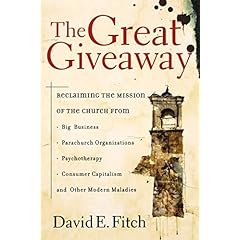
Some would go so far as to say that there is no distinction between inside and outside. David Fitch’s The Great Giveaway cranks the amp to eleven by stating that all charity should be within the church community: Definitely offer help to the needy outside our churches, but with the stipulation that they become part of the church first. That’s some serious tough love, but I can see the wisdom in it. Think of the wide-eyes among nonbelievers when encountering the early Christians looking after each other the way they did. I’m sure many of those pagans were dying to have some of what the Christians had.

How many lost people today are dying to have what we have? Are they beating down the doors of our churches to get in?

If we start thinking along the lines of the four points raised in this post, we’ll make progress toward true community in our churches. In the days ahead, we’ll discuss other ways that we can work toward the kind of Christian community that will change the world for Christ.

Posts in this series:

The Great Giveaway, Part 1

Standard

The Great Giveaway David E. Fitch’s The Great Giveaway: Reclaiming the Mission of the Church from Big Business, Parachurch Organizations, Psychotherapy, and Consumer Capitalism is the best Christian book I’ve read since Nancy Pearcey’s Total Truth. A fantastic primer discussing how the Church must live in a postmodern age, The Great Giveaway examines the ways the Church bowed the knee to modernism and gave away her soul. By allowing alternative scientific approaches to spirituality to trump the Gospel of Christ, the modern Church distanced itself from historic faithfulness. In keeping to this premise, The Great Giveaway does not attempt to critique postmodernism, but finds the everlasting truths of Christ and asks how they reveal themselves in this age.

If that sounds like emerging church rhetoric, trust me, it’s not. Fitch manages to step out of the emerging church versus traditional church battle and show where each is lacking. What makes The Great Giveaway better than all the books critiquing the American Church today is that Fitch not only sees the problems, he offers the best solutions I’ve encountered. (Much of what you’ve read on Cerulean Sanctum since the inception of this blog is mirrored in the pages of The Great Giveaway, so if it sounds like I’m tooting my own horn here, I’m trying to be as objective as I can under the circumstances.)

Is this a perfect book? By no means. Serious flaws spring up here and there. A couple months ago a commenter asked how I could recommend flawed books. (I had issues with some of the concepts in Randy Frazee’s two books, though I recommend them highly). I’d like to turn that around and ask what books besides the Scriptures are without flaws? Discernment, so utterly lacking in the Church today, necessitates that we read every book by every author—our favorites or not—with an eye toward error and truth. Real discernment is not blanket condemnation, but rather wrestling with ideas with the aid of the Holy Spirit and the Scriptures.

The Great Giveway features the following chapters, and I’ll deal with each in turn this week:

  1. Our Definition of Success
  2. Evangelism
  3. Leadership
  4. The Production of Experience
  5. The Preaching of the Word
  6. Our Understanding of Justice
  7. Spiritual Formation
  8. Moral Education


Our Definition of Success

Overview

Fitch begins his book with an easy target: “Megachurchianity,” as I call it. Numbers, he writes, do not translate into faithfulness. Church Growth Movement thinking owes more to business principles than Scripture. The result of working toward bigness is a consumeristic outgrowth of church that places rugged individualism and business efficiency at the core of church health rather than faithfulness to Christ. Faithful churches instead center their life in Christ and genuine community. That community is measured by real relationship with fellow believers that speaks hard truths into people’s lives, sees the need for confessing sin in a grace-filled local body, and calls on church members to partake in discerning prayer needs for each person’s life and the church as a whole.

Comments

Since most of the people who read Cerulean Sanctum agree that an obsession with numbers tends to curtail real discipleship, I have little comment. The Great Giveaway starts with an easy target and doesn’t add much to the discussion. We agree that consumerist Christianity fails. We know how megachurch religion missed the boat on every living and active part of the Church. Fitch doesn’t add much to the conversation. Think of this chapter as a touchstone for everything else that follows.


Evangelism

Overview

Fitch points out that postmodernism is the death-knell to evangelism that relies solely on apologetics. Postmoderns are not impressed by talk that does not follow walk. In fact, walk is proof of talk. Postmoderns are much more willing to listen to Bible truth when that truth is preceded with Bible walk.

Evangelical obsession with evangelistic methodology comes at the expense of real relationships with people. We’re more interested in getting someone saved than being their friend. The days of that thinking are numbered, though. What people today need to see in Christians is the actual living out of the evidence of Christ in us. This puts the evangelistic onus back on the community of believers rather than the individual. Individuals can still attest to Christ by their own life changes and Christ working through them, but the real power is in a transformed community. The early Church’s influence came about because people saw Christ in that community.

To that ends, hospitality, praying for others in need, showing mercy to those who desperately need it, and bringing justice to those without it are stronger evidences of the veracity of Christ than merely running through The Four Spiritual Laws or The Romans Road. Fitch by no means subjugates the Scriptures to experience, but instead shows that love overcomes roadblocks that enable the truth of Scripture to permeate the hardened hearts of people today. It’s the sun that melts the snow in Isaiah 55:10-11.

In an age when we in America have virtually no sense of real community, developing a worshipful community that embodies genuine relationships that alter how we live every day should fuel our evangelism. Fitch also seeks to recover the importance of our baptism into a worshipping community, stating that too much attention has been put on one singular act of conversion and not enough on the kind of long-term discipleship that Christ calls for in the Great Commission. He also sees Church planting as the healthy expression of a growing church rather than the tendency to grow into a megachurch.

Comments

We need to always be careful when someone states that God’s Word needs outside proof to be reconciled as true. Postmodernism’s obsession with avoiding absolute truth is infamous, but I don’t believe that Fitch is saying that walk makes talk true. God’s Word is true by itself. However, to a generation raised on hearing the Bible constantly—who can truly escape it in America?—but without seeing it practiced much by the Church, we need to consider how we walk out what we believe in front of others because our walk is supposed to be a reflection of the truth of the Gospel.

The failure of church bodies and individuals to live out what they believe is largely responsible for the mess we see both inside and outside our churches. Call it sin, unbelief, or laziness, but whatever the label, we blew it.

I agree with Fitch on most every comment and solution he offers in this chapter. We Christians do need to start living as an alternative community within the larger society rather than finding the church co-opting that society’s patterns of living and broken solutions to problems.

If I have one problem, I don’t believe that planting more churches is the answer. We have enough churches. Now if an existing church is growing so large that it naturally must subdivide, that’s a different response than simply planting churches. I think Fitch favors subdivision, but he doesn’t make that entirely clear when he discusses church planting.


The review of The Great Giveaway continues with Part 2 and Part 3 .