
A couple weeks back SF Gate columnist Mark Morford wrote an op/ed piece called “American Kids, Dumber than Dirt” in which he quotes a longtime teacher friend as saying that kids today are stupid to the point of verging on inert:
It’s gotten so bad that, as my friend nears retirement, he says he is very seriously considering moving out of the country so as to escape what he sees will be the surefire collapse of functioning American society in the next handful of years due to the absolutely irrefutable destruction, the shocking — and nearly hopeless — dumb-ification of the American brain. It is just that bad.
I know that I’m perpetually saddened (yet oddly amused) by what people don’t know. And that’s not in some kind of snobbish way. Watching a high school graduate grossly mis-tally a simple three item receipt from a restaurant makes me wonder how such a lapse can exist.
You long-time readers know that I have a degree in Christian Education and know all the educational theorists. You know that I homeschooled up until this fall. You also know my child is in public school right now. You know that I believe that no educational system is perfect.
But as much handwringing goes on today about education, I keep returning to one inescapable truth:
Kids are only as smart as their parents are.
The apple doesn’t fall very far from the tree, and in most cases today, a lot closer to the trunk than some would like. 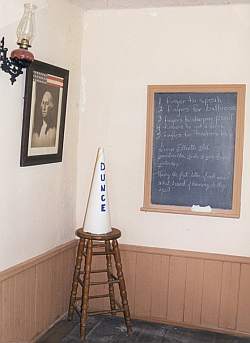 But when it comes right down to it, smart parents have smart kids—no matter what kind of education (public, private, or homeschooled) their children receive—because the parents themselves value education and pursue it in their own lives.
If the parents of a child are about as sharp as a bag of wet tribbles, then how can we expect the child to exceed the parent? That rarely, if ever, happens.
We expect most homeschoolers to be winners of spelling and geography bees, but look at the parents in those cases. They’re engineers, scientists, academics—the national brain trust, in other words. The only way they’re going to turn out a dim bulb is if they give birth to a brain-damaged kid. And even then, that’s going to be the brightest brain-damaged child of the lot.
But even when it comes to homsechooling, the weak link in the chain is the parent. A parent with smarts that rate a 6 on a scale of 10 is probably not going to teach their kids to a level 8 or higher. Why? Because that parent will be uncomfortable exceeding his or her own knowledge. This leads to what is known as the law of diminishing returns.
Parents are never going to feel adequate to teach their kids to the limits of their parental smarts—ever. That truth wipes out most distinctions of public, private, and homeschool. As much as a we’ve castigated public schooling, smart parents who put their kids in public school are not going to turn around when that kid is eighteen and find a numbskull. This truth works in the opposite, as well. If parents can barely tally three lines on a restaurant bill, why should we expect their children to? Yet we’re perpetually astonished by the seeming ignorance of youth today.
“But Dan,” you say, “isn’t your blog about the Church in America? How does this fit with your theme?”
If we wonder why the youth of today can’t theologize their way out of a damp paper bag, we have to look at the parents.
Christian parents suffer from a few maladies that make them inadequate to the task of teaching their children about the Lord:
- They’ve been told that they are inadequate for the job… – This same instructor superiority afflicts parents in all types of learning environments. The educational elites turned up their noses at the bourgeois attempts of parents to teach their own children and slapped their knuckles with a mighty big ruler in the process. And just as it afflicts the public and private school systems, it afflicts Christian education.
- …so as a result, parents have abandoned their role in education – This is not only the parents’ fault for being weak-willed and lazy in their children’s Christian education, but also the willingness of most church people to treat the educational staff at their churches like divine oracles who can do no wrong. Worse, those so-called oracles believe the hype and even fan it into flame. That’s got to stop, on all counts.
- We’ve made the Faith either too complex or too rudimentary. – It seems we can’t find the balance. We either make the faith into an intellectual exercise of splitting infralapsarian and amyraldian hairs (or whatever esoteric argument floats your ark) or we make it a brain-dead exercise in being nice to people. Well, shame on us—all of us. So parents think they either have to possess a seminary degree or else they think they can skate because there’s nothing to “this Christianity thing.” Either mentality jumps the educational tracks.
So how do we get parents into the right mindset and smarts-set to do this important job?
- We emphasize the importance of the work—and our willingness to help. It seems to me that part of the problem of Christian education today stems from either asking for the world of parents or asking nothing at all. We need to find a solid middle ground. But more than that, churches need to understand that they must partner with parents to ensure the next generation gets some theological smarts. Not by being condescending. Not by dumping all the load on parents. Not by pointing a rifle at anyone’s head. But by walking alongside parents and helping them learn how to teach their own kids. (I’ve long contended this should be the primary role of the youth minister!) The Christian education conducted by the church should always be viewed as a gap-filler, not as the primary source of education. That’s the parents’ job.
- We teach the parents what they need to know. As I’ve noted, kids will only be as smart as the parents. If the parents can’t grasp the atonement or what it means to die to self, there’s not a chance their kids will. If the parents won’t talk about those topics outside church (where the greatest growth occurs), their kids won’t hear it. Churches, this is your core emphasis in Christian Ed: Instilling a solid Christian worldview and theology in your adults, particularly those adults with children.
- We set attainable educational goals. Every child the age of seven should know why it was necessary for Jesus to come. That should be right on their lips if asked. Littler ones should at least know who Jesus is. A solid Christian curriculum should not only repeat the basics at every age level, but also add onto the previous age level. There’s no reason our teens can’t be asked the differences between the different views on the atonement. Or to explain covenant theology. Or to be able to stand up and expound a rational pneumatology. (In my Lutheran catechism, I got a one hour grilling on theology in a private session with the pastor and youth leader.) But to get there, set appropriate, attainable goals.
- We work to counter culture. Our society is in the brink of disaster with our busyness. Sadly, modern Evangelicalism contributes to our harried schedules by adding more and more things we MUST do that, in the end, aren’t necessary. Educating the next generation about the Lord is about as necessary as it gets. Getting your kid into a time-intensive soccer program that will score them a spot in an Ivy League college DOES NOT MATTER ETERNALLY. Yet this is what too many Christian parents want. A recent Barna poll, one of the most disturbing I ever saw, showed that Evangelical parents thought getting their kids into elite colleges outweighed whether those same kids knew Jesus Christ or not. God help us! We have to start demolishing these strongholds that entrap us if we’re to be a vital Church.
- We stop the school choice derangement syndrome. Homeschooling parents must desist in their schismatic, judgmental, and outright wicked accusations against non-homeschooling parents. This is not just an issue of “secular” education. If we wish to utterly negate the truths of the Gospel in front of our children and nullify Christlikeness in them, then by all means, let all sides on the school choice issue treat each other like vermin. That’ll teach the little ones the right people to hate and for the correct reasons. We all know that’s why Jesus came, right?
So yeah, it IS all about the parents. If we want smart kids, we better make smart parents. And there’s no better time to start on that path than today.
 but God forbid if some trained Christian artist creates a challenging oil painting and asks for support.
 Because nothing beats a spectacle when attempting to prove one’s royal lineage.