
 2005 has been a year of tremendous growth at Cerulean Sanctum. Hundreds of readers left comments and blessed me by what they wrote. Most of the posts linked here were cited as being particularly helpful (or contentious) by the folks who stop by here on a regular basis, so I hope this collection of the best of this blog will provide plenty of reading material for anyone looking for challenging ideas that seek to reflect the heart of the Lord.
God bless you all in 2006 and beyond!
General Church Issues
I ended 2005 with a series covering damaging messages that worm their way into the Gospel presentation in American Christianity.
- Hidden Messages of American Christianity: Classism
- Hidden Messages of American Christianity: Kneeling at the Altar of Excellence
- Hidden Messages of American Christianity: Correctness Before Love
- Hidden Messages of American Christianity: Pastor O’Gill and the Little People
- Hidden Messages of American Christianity: “We’re Cool, Too!”
- Hidden Messages of American Christianity: “Family Cocooning Session: No Trespassing Allowed!”
- Hidden Messages of American Christianity: The Outstretched Hand
- Hidden Messages of American Christianity Wrap-Up
The Little Things series looked at issues within the Church that often go ignored, but which can contribute to hurting others, failing in our ministry, and sabotaging the mission of the Church.
- The Little Things: Homes & Churches That Say, “Keep Out!”
- The Little Things: Ingrates
- The Little Things: The Zodiac Blogger
- The Little Things: Unkept Prayer Promises
- The Little Things: Excuses
- The Little Things: Illegal Worship
On the Brink of a Quantum Singularity with Calvin and Arminius asks if the Church is better served by staying at the feet of Christ rather than exploring the fringes of what it means to be in Him.
That Nutty Small Group Dialectic discusses Hegel’s “thesis + antithesis = synthesis” ideal and how it can wreck small group Bible studies.
The Reason the Church Exists explores the mission of the Church.
Ford, GM, and the Church and More Signs We Are Not Ready ask whether the Church in America is ready to go through difficult times, and if not, why not?
Is Christianity Broken? and its follow-up, Recovering Christianity’s Balance, look at the plethora of beliefs within Christian thought today, searching for a holy middle ground that best fits the narrow way.
A Long Obedience in the Same Direction seeks to restore a rational view of long-term Christian discipleship when we confront folks who are making mistakes in their walk with Christ.
Lifestyle Issues and Christian Living
The Christian & the Business World series garnered much attention throughout the blogosphere, providing an in-depth analysis of how the Church in America underestimated the power of the Industrial Revolution to profoundly change not only our society, but the Church itself—neither for the better. In the end, I called for a radical rethinking of how we live as countercultural Christians in a world altered by business practices rooted in Darwinian survival of the fittest morality.
- Upcoming Series: The Christian & the Business World
- The Christian & the Business World #1: My Qualifications for the Series
- The Christian & the Business World #2: Economic Systems
- The Christian & the Business World #3: Subduing the Earth
- The Christian & the Business World #4: The Industrial Church Revolution, Part 1
- The Christian & the Business World #5: The Industrial Church Revolution, Part 2
- The Christian & the Business World #6: The Industrial Church Revolution, Part 3
- The Christian & the Business World #7: Binding the Business Strongman
- The Christian & the Business World #8: The Redemption of Corporate America
- The Christian & the Business World #9: The Redemption of Corporate America, Part 2
- The Christian & the Business World #10: The Redemption of Corporate America, Part 3
- The Christian & the Business World #11: The Redemption of Corporate America, Part 4
- The Christian & the Business World #12: The Redemption of Corporate America, Part 5
- The Christian & the Business World #13: Radical Christian Workers Unite!
Are You a Hamster? Sometimes it feels like we’re on a spinning wheel with no way to get off. But a countercultural Christian solution exists.
The American Church’s Five Most Pressing Needs—the title says it all.
Love Sin / Hate Sin—What do we do when we say we hate sin—but not really?
What the Church Is Not Learning explores the lessons the Church in America resists.
The Humble Warrior demolishes the faux-manliness trumpeted in bestselling men’s books.
The To-Do List Christian is a peculiar creature that is half human, half PDA, and not entirely alive.
Stay-at-Home Dads (or “Guys the Church Would Like to Forget Exist”) As one of those men, I ask why so many Christians are willing to point fingers at us, but offer no solutions to the broken system that made us.
Singleness: Radical Answers for a Harsh Reality goes deep into the abandonment of many singles by their churches and the Christian culture we’ve erected in the early 21st century.
The Problem of Porn examines the underlying causes and issues that afflict those trapped in pornography.
Another Look at the Church’s Missing Men is a follow-up to a post last year, with an explanation as to why men are dropping out of our churches.
Trying to Get By sees the lost as sheep without a shepherd.
Isolationism, Materialism, and the Evils of Our Age blasts the accommodations we have made to our culture, but which the Church may unwittingly support because it has sought no better way.
Tougher People looks at the wimpiness of the West.
A Hodgepodge of Thoughts on This July Fourth offers some thoughts on cultural accommodation.
Controversial Subjects
The Myths of Homeschooling Series examined the hype that often surrounds the homeschooling movement, seeking common sense and true Christian charity from all sides of the discussion.
- The Myths of Homeschooling #1
- The Myths of Homeschooling #2
- The Myths of Homeschooling #3
- The Myths of Homeschooling #4 (Conclusion)
Creating a Theology from Unbelief was perhaps the most contentious post this year as I asked if we truly believe the Bible the way we claim to.
The Truth About Women (and Men) posits that we Christians have done a terrible job raising young women (and men) for the Lord.
Christian Blogging: A Waste of Time? Well, ask a bunch of bloggers if they’re wasting their time blogging and you’re sure to stir up a hornet’s nest.
Psychology a Pseudo-Science? asks the hard question of psychology as it further penetrates Christian thought.
Not So Wild About Harry—bring up Harry Potter and not get varying opinions? Hah!
Charismatic Issues
The last quarter of 2005 found the Godblogosphere choosing sides over cessationist and charismatic (or as it has been called recently, “continualist”) positions. As a non-charismaniac charismatic, I took up the cause that God still works supernaturally, not only by His own action, but through us, His human agents. In addition, a couple posts addressed the low position afforded the Holy Spirit in many of our churches.
Advertising Ashes and Overflowing both ask if the Church is honoring the third Person of the Trinity in faith and practice.
The Least-Believed Verse in the Bible wonders why so few believe that the mountain can be cast into the sea if we only have faith.
God Is Still Speaking counters a post by Steve Camp claiming that He is not.
Response to “Some Say It Blundered” reverses the burden of proof on charismatics to prove that the gifts still exist today.
How Not to Be a Charismatic Headcase is a companion post to 2003’s Charismatic Churches and the Cult of New asking charismatics to ditch the charismania.
Heretic Hunting and Judgment
Each of the posts listed here sought some sanity in the ongoing battle of who’s right and who’s wrong in American Christianity. So many times we try to justify our own positions while ignoring our own foibles. There have been several pitched battles between bloggers and church movements that amounted to nothing more than namecalling and ugliness. Let’s hope 2006 is a finer year for all of us.
Let’s Play “Spot the Heretic!” Soon everyone will be a heretic.
Witch Hunt questions our willingness to so easily find fault in other Christians.
Arrogance, Ignorance, and “I Don’t Know” wonders why so few are willing to say “I don’t know.”
Nyah, Nyah, Nyah, We’re Not Listening! asks why the traditional church and emerging church are so unwilling to listen to each other’s criticisms while also examining their own faults.
On Consigning Enemies of Christ to Hell asks why it is so easy to condemn others, but so hard to help them grow in Christ.
Tearing Down the Gallows calls for a greater willingness to correct others in true Christian love.
Has the Christian Blogosphere Lost Its Collective Mind? questions the Christian blogosphere’s cannibalistic practice of consuming its own in a fit of pique.
A Long Obedience in the Same Direction is a cautionary tale of judging God’s timetable in working out His perfect will in other believers’ lives.
Evil
Curses are real and can hamstring Christians if we fail to understand them.
The Chthonic Unmentionable delves into the world of the demonic and asks why so many Evangelicals start whistling in the air when confronted with the work of fallen angels.
Writing and Publishing
I work as a freelance writer, plus I’m finishing up my first novel. These two posts received plenty of commentary from other Christian writers.
Rock { Christian Author } Hard Place discusses the fine line a Christian novelist must walk in order to be all things to all Christians.
The Desperate Need for Heroes examines the trend in Christian fiction toward fitting heroes with progressively larger feet of clay.
More Cowbell Awards
The More Cowbell Award—the award no one wants to win—is a tongue-in-cheek look at the lunatic fringe of American Christianity.
Announcing the “More Cowbell Award” at Cerulean Sanctum explains the whole silly concept.
The More Cowbell Award I wonders how the Church Growth Movement managed to lose the Gospel along with all that church growth stuff.
The More Cowbell Award II has the courage to ask why producers of Christian music feel the need to back up adult singers with kiddie choirs.
The More Cowbell Award III delves into the seamy underbelly of Christian adware. Say no to fish stickers!
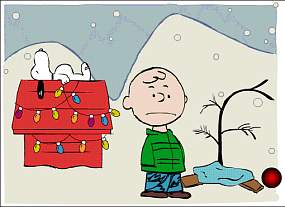 The following Christmas in 2001 drove home the fact , now that they were both gone, that they had borne a far greater role in the joy of the season for me than I had understood. You are always a child at Christmastime as long as you’ve got a surviving parent, but take that away and now it’s up to you to be the one who maintains the Christmas spirit. Now it’s for your children more than for you. It’s a role we never think about accepting until it is thrust upon us and there is no one else to turn to.
 This series has proven to be popular and some have suggested it’s too early to be concluding it. No doubt there are dozens of hidden messages we Christians send along with the Gospel, confusing its purity, especially in the ears of the lost. Stepping back and analyzing what we say and how we say it should be an essential part of all we do. We live in an age when truth is lacking or is filled with so much noise as to be obscured altogether, so diligence in keeping the Gospel free from extraneous garbage has never been more needed.